
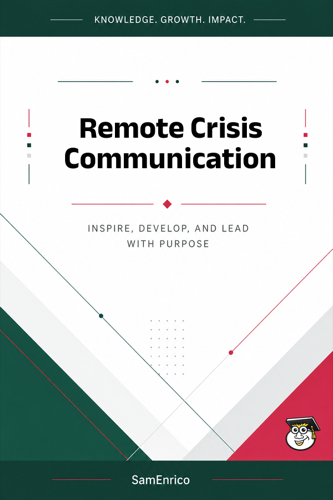
Remote Crisis Communication Audiobook
Manages emergencies across distributed teams.
by Lomax Fred
Manages emergencies across distributed teams.
Formats
Free sample
Chapter 1: The Digital Reaction Lag--The CEO’s fingers hovered over the keyboard. A server breach. Customer data. Four time zones. She typed “Everyone get on Zoom now” and hit send.
Twelve minutes later, the first person joined. By the time the last executive appeared, a colocated competitor had already contained their identical breach. The difference wasn’t skill, technology, or budget. It was the six-minute gap between colocated instinct and remote reality. That gap has a name: Digital Reaction Lag.
And it is the single greatest unacknowledged risk facing every distributed team on the planet.The Colocated Assumption That Is Killing Your Response Time Every crisis communication protocol written before 2020 contains a hidden, poisonous assumption: that the people who need to talk to each other can see each other. This assumption is so deeply embedded that most crisis plans never state it explicitly. They simply act as if a manager can walk to an office, close a door, and speak in low tones. They assume that urgency transmits through presence, that a furrowed brow or a raised hand can interrupt a conversation, that the simple act of gathering in one room creates a shared reality.Remote work destroys every single one of these assumptions.The colocated crisis model relies on what organizational psychologists call “ambient awareness.” In an office, you know who is stressed because you see them pacing. You know who has information because you hear their voice in the hallway.
You know when a situation is escalating because the energy in the room changes. None of these cues exist in Slack. None of them travel through Zoom. None of them are captured in an email.This chapter introduces a new framework for understanding why remote teams fail in the first hour of a crisis. It is called the Digital Reaction Lag model, and it breaks the gap between event and action into three measurable, manageable components.
Once you understand these three delays, you can stop blaming your team and start redesigning your workflow.The Three Delays That Define Remote Crisis Failure Digital Reaction Lag is the sum of three distinct time periods: Notification Delay, Assembly Delay, and Decision Delay. In a colocated environment, these three delays might total sixty seconds. In a remote environment, they can stretch to sixty minutes or more. The most dangerous part? Remote teams rarely notice the lag happening.
They feel busy. They feel responsive. But busy is not the same as fast, and responsive is not the same…
This is the end of the free sample. Get the Audiobook to keep going. Buy now
About this book
Details
- Author
- Lomax Fred
- Publisher
- SamEnrico
- Language
- English
- Genre
- Non-Fiction, Self-Help, Crisis
- Released
- 2026-06-06
- Pages (approx.)
- 141
- Available as
- eBook, Audiobook

Listen in the VoxFlicks app
Audiobooks and audio dramas wherever you go. Sign in with your SamEnrico account and press play.
More by Lomax Fred
 Rugby Player Hypnosis GuideLomax Fred$11.99
 Hot Air Balloon RelaxationLomax Fred$11.99
 Acupuncture for TraumaLomax Fred$11.99
 Senior Fall Prevention ConfidenceLomax Fred$11.99
 Self Hypnosis for IBS PainLomax Fred$11.99
 Brand Style Guide CanvaLomax Fred$11.99
 Eisoptrophobia Mirror FearLomax Fred$11.99
 The Ghosts of Beirut: Prohibition's Forgotten Cold CasesLomax Fred$11.99
 Kabaddi Kings: The Rise of India's Olympic DreamLomax Fred$11.99
 How to Start a Extrusion Compounds (plastics) Business (Beginners Guide)Lomax Fred$11.99
 How to Produce Dessert PlatesLomax Fred$11.99
 A Collector's Handbook to the Wolseley 48Lomax Fred$11.99
You may also like
 Hong Kong Handover 1997Dunn Johnnie$11.99
 Zumba For Postnatal Recovery CourseNeal Christian$11.99
 Zumba for BeginnersLadner Nikia$11.99
 YouTube Comment Mining GuideHumes Pandora$12.99
 Worry Box MeditationCarlin Rudy$11.99
 Workplace Stress MeditationNguyen Lynn$11.99
 Workplace Stress and Sleep RepairHawley Ivory$11.99
 Workplace Perfectionism CureDelaney Jeffry$11.99
 Workplace Injustice Anger GuideWallen Isabelle$11.99
 Work Addiction and Burnout LinkGreenwood Ester$11.99
 Women in Yoga and WellnessBeattie Galina$11.99
 Women in Stand Up ComedyChun Evangeline$11.99