
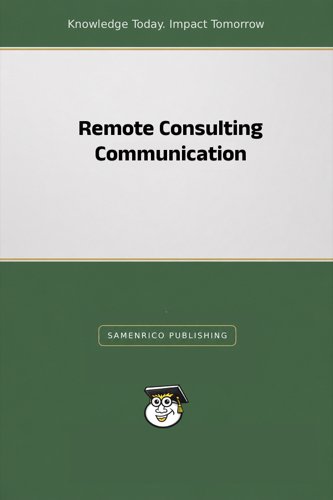
Non-FictionSelf-HelpConsulting
Remote Consulting Communication eBook
Teaches delivering expert advice and presentations
by Weddle Audie
Teaches delivering expert advice and presentations virtually.
Formats
Free sample
Chapter 1: The Remote Decay Curve--–- The first time I lost a client before I finished my opening sentence, I was sixty-two seconds into a Zoom call. I had prepared for three days. I had slides with perfect branding, a data set that took two weeks to clean, and a recommendation that would save the client $400,000 annually. None of it mattered. The client’s chief operating officer joined late, did not turn on his camera, and spent the first ninety seconds looking at a second monitor while I introduced myself.
When I paused to ask a question, he said—and I am quoting exactly—“I’m sorry, can you repeat that? I was answering an email.” Sixty-two seconds. That is how long it took for three days of preparation to become background noise.That experience was not an anomaly. It was a warning. And it is the reason this chapter exists.Let me tell you what actually happened in that call, because understanding the mechanics of failure is the first step toward never repeating it.
I was a seasoned consultant with twelve years of experience. I had delivered this same recommendation in person a dozen times, always to enthusiastic reception. I knew my material cold. I knew the client’s industry. I had even rehearsed my opening on video to check my framing and lighting.
By every measure, I was prepared. But I was prepared for a room, not for a rectangle. I was prepared for eye contact, shared silence, and the subtle head nods that tell you when someone is following along. I was not prepared for the Remote Decay Curve.What is the Remote Decay Curve? It is the measurable loss of communication nuance, trust, and attention that occurs the moment you move from an in-person interaction to a remote one.
It is not a feeling or a vague anxiety. It is a predictable, quantifiable phenomenon. Drawing on decades of communication theory research—specifically the work on paralinguistic cues, rapid feedback loops, and shared context—we can say with confidence that approximately thirty percent of communication nuance disappears in a remote setting. That thirty percent is not random noise. It is the thirty percent that carries emotion, hesitation, agreement, doubt, sarcasm, and trust.Think about what happens in a room.
When you are sitting across from someone, you can hear the slight rise in their voice that signals uncertainty. You can see them lean forward when they are engaged or cross their arms when they are skeptical. You can pause for three seconds without panic because shared silence feels collaborative, not accusatory. You can point to a whiteboard and say “this” without confusion because both of you are looking at the same physical object. These are not luxuries.
They are the infrastructure of human communication. And when you move to a remote setting, that infrastructure collapses.The Remote Decay Curve is the name we will use throughout this book for that collapse. I have chosen a single, unifying term because other books scatter metaphors—the void, the gap, the friction, the tax—without connecting them. That creates confusion. From this point forward, when you read “Remote Decay,” you will know exactly what it means: the predictable degradation of communication quality that happens when you leave the room.
And because it is predictable, it is manageable. You cannot eliminate Remote Decay. But you can budget for it.Budgeting for Remote Decay The concept of budgeting is critical here. You do not complain about the rain; you bring an umbrella. Similarly, you do not complain that remote communication is harder; you build in compensations.
The consultants who succeed remotely are not the ones who pretend nothing has changed. They are the ones who explicitly, deliberately, and consistently over-communicate structure, confirmation, and closure to offset what has been lost.Let me give you a concrete example. In that failed sixty-two-second call, I made three mistakes, each of which accelerated Remote Decay. First, I assumed the client was present and attentive. He was not.
I had not established a verbal contract at the beginning of the call that required acknowledgment. Second, I used deictic language—words like “this” and “that” and “here”—without visual anchors. I said “this approach” while gesturing vaguely at a slide he was not looking at. Third, I did not build in confirmation loops. I assumed that silence meant understanding.
In a room, silence often does mean understanding. On a call, silence can mean distraction, technical issues, or a second monitor.The solution to each of these problems is a budget. You budget for Remote Decay by adding three minutes of explicit confirmation for every ten minutes of content. You budget by replacing assumptions with agreements. You budget by building a “state check” into every transition.
And you budget by accepting that you will never fully recover the lost thirty percent—but you can recover enough to win the deal.The Science of What Gets Lost To budget effectively, you need to understand exactly what Remote Decay destroys. Communication theorists have studied this question for decades, and the answer falls into three categories: paralinguistic cues, rapid feedback loops, and shared physical context.Paralinguistic cues are the non-verbal elements of speech: tone, pitch, pace, volume, and hesitation. In person, you can hear someone’s confidence drop when their voice rises at the end of a statement. You can hear skepticism in a slight delay before they answer. You can hear excitement in faster pacing.
In a remote setting, these cues are compressed. Microphones and algorithms flatten tone. Lag introduces unnatural pauses. And when cameras are off—which they increasingly are, especially in executive settings—you lose facial expressions entirely. The result is that a neutral statement sounds neutral even when the speaker is enthusiastic, and a joke sounds flat even when it is funny.Rapid feedback loops are the back-and-forth exchanges that keep conversations aligned.
In person, these loops happen in milliseconds. You say something, the other person nods, you continue. You see confusion, you clarify. You sense resistance, you adjust. Remotely, these loops stretch.
A simple “does that make sense?” takes three seconds to transmit and receive, and that lag creates unnatural gaps. People fill those gaps with words, and the words accumulate into interruptions. The result is that conversations become less fluid, more stilted, and more prone to misunderstanding.Shared physical context is perhaps the most obvious loss. In a room, you point to a whiteboard. You gesture to a document.
You lean over a spreadsheet. Everyone sees the same thing at the same time. Remotely, you have screen sharing, which is a pale imitation. Screen sharing is a broadcast, not a collaboration. One person controls the view, and everyone else watches.
The result is that “this” and “that” become ambiguous, and misunderstandings multiply.The Thirty Percent Rule I want to be precise about the thirty percent figure because it is easy to dismiss as a rough estimate. It is not. The research on technology-mediated communication consistently shows a degradation in information richness when moving from face-to-face to video, and a further degradation when moving from video to audio, and a further degradation when moving from audio to…
This is the end of the free sample. Get the eBook to keep going. Buy now
About this book
Details
- Author
- Weddle Audie
- Publisher
- SamEnrico
- Language
- English
- Genre
- Non-Fiction, Self-Help, Consulting
- Released
- 2026-06-09
- Pages (approx.)
- 158
- Available as
- eBook, Audiobook

Read better in the ZLOADR app
Your eBooks on your phone or tablet. Sign in with your SamEnrico account and start reading.
More by Weddle Audie
 Twelve Step for Internet and Gaming AddictionWeddle Audie$11.99
 Family Secret Keeping ChildhoodWeddle Audie$11.99
 The Cowboy StanceWeddle Audie$11.99
 Binge Eating Mindfulness Approach GuideWeddle Audie$11.99
 Anticipatory Grief and HospiceWeddle Audie$11.99
 The Marine Corps OverdoseWeddle Audie$11.99
 Wrist and Forearm Stretching for GamersWeddle Audie$11.99
 Hearst San FranciscoWeddle Audie$11.99
 The Quantum Pioneers of Almaty: Unveiling the Mysteries of the Invisible WorldWeddle Audie$11.99
 The Troll King's Exile: A Saga of Ice and StoneWeddle Audie$11.99
 The Complete Guide to This Is Why You're FatWeddle Audie$11.99
 Understanding AtrophyWeddle Audie$17.99
You may also like
 Hong Kong Handover 1997Dunn Johnnie$11.99
 Zumba For Postnatal Recovery CourseNeal Christian$11.99
 Zumba for BeginnersLadner Nikia$11.99
 YouTube Comment Mining GuideHumes Pandora$12.99
 Worry Box MeditationCarlin Rudy$11.99
 Workplace Stress MeditationNguyen Lynn$11.99
 Workplace Stress and Sleep RepairHawley Ivory$11.99
 Workplace Perfectionism CureDelaney Jeffry$11.99
 Workplace Injustice Anger GuideWallen Isabelle$11.99
 Work Addiction and Burnout LinkGreenwood Ester$11.99
 Women in Yoga and WellnessBeattie Galina$11.99
 Women in Stand Up ComedyChun Evangeline$11.99