
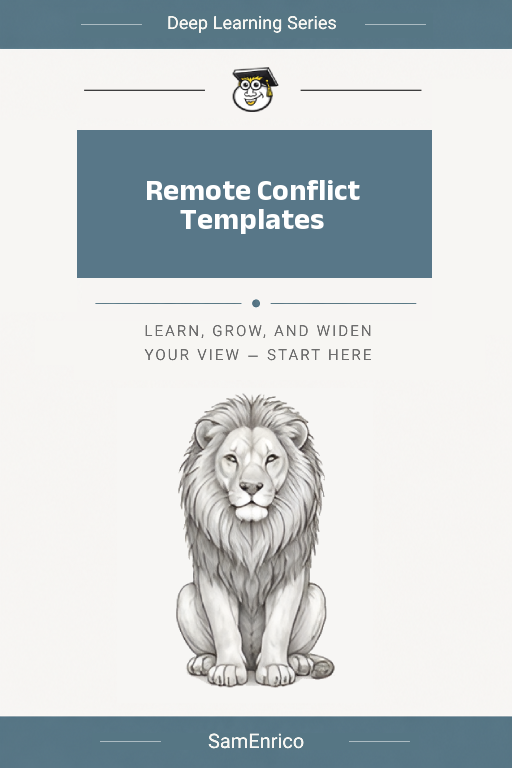
Non-FictionProfessional's Cheat SheetTemplates
Remote Conflict Templates Audiobook
Ready-to-use conflict resolution templates, script
Ready-to-use conflict resolution templates, scripts, and email drafts for remote teams.
Formats
Free sample
Chapter 1: The Inference Gap...--–- The Slack message arrived at 2:47 PM on a Tuesday. It contained exactly two words: “That’s fine.” Within ninety minutes, a senior designer had rewritten three pages of approved wireframes, a product manager had scheduled an emergency call with HR, and a software engineer had updated his Linked In profile to “open for work.” No one had yelled. No one had been overtly rude. No policy had been violated. And yet, a conflict had erupted that would take eleven days and approximately fourteen hours of meeting time to fully resolve.
The cause was not a disagreement about strategy, resources, or deadlines. The cause was four characters: a space, the letter T, the letter H, the letter E, the letter space, the letter F, the letter I, the letter N, the letter E, and a period. The cause was the inference gap.This is the single most misunderstood dynamic in remote work. When people cannot see each other’s faces, hear each other’s tones, or observe each other’s body language, their brains do not simply register the absence of information. They do something far more dangerous: they invent information to fill the void.
And because human beings are hardwired for negativity bias, the invented information is almost always worse than reality. The colleague who types “That’s fine” is probably, in fact, fine. They are busy. They are typing one-handed while holding a coffee. They are distracted by a notification from their child’s school.
But the recipient does not imagine these benign possibilities. The recipient imagines passive aggression, withheld criticism, simmering resentment, or quiet rejection. The recipient then responds to the imaginary conflict, not the real one. And the imaginary conflict, unlike the real one, has no solution because it was never actually stated.This chapter is about the low-resolution problem at the heart of remote conflict. It explains why text-based communication inevitably creates inference gaps, why those gaps trigger predictable patterns of escalation, and what teams can do to close those gaps before they become crises.
By the end of this chapter, you will understand why the most dangerous word in remote work is not “no” or “wrong” or “failed.” The most dangerous word is “fine.”The Science of the Inference Gap To understand remote conflict, you must first understand how human communication actually works. Most people believe that communication is the…
This is the end of the free sample. Get the Audiobook to keep going. Buy now
About this book
Details
- Author
- Randall Kaitlin
- Publisher
- SamEnrico
- Language
- English
- Genre
- Non-Fiction, Professional's Cheat Sheet, Templates
- Released
- 2026-06-01
- Pages (approx.)
- 149
- Available as
- eBook, Audiobook

Listen in the VoxFlicks app
Audiobooks and audio dramas wherever you go. Sign in with your SamEnrico account and press play.
More by Randall Kaitlin
 Overlanding the KarakoramRandall Kaitlin$11.99
 Yoga Nidra Sleep MethodRandall Kaitlin$11.99
 Law Student Anxiety HandbookRandall Kaitlin$11.99
 Social Worker Compassion FatigueRandall Kaitlin$11.99
 Antwerp Heist Economic ImpactRandall Kaitlin$11.99
 Shadows of the Iron Eagle: The Untold Story of WWII's Phantom AceRandall Kaitlin$11.99
 The Blood of the Andes: How a Volcanic Eruption Unlocked the Secrets of LifeRandall Kaitlin$11.99
 Understanding Fetal Warfarin SyndromeRandall Kaitlin$17.99
 How to Become a Musical-string MakerRandall Kaitlin$11.99
 Canada Startup Visa WorkbookRandall Kaitlin$12.99
 Sports ReporterRandall Kaitlin$11.99
You may also like
 Hong Kong Handover 1997Dunn Johnnie$11.99
 Zumba For Postnatal Recovery CourseNeal Christian$11.99
 Zumba for BeginnersLadner Nikia$11.99
 YouTube Comment Mining GuideHumes Pandora$12.99
 Worry Box MeditationCarlin Rudy$11.99
 Workplace Stress MeditationNguyen Lynn$11.99
 Workplace Stress and Sleep RepairHawley Ivory$11.99
 Workplace Perfectionism CureDelaney Jeffry$11.99
 Workplace Injustice Anger GuideWallen Isabelle$11.99
 Work Addiction and Burnout LinkGreenwood Ester$11.99
 Women in Yoga and WellnessBeattie Galina$11.99
 Women in Stand Up ComedyChun Evangeline$11.99