
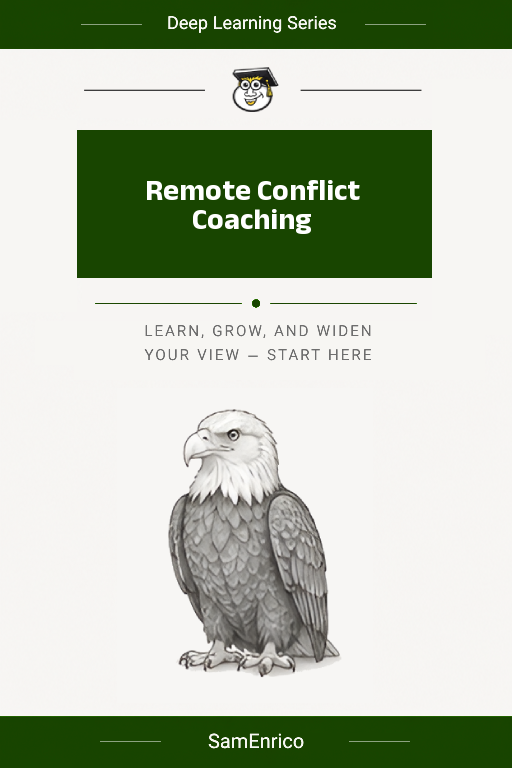
Non-FictionProfessional's Cheat SheetCoaching
Remote Conflict Coaching eBook
Coach remote employees to resolve their own confli
Coach remote employees to resolve their own conflicts without manager intervention.
Formats
Free sample
Chapter 1: The Silence Bubble--–- The missed deadline appeared in your project management tool at 4:47 PM on a Tuesday. No one mentioned it in Slack. No one tagged you in a follow-up. The channel went quiet. You told yourself it was fine—everyone misses deadlines sometimes.
By Thursday, you noticed your teammate had stopped using emoji reactions to your messages. By Friday, they were taking four hours to reply to simple questions. By Monday, you were convinced they hated you. The conflict never had a fight. It had a silence bubble.This is how remote conflict begins.
Not with raised voices or slammed doors. Not with a tense meeting where someone finally snaps. It begins with absence. A missing reply. A thread that dies without resolution.
A @mention that never comes. In an office, tension announces itself through crossed arms, sighs, red faces, or the sound of a keyboard being pounded too hard. In remote work, tension is invisible. It hides in the space between messages, in the delay of a response, in the slow withdrawal of a colleague who was once warm and is now professional to the point of coldness.You cannot see a silence bubble. But you can feel it.
And once you learn to recognize it, you will realize that most of the conflicts you have experienced in remote work were not caused by what someone said. They were caused by what someone did not say.The Anatomy of a Silence Bubble Let us define our terms clearly. A silence bubble is any period of unexplained communicative absence that triggers your brain to fill the gap with negative assumptions. It is the distance between a question and an answer, measured not in time but in anxiety. It is the empty space where context should live but does not.Consider the difference between an office and a remote environment.
In an office, if you ask a question and your colleague does not answer immediately, you can see them. Perhaps they are on the phone. Perhaps they are deep in concentration. Perhaps they are walking to the coffee machine. Your brain receives visual data that explains the delay.
No story is required. The silence is filled with observable reality.Now consider the same question asked over Slack. You send a message at 10:00 AM. The recipient reads it at 10:01 AM (you see the read receipt). They do not reply.
At 10:30 AM, you check again. Nothing. At 11:00 AM, your brain has begun to construct a story. Perhaps they are ignoring you. Perhaps they are angry about something you did last week.
Perhaps they are copying your manager on a complaint. At 12:00 PM, they reply with a single sentence: "Sorry, was in back-to-backs." The story your brain built was false. But the damage is already done. You spent two hours in a state of low-grade conflict that never actually existed.This is the asynchronous gap. When communication is not real-time, your brain does not wait patiently for data.
It fills the silence with worst-case assumptions. This is not a personal failing. It is a neurological artifact of human evolution. Our ancestors who assumed that a rustle in the bushes was a predator—even when it was only wind—survived to pass on their genes. The ones who waited for more data were eaten.
Your brain is not trying to annoy you. It is trying to protect you. But in a remote work environment, this protective mechanism misfires constantly.The Three Ghosts of Remote Conflict Over years of studying remote teams, researchers have identified three specific patterns of avoidance that manifest as silence bubbles. I call them the Three Ghosts because they haunt teams without ever being named.The first ghost is Ghosting. This is the complete disappearance of a colleague from a conversation or channel.
They were present. They were engaged. Then, suddenly, they are gone. No explanation. No "brb." No "let me think about that." Just silence.
Ghosting is the most visible form of silence bubble because it is absolute. It is also the rarest. Most remote conflict does not escalate to full ghosting because full ghosting is too obvious to ignore. When someone ghosts you, you know something is wrong. The more dangerous ghosts are the subtle ones.The second ghost is Glassing.
This is named for the way glass is transparent yet solid—you can see through it, but you cannot pass through it. Glassing occurs when a colleague continues to communicate but removes all warmth, personality, and generosity from their messages. They used to write "Hey! Great point! Let me think about that and get back to you 😊" Now they write "Noted." They used to use emojis, exclamation points, and your name.
Now they use periods, one-word answers, and no salutation. Glassing is insidious because it is deniable. If you ask, "Are you upset with me?" they can reply, "No, just busy." And technically, they are still communicating. But the texture of the communication has changed. And your brain notices.The third ghost is Bcc-ing.
This is the practice of triangulating conflict by copying or complaining to a third party instead of addressing the person directly. Bcc-ing is named for the email field that allows you to secretly include someone on a message without the primary recipient knowing. In Slack, Bcc-ing looks like this: You have a disagreement with a colleague. Instead of resolving it with them, you message a different colleague: "Can you believe what they just said?" Or you start a private channel without the person. Or you mention the conflict in a retrospective when the person is not present.
Bcc-ing is dangerous because it creates coalitions. The original conflict stops being about two people and becomes about tribes. Once that happens, resolution becomes nearly impossible.Every remote conflict you have ever experienced or observed can be mapped onto these three ghosts. The missed deadline that no one mentioned? That was Glassing—the warmth of accountability disappeared.
The teammate who stopped replying to your DMs? Ghosting. The passive-aggressive comment in a team channel about "some people" not pulling their weight? Bcc-ing directed at an invisible audience.The Cost of the Silence Bubble You might be tempted to dismiss silence bubbles as minor annoyances. Everyone gets busy.
Everyone has off days. But the cumulative cost of unresolved silence bubbles is staggering, and it is rarely measured.Let us start with time. A direct conflict that is addressed immediately takes approximately fifteen minutes to resolve. You send a message. You receive a clarification.
You move on. A silence bubble that is allowed to fester takes an average of six days to resolve—and that resolution is often incomplete. Why six days? Because silence bubbles do not stay silent. They grow.
The first day, you ignore the feeling. The second day, you start to ruminate. The third day, you mention it to a trusted colleague (Bcc-ing). The fourth day, that colleague offers their interpretation, which may be wrong. The fifth day, you decide to say something, but you are now so anxious that your message comes across as accusatory.
The sixth day, the other person responds defensively, and what should have been a fifteen-minute clarification becomes a three-day argument.Now…
This is the end of the free sample. Get the eBook to keep going. Buy now
About this book
Details
- Author
- Lovelace Gabriele
- Publisher
- SamEnrico
- Language
- English
- Genre
- Non-Fiction, Professional's Cheat Sheet, Coaching
- Released
- 2026-06-01
- Pages (approx.)
- 147
- Available as
- eBook, Audiobook

Read better in the ZLOADR app
Your eBooks on your phone or tablet. Sign in with your SamEnrico account and start reading.
More by Lovelace Gabriele
 Trans Siberian Off RoadLovelace Gabriele$11.99
 Antwerp Heist Book vs RealityLovelace Gabriele$11.99
 EQ Self Awareness Training CourseLovelace Gabriele$11.99
 Environmental Toxins And AutoimmunityLovelace Gabriele$11.99
 Stress and Derealization GuideLovelace Gabriele$11.99
 The Viking Reawakening: Rediscovering the Forgotten Canoe Routes of EuropeLovelace Gabriele$11.99
 Silk & Sabotage: The Unseen War of Fashion’s Golden AgeLovelace Gabriele$11.99
 Low Income Product Fit WorkbookLovelace Gabriele$12.99
 How to Become a Circulating Process InspectorLovelace Gabriele$11.99
 Understanding Fetal Iodine SyndromeLovelace Gabriele$17.99
 Software Test SpecialistLovelace Gabriele$11.99
You may also like
 Hong Kong Handover 1997Dunn Johnnie$11.99
 Zumba For Postnatal Recovery CourseNeal Christian$11.99
 Zumba for BeginnersLadner Nikia$11.99
 YouTube Comment Mining GuideHumes Pandora$12.99
 Worry Box MeditationCarlin Rudy$11.99
 Workplace Stress MeditationNguyen Lynn$11.99
 Workplace Stress and Sleep RepairHawley Ivory$11.99
 Workplace Perfectionism CureDelaney Jeffry$11.99
 Workplace Injustice Anger GuideWallen Isabelle$11.99
 Work Addiction and Burnout LinkGreenwood Ester$11.99
 Women in Yoga and WellnessBeattie Galina$11.99
 Women in Stand Up ComedyChun Evangeline$11.99