
Non-FictionSelf-HelpCommuteTime Use
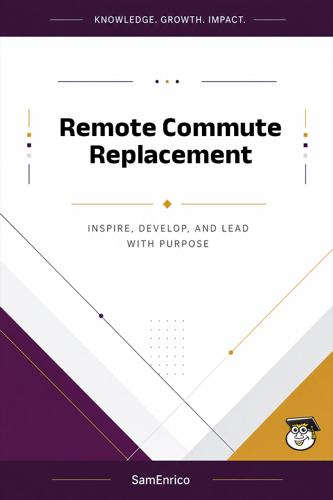
Remote Commute Replacement eBook
Use saved commute time for personal development an
Use saved commute time for personal development and rest.
Formats
Free sample
Chapter 1: The Vanished Buffer--–- The author’s alarm shrieks at 6:45 AM. By 7:15 AM, she is in the car, coffee in one hand, steering wheel in the other. For thirty-seven minutes, she sits in traffic, listens to a podcast she barely hears, and stares at the brake lights of the car in front of her. She complains about the commute. Everyone does.
At 7:52 AM, she parks, walks into her office building, and by 8:00 AM, she is at her desk. Nobody notices the transition. It just happens.At 5:00 PM, the reverse occurs. She packs her bag, walks to the car, and spends another thirty-four minutes in traffic. She calls her mother.
She thinks about what to make for dinner. She listens to the news. By 5:45 PM, she pulls into her driveway, walks inside, and becomes the person who cooks, cleans, and relaxes. No conscious shift is required. The commute did the work for her.Then the pandemic came.
The office closed. The car stayed in the driveway. And suddenly, the thirty-seven minutes in the morning and the thirty-four minutes in the evening simply evaporated. The author gained seventy-one minutes back in her day. She celebrated.
Everyone celebrated.But six months later, she was exhausted. Not the kind of tired that sleep fixes. The kind of tired that lives in the bones. She logged on at 7:15 AM now, because why not? She worked until 6:00 PM, because there was no drive home to stop her.
She answered emails at 10:00 PM because her laptop was right there on the dining table. She had gained seventy-one minutes, but she had lost something she never knew she needed: the buffer.This book is for everyone who has ever said, "I don't miss the commute," but secretly feels more drained than ever before.The Great Disappearing Act The daily commute was never beloved. Surveys consistently show that workers rank commuting as one of the most unpleasant parts of their day—below meetings, below performance reviews, sometimes even below filing expenses. We complained about traffic, about crowded trains, about the cost of gas, about the time stolen from our families and our hobbies. When remote work became not just possible but mandatory in 2020, millions of people breathed a collective sigh of relief.
No more rush hour. No more delays. No more sitting behind a bus belching diesel fumes.And that relief was real and justified. The average American commuter spent 54.2 minutes per day traveling to and from work before the pandemic, according to the U.S. Census Bureau.
That is 4.5 hours per week, 18 hours per month, and more than nine full 24-hour days per year. Nine days. Every year. Sitting in traffic or standing on a train platform. When remote work eliminated that time, it felt like a raise.
Not a financial raise, but a temporal one. A raise of nearly an hour every single day.But something strange happened. By the middle of 2021, researchers began noticing a disturbing trend. Remote workers were reporting higher levels of burnout than they had when they were commuting. Not slightly higher.
Significantly higher. A study from the National Bureau of Economic Research found that the average workday lengthened by 48.5 minutes after the shift to remote work. Another study from Harvard Business Review found that the number of meetings increased by 13 percent, and the average meeting length actually increased slightly. The time saved on commuting was not being returned to workers as leisure. It was being eaten by more work.The Trap That Swallowed the Dividend This is what I call The Trap.
It has two forms, and most remote workers fall into both.The Morning Trap: The former morning commute—that 20-to-45-minute window between waking and arriving at work—gets filled with labor. Instead of driving to the office, you roll out of bed, walk ten feet to your desk, and open your laptop. You check email before you have had coffee. You respond to Slack messages while still in your pajamas. You attend your first meeting of the day at 8:30 AM instead of 9:30 AM because, well, why not?
You are already there.The Evening Trap: The former evening commute—that buffer between closing your laptop and walking through your front door—simply disappears. One moment you are in a Zoom call, and the next moment you are standing in your kitchen trying to figure out what to make for dinner. There is no decompression. There is no transition. There is only the jarring shift from work-self to home-self, and it happens in an instant.
As a result, many people keep working. They send "just one more email" at 6:30 PM. They review a document at 7:00 PM. They answer a Slack message at 9:00 PM because their phone buzzed and they were holding it anyway.The Trap is not a failure of willpower. It is not a character flaw.
It is a structural problem. The commute was a structure, an external constraint that forced a transition whether you wanted it or not. When that structure vanished, nothing replaced it. And nature abhors a vacuum, so work rushed in to fill the space.Consider the data more carefully. A longitudinal study of 3,100 remote workers conducted by the research firm Qualtrics found that 61 percent reported working more hours from home than they did in the office.
The same study found that 45 percent felt pressure to be available outside normal working hours. Another study from the payroll platform Gusto found that remote workers added an average of 4.2 hours to their workweek—not because they were asked to, but because they simply kept going.The most striking finding comes from a 2022 analysis of anonymized computer usage data from 21,000 remote workers. The researchers could see exactly when people logged on and off. They found that the typical remote worker logged on 47 minutes earlier than they had when commuting and logged off 23 minutes later. That is a net increase of 70 minutes of work per day.
Almost exactly the amount of time saved from the commute. The commute dividend did not go to rest or personal development or family. It went right back to the employer.The Commute Dividend: An Asset You Already Own This book is built on a single radical proposition: The time you used to spend commuting is not a gift you give back to your employer. It is a dividend you have already earned. Call it the Commute Dividend.Let me be explicit about what the Commute Dividend is and what it is not.
It is not "free time" in the vague sense of unstructured hours that drift away into scrolling and streaming. It is not a bonus to be squandered. It is a fixed, non-negotiable asset: 45 to 90 minutes every single day. Five to seven hours every single week. More than three hundred hours every single year.Let that sink in.
Three hundred hours. That is enough time to learn a new language to conversational fluency. Enough time to read fifty books. Enough time to train for a half marathon. Enough time to write a novel.
Enough time to become significantly better at almost any skill you can name. And for most remote workers, that time is currently being surrendered to early morning emails and…
This is the end of the free sample. Get the eBook to keep going. Buy now
About this book
Details
- Author
- Royer Alejandra
- Publisher
- SamEnrico
- Language
- English
- Genre
- Non-Fiction, Self-Help, Commute, Time Use
- Released
- 2026-06-08
- Pages (approx.)
- 147
- Available as
- eBook, Audiobook

Read better in the ZLOADR app
Your eBooks on your phone or tablet. Sign in with your SamEnrico account and start reading.
More by Royer Alejandra
 Papua New Guinea TrekRoyer Alejandra$11.99
 The Sleep Apnea Brain ConnectionRoyer Alejandra$11.99
 Lonely Musician On TourRoyer Alejandra$11.99
 The High Cortisol Management GuideRoyer Alejandra$11.99
 Blood on the Andes: Pizarro's Betrayal at Cajamarca (1532)Royer Alejandra$11.99
 Learn to Play the Bass ClarinetRoyer Alejandra$11.99
 How to Start a Firewood (retail) Business (Beginners Guide)Royer Alejandra$11.99
 Barytocalcite MiningRoyer Alejandra$11.99
 Startup World Cup GuideRoyer Alejandra$12.99
 EE for RA TA ExperienceRoyer Alejandra$12.99
You may also like
 Hong Kong Handover 1997Dunn Johnnie$11.99
 Zumba For Postnatal Recovery CourseNeal Christian$11.99
 Zumba for BeginnersLadner Nikia$11.99
 YouTube Comment Mining GuideHumes Pandora$12.99
 Worry Box MeditationCarlin Rudy$11.99
 Workplace Stress MeditationNguyen Lynn$11.99
 Workplace Stress and Sleep RepairHawley Ivory$11.99
 Workplace Perfectionism CureDelaney Jeffry$11.99
 Workplace Injustice Anger GuideWallen Isabelle$11.99
 Work Addiction and Burnout LinkGreenwood Ester$11.99
 Women in Yoga and WellnessBeattie Galina$11.99
 Women in Stand Up ComedyChun Evangeline$11.99