
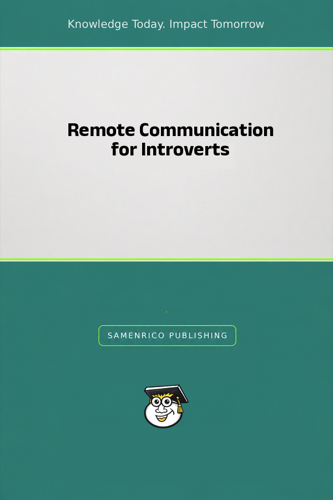
Remote Communication for Introverts eBook
Leverages async tools for quieter voices.
by Combs Mervin
Leverages async tools for quieter voices.
Formats
Free sample
Chapter 1: The Extrovert Tax--–- You are not broken. You are not too slow. You are not “bad at communication.” And you are certainly not alone. Before we go any further, let me say that clearly, because if you are an introvert who has spent any time in a traditional workplace—or even a remote workplace that has simply copied the worst habits of an office—you have almost certainly been told, indirectly or directly, that something is wrong with you. You take too long to answer.
You don’t speak up enough in meetings. You’re “quiet.” People can’t “read” you. You need to be more “present.” More “assertive.” More… something else. Something you are not.Here is what is actually happening: you are paying a tax that extroverts do not pay. I call it the Extrovert Tax.The Extrovert Tax is the invisible drain on your energy, your confidence, and your career progress that comes from working inside a communication system designed by and for people who think out loud.
Every time you force yourself to speak before you are ready, every time you say “yes” to a live call you know could have been an email, every time you spend an hour recovering from a thirty-minute Zoom meeting—that is the tax. And if you work remotely, you might assume the tax would be lower. After all, you are no longer in a noisy open-plan office. You are in your own home, wearing comfortable clothes, with no commute. Surely remote work is the introvert’s paradise?It is not.
Not automatically. And that paradox is exactly why this book exists.Remote work has been sold as a great equalizer. The quiet voice, we were told, would finally have a chance to be heard. Without the physical presence of louder colleagues, without the performative theater of the conference room, the thoughtful writer would rise. The deep thinker would be valued.
The person who needs time to process would finally be on equal footing. For a brief moment, in the early days of the pandemic-driven remote experiment, that seemed possible. But then something happened. Companies did not redesign their communication cultures. They simply lifted the old office habits and dropped them into Zoom.
The same rapid-fire meetings became thirty-minute video calls instead of hour-long in-person ones, but the structure remained identical. The same expectation of immediate answers moved from hallway conversations to Slack pings. The same loudest-voice-wins dynamic simply migrated from the conference table to the grid of faces on a screen.The result is a world where introverts are still exhausted, still overlooked, and still apologizing for who they are—just from the comfort of their own homes.I wrote this book because I have watched too many brilliant, thoughtful, deeply capable introverts burn out, shrink back, or leave jobs they loved because they believed the problem was them. It was not. The problem is the Extrovert Default, and until you see it clearly, you will keep paying the tax.The Hidden Bias You Have Been Living With Let me define my terms carefully.
When I say “extrovert” and “introvert,” I am not talking about shyness versus sociability. Shyness is the fear of social judgment. Introversion is something entirely different. Introversion, as defined by the psychologist Carl Jung and popularized by researchers like Susan Cain in her landmark book Quiet, is about where you get your energy. Extroverts recharge in social situations.
They think out loud. They process externally. Introverts recharge in solitude. They process internally. They think before they speak—not because they are afraid, but because that is how their brains are wired.This is not a preference.
It is a neurological difference. Research using functional magnetic resonance imaging (f MRI) has shown that introverts have more blood flow to the frontal lobes and the anterior thalamus—areas associated with internal processing, planning, and memory recall. Extroverts show more blood flow to the posterior thalamus and the anterior cingulate gyrus—areas associated with sensory processing and external stimuli. In plain English: introverts literally have longer, more complex neural pathways for processing information. You are not “slow.” You are thorough.
Your brain is doing more work per input than an extrovert’s brain does. That is a strength in a complex world. But in a workplace built for speed over depth, it feels like a curse.The Extrovert Default is the unexamined assumption that faster communication is better communication, that speaking immediately equals thinking clearly, and that the person who answers first in a meeting must be the person who has the most valuable input. This default is baked into nearly every workplace ritual. Brainstorming sessions reward the loudest.
Performance reviews praise “visibility.” Hiring processes favor the charismatic. And remote work, despite its promise, has mostly replicated these biases rather than dismantling them.Consider the daily standup meeting, imported directly from agile software development into every industry. In theory, it is a quick check-in: what did you do yesterday, what will you do today, any blockers? In practice, it is a performance. The extrovert rattles off a list of accomplishments, embellishes slightly, sounds confident.
The introvert, who spent yesterday doing deep, valuable work that is hard to summarize in thirty seconds, stumbles. The team perceives the extrovert as productive and the introvert as unfocused. That is the Extrovert Tax in action.Or consider the Slack channel. A question is posted. The extrovert answers immediately, even if the answer is half-baked.
The introvert takes fifteen minutes to research, confirm, and craft a complete, accurate response. By the time the introvert answers, the conversation has moved on. The team perceives the extrovert as helpful and responsive. The introvert, despite providing the better answer, is seen as slow. Another tax.This is not fair.
But fairness is not the goal of this book. The goal is to stop paying the tax.The Paradox of Remote Work The pandemic of 2020 forced the largest remote work experiment in human history. Nearly forty percent of the global workforce worked from home at the peak. And for a few glorious months, introverts reported lower stress, higher productivity, and a sense of relief they had never experienced in an office. No commute.
No forced small talk. No open-plan noise. No one stopping by your desk to ask a question that could have been an email.But as remote work became permanent for many companies, the relief faded. Why? Because managers who were trained in the Extrovert Default could not imagine managing any other way.
They replaced in-person meetings with Zoom calls. They replaced hallway check-ins with Slack pings. They replaced the pressure of the conference room with the pressure of the green “available” dot. The container changed, but the content did not.In fact, some aspects of the Extrovert Tax became worse in remote work. In an office, you could at least see when someone was deep in concentration.
You could read body language. You knew not to interrupt the person staring intently at their screen with headphones on. Remote work removed those visual cues. Now, your colleagues cannot see that you are thinking. They only see that you have not replied.
The absence of a response is interpreted as absence of work. So you feel pressure to reply instantly, even when…
This is the end of the free sample. Get the eBook to keep going. Buy now
About this book
Details
- Author
- Combs Mervin
- Publisher
- SamEnrico
- Language
- English
- Genre
- Non-Fiction, Self-Help, Introvert
- Released
- 2026-06-05
- Pages (approx.)
- 128
- Available as
- eBook, Audiobook

Read better in the ZLOADR app
Your eBooks on your phone or tablet. Sign in with your SamEnrico account and start reading.
More by Combs Mervin
 Senior Cancer Survivor GuideCombs Mervin$11.99
 Group Creative Documentation GuideCombs Mervin$11.99
 Equestrian Hypnosis CourseCombs Mervin$11.99
 Acupuncture for Injury RehabilitationCombs Mervin$11.99
 Canva Color Palette SelectionCombs Mervin$11.99
 Social Phobia Recovery GuideCombs Mervin$11.99
 Self Hypnosis for Cancer PainCombs Mervin$11.99
 The Forgotten Codebreaker: The Woman Who Cracked the Nazis Before TuringCombs Mervin$11.99
 Jazz Machines: How Europe's Jazz Pioneers Shaped the First Video GamesCombs Mervin$11.99
 A Collector's Handbook to the Willys 77Combs Mervin$11.99
 How to Produce Pinball Machine AccessoriesCombs Mervin$11.99
 Staffordshire Bull Terriers: Staffy TemperamentCombs Mervin$11.99
You may also like
 Hong Kong Handover 1997Dunn Johnnie$11.99
 Zumba For Postnatal Recovery CourseNeal Christian$11.99
 Zumba for BeginnersLadner Nikia$11.99
 YouTube Comment Mining GuideHumes Pandora$12.99
 Worry Box MeditationCarlin Rudy$11.99
 Workplace Stress MeditationNguyen Lynn$11.99
 Workplace Stress and Sleep RepairHawley Ivory$11.99
 Workplace Perfectionism CureDelaney Jeffry$11.99
 Workplace Injustice Anger GuideWallen Isabelle$11.99
 Work Addiction and Burnout LinkGreenwood Ester$11.99
 Women in Yoga and WellnessBeattie Galina$11.99
 Women in Stand Up ComedyChun Evangeline$11.99