
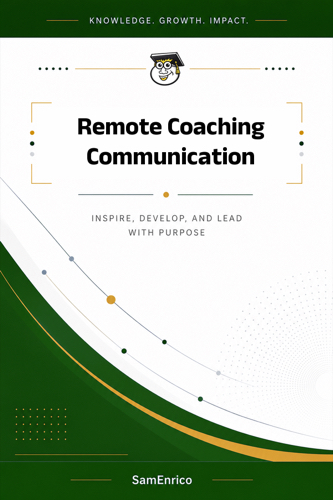
Remote Coaching Communication eBook
Teaches life and business coaches to guide clients
Teaches life and business coaches to guide clients effectively online.
Formats
Free sample
Chapter 1: The 1.5-Second Lie...–- The room was silent except for the soft hum of a laptop fan. On the screen, a client named Sarah sat frozen mid-sentence, her face caught in the awkward purgatory of a lagging video call. The coach, Michael, had been doing this for twelve years. He had coached executives through bankruptcies, founders through IPOs, and leaders through global crises. But in that moment—watching Sarah’s pixelated face stutter and pause—he felt something he rarely admitted: he was losing her.Three seconds passed.
Then five. Michael’s internal alarm began to blare. Say something. Fill the gap. Ask a question.
Make a joke. Do anything. He opened his mouth and heard himself say, “It sounds like you’re really frustrated with your team’s response to the new policy.” Sarah blinked. Her face, now re-animated by the restored connection, showed something Michael had not expected. Not gratitude.
Not insight. Disappointment.“Actually,” she said slowly, “I was about to tell you that I realized I’m the problem. But you got there first.”That session ended early. Sarah finished out her package and did not renew. In her exit survey, under “What could your coach have done better?” she wrote four words that Michael never forgot: “Let me finish my thoughts.”Michael had fallen for what this book will call the 1.5-Second Lie—the false belief that silence on a remote call is a problem to be solved, rather than an invitation to be honored.
He is not alone. Across the coaching profession, thousands of skilled, well-intentioned practitioners are losing clients not because they lack expertise, but because they have not yet learned the unique rhythms of remote communication.This book exists to fix that.The Invisible Shift No One Prepared You For Let us begin with a number that should stop you cold: fifty-three percent. According to a 2024 global survey of professional coaches conducted by the International Coaching Federation, fifty-three percent of all coaching interactions now happen partially or entirely remotely. That number was eleven percent in 2019. In five years, the profession underwent a transformation faster than any since coaching became a certified discipline in the 1990s.And yet—here is the problem—the vast majority of coaches practicing today were trained for a world that no longer exists.
Coaching certification programs, from the most rigorous to the most cursory, were designed around physical co-presence. They taught you how to read a client’s posture across a table, how to lean in at the right moment, how to hand a tissue without breaking rapport, how to end a session with a handshake that sealed commitment. They did not teach you how to do any of this through a screen.The result is a profession in crisis. Coaches report higher rates of burnout, lower rates of client retention, and a creeping sense that something essential has been lost. Clients, meanwhile, report feeling less heard, less connected, and less confident in the coaching process than they did before the remote shift.
Both parties are doing their best. Both parties are failing—not because they lack skill, but because they are using an in-person playbook for a remote game.This chapter will introduce you to the central paradox of remote coaching, the three invisible forces that undermine your effectiveness, and the foundational mindset shift that separates coaches who struggle from coaches who thrive. By the time you finish this chapter, you will understand why the screen is not your enemy—but your current habits might be.The Paradox of the Pixelated Connection Here is the contradiction that sits at the heart of every remote coaching session: technology designed to bring us closer often makes us feel further apart. We call this the Paradox of the Pixelated Connection.Consider what happens when you walk into a physical room with a client. You smell the coffee on their breath, which tells you they have not slept well.
You feel the temperature of the room, which tells you if they are comfortable or on edge. You notice the papers scattered on the table, which tells you what has been occupying their attention. You shake their hand, and the temperature and pressure of that touch communicate trust, anxiety, or guardedness before a single word is spoken.Now consider a remote session. You see a face—sometimes clear, sometimes blurry—floating against a background. You hear a voice, often compressed and stripped of its lower frequencies.
You cannot smell, cannot touch, cannot feel the ambient energy of the space. You are, in the most literal sense, deprived of ninety percent of the sensory data your brain evolved to use for social connection.And yet—here is the paradox—the screen feels like it should be enough. The face is there. The voice is there. Your brain, tricked by the illusion of presence, expects to read all the normal cues.
When those cues do not arrive, your brain does not blame the technology. It blames you. You must not be paying close enough attention. You must not be asking the right questions. You must be losing your touch.This is the lie that the screen tells.
And it is the first lie we must expose.The Three Ghosts in the Digital Machine If the Paradox of the Pixelated Connection is the what, then the three invisible forces described below are the why. These are the specific mechanisms that undermine remote coaching, and they operate whether you are aware of them or not. We call them the Three Ghosts.Ghost One: Proximity Anxiety Proximity anxiety is the name researchers have given to the subtle, often unconscious fear that remote interaction triggers in both parties. For the client, it sounds like this: If they cannot see me fully, will they forget about me between sessions? If I am not in the room, am I really a priority?For the coach, it sounds like this: If I cannot see my client fully, am I missing something important?
If they do not seem engaged, is it because I am failing?Proximity anxiety is not rational. It is primal. Human beings evolved in tribes where physical proximity meant safety and distance meant danger. Your nervous system does not know the difference between a client who is three thousand miles away and a tribe member who has wandered into predator territory. It responds the same way: with vigilance, with discomfort, and with a desperate urge to do something to close the gap.That urge is what drives coaches to fill silence, to over-explain, to offer advice too quickly, to check in too frequently, and to generally over-function in the coaching relationship.
You are not being needy. You are being human. But your humanity, unexamined, is damaging your coaching.Ghost Two: The Attention Gap In a physical room, you and your client are mutually captive. There are no notifications popping up in the corner of the table. There is no second screen glowing with unread emails.
There is no Slack channel chiming with a “urgent” message from a colleague.On a screen, all of that changes. Your client is not just in a coaching session. They are in a browser with…
This is the end of the free sample. Get the eBook to keep going. Buy now
About this book
Details
- Author
- Bartholomew Trudy
- Publisher
- SamEnrico
- Language
- English
- Genre
- Non-Fiction, Self-Help, Coaching
- Released
- 2026-06-07
- Pages (approx.)
- 148
- Available as
- eBook, Audiobook

Read better in the ZLOADR app
Your eBooks on your phone or tablet. Sign in with your SamEnrico account and start reading.
More by Bartholomew Trudy
 Step Eleven Evening Review RoutineBartholomew Trudy$11.99
 Anticipatory Grief and Medical DecisionsBartholomew Trudy$11.99
 The Gorilla StanceBartholomew Trudy$11.99
 Only Sane One Survivor GuideBartholomew Trudy$11.99
 Food Addiction And Shame Recovery GuideBartholomew Trudy$11.99
 The Soldier's Second OverdoseBartholomew Trudy$11.99
 Growth Hormone Youthful MetabolismBartholomew Trudy$11.99
 News Corp ScandalBartholomew Trudy$11.99
 The Great Barrier Bleach: How a Heatwave Turned Paradise into PerilBartholomew Trudy$11.99
 The Stoic Marketplace: How Marcus Aurelius and Seneca Built an Empire of WisdomBartholomew Trudy$11.99
 The Lost Letters of Sylvia Plath: A Poet’s Secret LifeBartholomew Trudy$11.99
 The Complete Guide to Think, Eat, Move, ThriveBartholomew Trudy$11.99
You may also like
 Hong Kong Handover 1997Dunn Johnnie$11.99
 Zumba For Postnatal Recovery CourseNeal Christian$11.99
 Zumba for BeginnersLadner Nikia$11.99
 YouTube Comment Mining GuideHumes Pandora$12.99
 Worry Box MeditationCarlin Rudy$11.99
 Workplace Stress MeditationNguyen Lynn$11.99
 Workplace Stress and Sleep RepairHawley Ivory$11.99
 Workplace Perfectionism CureDelaney Jeffry$11.99
 Workplace Injustice Anger GuideWallen Isabelle$11.99
 Work Addiction and Burnout LinkGreenwood Ester$11.99
 Women in Yoga and WellnessBeattie Galina$11.99
 Women in Stand Up ComedyChun Evangeline$11.99