
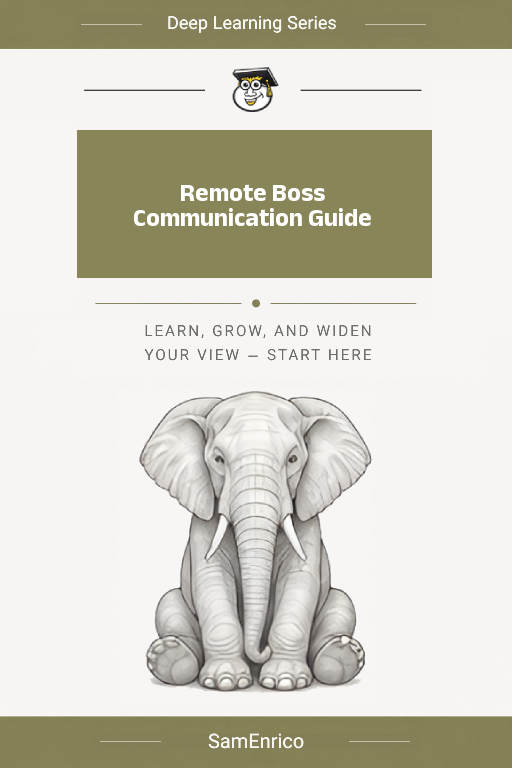
Non-FictionProfessional's Cheat SheetRemote
Remote Boss Communication Guide eBook
Manage a difficult manager from afar with written
Manage a difficult manager from afar with written updates, virtual presence, and boundaries.
Formats
Free sample
Chapter 1: The Proximity Paradox--Every remote worker remembers the exact moment they realized distance doesn't solve bad management—it weaponizes it.For Sarah, a senior marketing manager in Austin, that moment came at 6:47 PM on a Tuesday. She had just closed her laptop after a ten-hour day when her phone buzzed. A Slack message from her boss, who worked three time zones away: "Quick check-in? Just want to see where things stand on the deck for tomorrow."Sarah had sent the deck at 2 PM. She had attached it to a four-sentence email with "FINAL DECK FOR REVIEW" in the subject line.
She had even sent a follow-up message at 4 PM saying, "Just flagging that the deck is ready whenever you have a moment."Her boss had read none of it.By 7 PM, Sarah was reopening her laptop, resending the deck, and answering questions that were already answered on slide three. By 8 PM, she was crying over a bowl of cold pasta, convinced she was failing at a job she had excelled at for six years when she sat twenty feet from her manager's desk.Here is what Sarah didn't know: her boss wasn't a monster. He was an anxious manager experiencing what organizational psychologists call the Proximity Paradox. The further away his team moved, the less in control he felt. And the less in control he felt, the more he reached out.
And the more he reached out, the less his team got done. And the less his team got done, the more anxious he became.A death spiral invisible to both parties.This chapter is not about fixing your boss. This chapter is about understanding why your boss behaves the way they do when you work remotely—so you can stop taking it personally and start responding strategically. Because here is the uncomfortable truth that every best-selling book on remote work dances around but rarely says aloud: Distance does not make the heart grow fonder in corporate culture. Distance makes every existing flaw worse.The Signal Anxiety Phenomenon Let us start with a concept that will reframe everything you think you know about your difficult manager.In their groundbreaking work on remote leadership, management researchers identified a pattern they called "Signal Anxiety." The term describes a specific type of managerial stress that emerges when leaders cannot physically observe their team's work.
Without visual cues—seeing someone typing, overhearing a productive phone call, noticing a focused expression—the manager's brain fills the information vacuum with worst-case assumptions."Is Sarah actually working?""Did John understand the deadline?""What if the team is falling behind and I don't know it?"These questions are not signs of a bad person. They are neurological responses to uncertainty. The human brain is wired to prefer negative certainty over positive ambiguity. In other words, most managers would rather know something bad is happening than not know what is happening at all. Because if they know something bad is happening, they can act.
If they don't know, they are powerless.This is why a manager who was mildly controlling in the office—the one who peeked over your cubicle wall once a day, who asked "how's it going?" a little too often, who sent a few too many follow-up emails—becomes a full-blown micromanager on Slack. The office provided passive surveillance. Remote work provides none. So the manager compensates by sending double-texts, reaction emojis, and "just checking in" messages every forty-five minutes.The cruel irony: The more the manager reaches out, the less the team gets done. The less the team gets done, the more the manager reaches out.
The employee feels harassed and distrusted. The manager feels ignored and anxious. Neither is wrong. Both are trapped.Understanding Signal Anxiety is your first step out of the trap. Because once you recognize that your boss's behavior is driven by a neurological response to uncertainty—not by a personal vendetta against you—you can stop reacting emotionally and start responding architecturally.Your boss needs signal.
Your job is to provide it on your terms.The Four Archetypes of Difficult Remote Managers Not all difficult remote managers are difficult in the same way. Some over-communicate until you want to throw your laptop into a river. Some under-communicate until you forget they exist. Some steal credit. Some hoard information.
Some do all four depending on the day of the week.To manage your boss effectively, you must first diagnose which type of dysfunction you are dealing with. The following four archetypes are drawn from thousands of case studies across remote teams in technology, finance, healthcare, education, and non-profit sectors. You will likely recognize your boss in one of these categories—or in a hybrid of two.Archetype One: The Ghost Definition: The Ghost goes silent for days, ignores critical questions, leaves you stranded on projects, then emerges angry that nothing is done.Behavioral Signature: You send an email on Monday with three clear questions. On Wednesday, you send a follow-up. On Friday, you hear nothing.
On Saturday morning, you receive a message: "Why hasn't this moved forward?" When you reply, "I was waiting for your input on questions one and two," the Ghost responds, "You should have used your judgment."Root Cause: The Ghost is not lazy. The Ghost is overwhelmed, avoidant, or both. They have so many competing demands that they freeze. Rather than admitting they don't have an answer, they disappear. The silence is not malice.
It is paralysis.How You Feel: Abandoned, confused, and responsible for outcomes you cannot control. You waste hours waiting for decisions that never come. You second-guess whether you should have just acted without permission—even though past experience taught you that acting without permission leads to criticism.Why This Archetype Is Dangerous: The Ghost creates a no-win scenario. If you wait for them, nothing gets done, and you get blamed. If you act without them, you made the wrong decision, and you get blamed.
Over time, you learn that safety lies in doing nothing—which is exactly the opposite of what your career needs.The Ghost in Remote Settings: In an office, the Ghost could be physically located. You could stand at their door until they looked up. You could catch them in the hallway. Remote work removes those opportunities. The Ghost simply closes their laptop and disappears into the digital ether.Archetype Two: The Bot Definition: The Bot treats you like a ticket in a queue.
They only communicate via status reports, never provide context or empathy, and respond to "I need help" with "Please update the tracker."Behavioral Signature: Every interaction follows the same script. You ask, "Can we talk through the strategy for Project X?" The Bot replies, "What's the current status in the tracker?" You say, "I'm stuck because the data is inconsistent." The Bot says, "Have you logged the inconsistency as a blocker in the tracker?" You say, "I'm feeling burned out." The Bot says, "Please log your hours in the time tracking system."Root Cause: The Bot is not heartless. The Bot is a systems-thinker who believes that process solves all problems. They have been burned in the past by ambiguity and have retreated into rigid structures. They genuinely…
This is the end of the free sample. Get the eBook to keep going. Buy now
About this book
Details
- Author
- Benson Francisco
- Publisher
- SamEnrico
- Language
- English
- Genre
- Non-Fiction, Professional's Cheat Sheet, Remote
- Released
- 2026-05-30
- Pages (approx.)
- 135
- Available as
- eBook, Audiobook

Read better in the ZLOADR app
Your eBooks on your phone or tablet. Sign in with your SamEnrico account and start reading.
More by Benson Francisco
 Non Alcoholic Drink Substitution GuideBenson Francisco$11.99
 House of Wisdom DestructionBenson Francisco$11.99
 Tom Hanks EverymanBenson Francisco$11.99
 Financial Stress MeditationBenson Francisco$11.99
 The Working Memory for DyslexiaBenson Francisco$11.99
 Spouse Loss and Children GuideBenson Francisco$11.99
 Asana Status Update AutomationBenson Francisco$11.99
 Job Loss JournalBenson Francisco$11.99
 The Dreadful Gaze of Medusa: A Sociological Study of Fear and PowerBenson Francisco$11.99
 The Dragon and the Dream: How Taiwan's Hsinchuang High School Defied the Odds in the 1990sBenson Francisco$11.99
 Growing BiarumBenson Francisco$11.99
 A Collector's Handbook to the Rockne -1933Benson Francisco$11.99
You may also like
 Hong Kong Handover 1997Dunn Johnnie$11.99
 Zumba For Postnatal Recovery CourseNeal Christian$11.99
 Zumba for BeginnersLadner Nikia$11.99
 YouTube Comment Mining GuideHumes Pandora$12.99
 Worry Box MeditationCarlin Rudy$11.99
 Workplace Stress MeditationNguyen Lynn$11.99
 Workplace Stress and Sleep RepairHawley Ivory$11.99
 Workplace Perfectionism CureDelaney Jeffry$11.99
 Workplace Injustice Anger GuideWallen Isabelle$11.99
 Work Addiction and Burnout LinkGreenwood Ester$11.99
 Women in Yoga and WellnessBeattie Galina$11.99
 Women in Stand Up ComedyChun Evangeline$11.99