
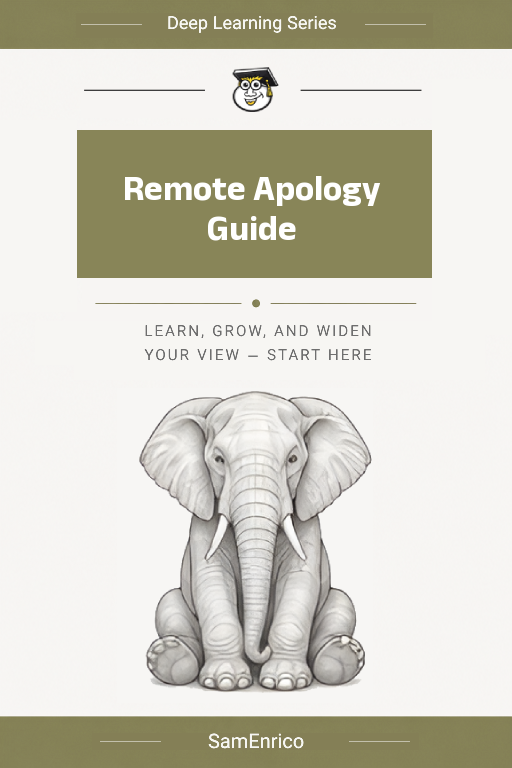
Non-FictionProfessional's Cheat SheetApology
Remote Apology Guide eBook
How to deliver effective apologies remotely to rep
by Mayer Cary
How to deliver effective apologies remotely to repair relationships.
Formats
Free sample
Chapter 1: The Second Wound--When Sarah received the text from her best friend of twelve years saying “I can’t do this anymore,” she sat in stunned silence for forty-seven minutes. Then she typed back: “I’m sorry you feel that way.” She hit send at 11:23 PM on a Friday night. Her friend read it at 11:24 and never replied. Two years of friendship, three shared apartments, and one broken bridesmaid promise—dissolved by seven words and a timing choice that Sarah never knew was a weapon.Sarah is not a bad person. She is not cruel, indifferent, or incapable of love.
She is a perfectly normal human being who made two mistakes that nearly everyone makes when trying to apologize from a distance. She waited too long to respond, then used a construction that sounded like an apology but functioned as an accusation. She did what thousands of people do every day: she turned a potential moment of healing into a second wound.This book exists because Sarah’s story is not an exception. It is the rule.The Hidden Epidemic of Broken Remote Communication We are living through the largest unstudied social experiment in human history. Never before have so many relationships—romantic, familial, professional, platonic—been mediated entirely through screens.
The average adult now sends over ninety text messages per day, spends nearly seven hours on digital devices, and conducts the majority of their conflict resolution through platforms that were designed for efficiency, not empathy.And yet, almost no one has been taught how to apologize remotely.Think about that for a moment. We learn to say “I’m sorry” as toddlers. We practice it on playgrounds, in living rooms, across dinner tables where we can see the other person’s face. We learn to read the subtle cues: the softening of their shoulders, the small exhale that signals acceptance, the way their eyes might water or look away. We learn that a hug can finish what words started.Then we become adults, and we move our most important relationships onto screens.
We fight over text. We reconcile—or fail to reconcile—over email. We send voice memos at midnight and video call apologies with bad lighting and barking dogs in the background. We are flying blind, using tools that strip away 93 percent of emotional communication, and we are surprised when everything falls apart.The data is sobering. Research from the University of Southern California found that people correctly interpret emotional tone in text messages only 56 percent of the time—barely better than random chance.
When the sender intends sincerity, the receiver perceives sarcasm nearly one-third of the time. When the sender intends remorse, the receiver perceives defensiveness almost half the time.In other words, your well-intentioned apology has nearly a fifty percent chance of landing as an attack.This is not because you are bad at apologizing. It is because the medium is fundamentally hostile to the message.The Three Channels of In-Person Apology To understand why remote apologies fail so catastrophically, we must first understand what you lose when you move from presence to screen.An in-person apology transmits through three simultaneous channels. The first is words—the literal content of what you say. “I was wrong.
I hurt you. I am sorry.” These are important, but they are only the beginning.The second channel is tone of voice. The same words spoken with different inflection become entirely different messages. “I am sorry” can be a confession, a dismissal, a plea, or a threat depending entirely on pitch, pace, and volume. In person, your tone is involuntary.
It leaks out of you. Someone who is genuinely remorseful sounds different from someone who is simply tired of fighting. You do not have to explain your tone; it simply exists, and the other person hears it.The third channel is body language. This is the most information-rich channel and the first to disappear when you move to text. Eye contact, posture, facial expression, hand placement, breathing rate, proximity—all of these communicate remorse or its absence without a single word being spoken.
When someone apologizes in person, you can see their hands trembling. You can see if they are leaning toward you or away from you. You can see if their face matches their words.In person, these three channels work together. If one channel is ambiguous—if their words say “I’m sorry” but their face looks bored—you have the other channels to clarify. You can ask a question.
You can say “You don’t look sorry.” You can calibrate in real time.Remote communication strips away two of these three channels. Text removes tone and body language entirely. Voice memos restore tone but remove body language. Video calls restore some body language but compress it through a tiny lens with lag, lighting issues, and the strange phenomenon of watching yourself on screen.What remains is a thin, fragile signal of intention, easily misread and easily broken.The Freeze Response: Why Silence Feels Like Violence There is a specific moment in remote conflict that determines everything. It happens in the space between the hurtful message and the response.Imagine you receive a text that stings.
Maybe it is a passive-aggressive comment from a partner. Maybe it is a dismissive remark from a colleague. Maybe it is a friend implying that you have been selfish. You read it. Your body reacts before your mind does.
Your jaw tightens. Your shoulders rise toward your ears. Your breath becomes shallow. Your heart rate increases.This is the freeze response, a cousin to the better-known fight-or-flight reaction. Harriet Lerner, the renowned psychologist and author of Why Won’t You Apologize?, describes it as the body’s way of preparing for threat when the threat is not physical but emotional.
Your nervous system does not distinguish between a predator and a painful text. It simply knows that something is wrong, and it prepares you to protect yourself.Now here is where remote communication becomes uniquely destructive.In person, when someone hurts you and then freezes, you can see it. Their silence is accompanied by visible distress. You might see them look away, swallow hard, or take a shaky breath. You interpret their silence as processing, not punishment.Remotely, you see none of that.
You see a text marked “Read at 9:32 AM.” And then you see nothing. The silence is total, opaque, and endless.The other person, meanwhile, might be frozen in genuine distress. They might be trying to find the right words. They might be so overwhelmed by shame that they cannot type. They might be crying.
But you cannot see any of that. All you see is a read receipt and an empty chat window.This is the freeze response amplified by absence. The injured party does not experience the apologizer’s silence as processing. They experience it as stonewalling, rejection, or punishment. They fill the vacuum of information with the worst possible interpretation because the human brain is wired to assume the worst when it lacks data.Dr.
John Gottman’s research on relationships identified stonewalling as one of the “Four Horsemen” that predict divorce. Stonewalling—the act of withdrawing from interaction…
This is the end of the free sample. Get the eBook to keep going. Buy now
About this book
Details
- Author
- Mayer Cary
- Publisher
- SamEnrico
- Language
- English
- Genre
- Non-Fiction, Professional's Cheat Sheet, Apology
- Released
- 2026-06-01
- Pages (approx.)
- 127
- Available as
- eBook, Audiobook

Read better in the ZLOADR app
Your eBooks on your phone or tablet. Sign in with your SamEnrico account and start reading.
More by Mayer Cary
 The MCS Survival GuideMayer Cary$11.99
 The Salt Flats ExpeditionMayer Cary$11.99
 Graduate School Stress Management GuideMayer Cary$11.99
 Firefighter Trauma Recovery GuideMayer Cary$11.99
 Antwerp Heist Reenactment GuideMayer Cary$11.99
 White Gold & Blood Money: The Untold War of the Colombian Coffee CartelsMayer Cary$11.99
 The Bone Chronicles: Unlocking the Secrets of Australia’s Ancient PastMayer Cary$11.99
 Understanding Fetal Methyl Mercury SyndromeMayer Cary$17.99
 Soybean HarvestingMayer Cary$11.99
 Micro Transaction Fit PrimerMayer Cary$12.99
 How to Become a Nail-assembly-machine OperatorMayer Cary$11.99
You may also like
 Hong Kong Handover 1997Dunn Johnnie$11.99
 Zumba For Postnatal Recovery CourseNeal Christian$11.99
 Zumba for BeginnersLadner Nikia$11.99
 YouTube Comment Mining GuideHumes Pandora$12.99
 Worry Box MeditationCarlin Rudy$11.99
 Workplace Stress MeditationNguyen Lynn$11.99
 Workplace Stress and Sleep RepairHawley Ivory$11.99
 Workplace Perfectionism CureDelaney Jeffry$11.99
 Workplace Injustice Anger GuideWallen Isabelle$11.99
 Work Addiction and Burnout LinkGreenwood Ester$11.99
 Women in Yoga and WellnessBeattie Galina$11.99
 Women in Stand Up ComedyChun Evangeline$11.99