
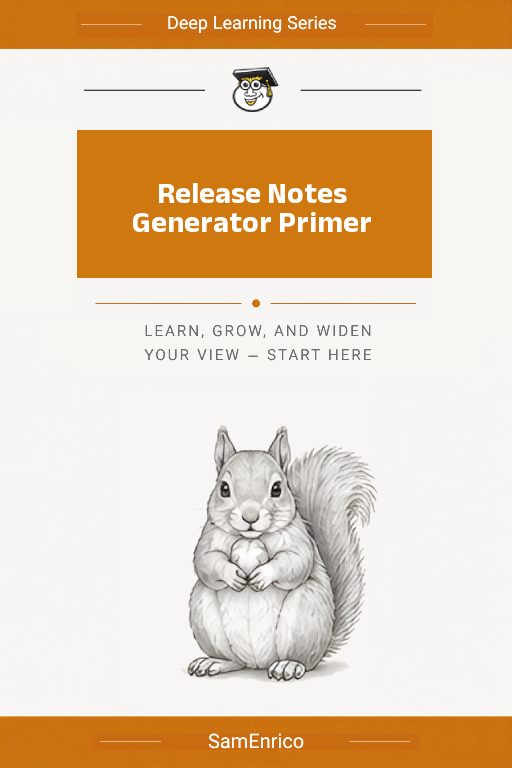
Release Notes Generator Primer
Transform Jira tickets and commit logs into clear,
Transform Jira tickets and commit logs into clear, customer-facing release notes using AI. Includes feature vs fix categorization, impact statements, and technical-to-plain English translation.
Formats
About this book
Free sample
Chapter 1: The Silent Revenue Leak...--–- On a Tuesday morning in March, a mid-sized Saa S company called Cloud Fast pushed a routine security patch to their authentication service. The engineering team did everything right: they wrote clean code, passed all tests, and deployed with zero downtime. Then they wrote their release notes: "Minor bug fixes and performance improvements." Within 48 hours, their largest enterprise customer—a financial services firm with 12,000 users—opened a support ticket asking why "nothing important" had been shipped in the last three sprints. The customer was considering switching to a competitor who communicated more transparently. The security patch that Cloud Fast's engineers had worked nights to complete?
It never appeared in the release notes. The customer never knew. And Cloud Fast almost lost $500,000 in annual recurring revenue because of four words: "Minor bug fixes."This is not an isolated cautionary tale. It is the everyday reality of thousands of engineering teams who have convinced themselves that release notes are a bureaucratic afterthought—a box to check before moving on to the next sprint. They are wrong.
And the cost of their wrongness is invisible, recurring, and entirely preventable.The $10,000 Assumption Let me state this as directly as possible: bad release notes are not a documentation problem. They are a revenue problem, a trust problem, and a team morale problem wrapped in a user interface you have probably never thought about twice.When you write "Miscellaneous fixes" or copy a Jira title like "Fix race condition in Web Socket handshake retry logic" directly into your customer-facing changelog, you are not saving time. You are actively destroying value that your engineering team just spent days or weeks creating. The customer does not know what a Web Socket handshake is. They do not care about your retry logic.
They care about whether the application they depend on for their work or their life is getting better, more reliable, or more valuable. Your release notes are the only bridge between the code you write and the value they perceive. When that bridge is a foggy, jargon-filled, copy-pasted mess, the…
This is the end of the free sample. Get the eBook to keep going. Buy now
Contents
- Chapter 1
- Chapter 2
- Chapter 3
- Chapter 4
- Chapter 5
- Chapter 6
- Chapter 7
- Chapter 8
- Chapter 9
- Chapter 10
- Chapter 11
- Chapter 12
Details
- Author
- Staggs Marcela
- Publisher
- SamEnrico
- Language
- English
- Genre
- Non-Fiction, AI Operator, Content Engineering, Release Guide
- Released
- 2026-05-28
- Pages (approx.)
- 130
- Available as
- eBook, Audiobook

Read better in the ZLOADR app
Your eBooks on your phone or tablet. Sign in with your SamEnrico account and start reading.
More by Staggs Marcela
 Burnout Prevention for Executives HandbookStaggs Marcela$11.99
 Science of MBSRStaggs Marcela$11.99
 Open Source AI Exceptions BriefStaggs Marcela$11.99
 Cousteau's Celebrity StatusStaggs Marcela$11.99
 The RLS Partner Support GuideStaggs Marcela$11.99
 The Siege of Tabriz: Shah Abbas' Masterstroke (1603)Staggs Marcela$11.99
 Understanding Kifafa Seizure DisorderStaggs Marcela$17.99
 Asia Pacific SaaS Growth GuideStaggs Marcela$12.99
 Warehouse EmployeeStaggs Marcela$11.99
 How to Start a On-line Advertising Material Publishing Business (Beginners Guide)Staggs Marcela$11.99