
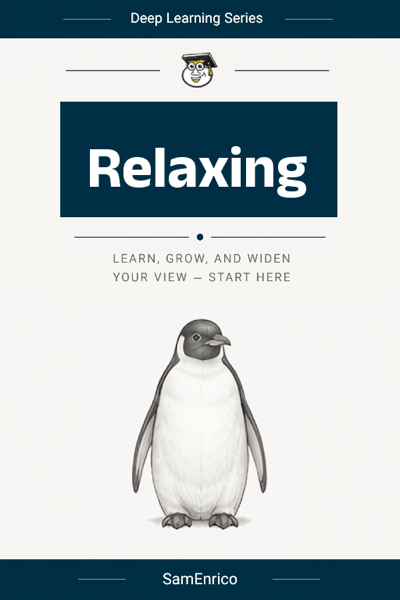
Non-FictionInformativeEducational
Relaxing eBook
A Coursebook on Relaxing
A Coursebook on Relaxing
Formats
Free sample
Chapter 1: The Trap of Trying...--I had a panic attack during a meditation retreat. Let me repeat that for emphasis: I paid money, drove two hours, and sat on a cushion in a room full of serene-looking strangers—and my body responded by going into full fight-or-flight mode. My heart raced. My palms sweated. My vision tunneled.
I was supposed to be "relaxing," and instead, I felt like I was dying. The teacher, a gentle woman with a shaved head and a voice like warm honey, leaned over and whispered, "Just breathe into the anxiety." I wanted to throw my cushion at her.That moment—that humiliating, terrifying, deeply ironic moment—taught me something no book on relaxation had ever admitted: trying to relax often makes you more anxious.This is the great unspoken secret of the wellness industry. We are told to meditate, breathe deeply, visualize calm beaches, and "just let go." But when we try these things and fail—when our minds race instead of quieting, when our chest tightens instead of loosening—we don't blame the technique. We blame ourselves. We think, I'm broken.
I can't meditate. Relaxation isn't for me. And then we try harder. Which makes it worse. Which confirms our brokenness.
It is a beautiful, brutal trap.This book exists because I spent ten years stuck in that trap. I tried everything: transcendental meditation, yoga, biofeedback, hypnosis, float tanks, CBD oil, prescription sleep aids, mindfulness apps, silent retreats, and one very expensive "sound bath" that was just a guy hitting a gong for an hour. Some things helped a little. Most things didn't. And the common thread in all my failures was this: I was trying to relax the way someone tries to fall asleep by shouting "SLEEP NOW" at their brain.It doesn't work.
It has never worked. And yet, almost every relaxation book on the market operates on this flawed premise. They give you techniques. They tell you to practice. They assure you that with enough effort, you will achieve calm.
But they never address the fundamental paradox: effort is the enemy of relaxation.This chapter will introduce you to that paradox. We will explore why the pressure to relax creates anxiety, why your brain is wired to resist commands to "calm down," and why the most effective relaxation strategies look nothing like trying. By the end of this chapter, you will have permission to stop trying—and that permission, ironically, will be the first real step toward genuine rest.The Day I Learned That Trying Was the Problem Before we dive into the science, let me tell you the full story of that meditation retreat, because it illustrates everything wrong with how we think about relaxation.I was twenty-eight years old, working seventy-hour weeks at a startup, and running on caffeine and cortisol. My sleep was a disaster—I would lie awake for hours, my brain cycling through to-do lists, imagined catastrophes, and replayed arguments. My doctor said my blood pressure was "concerning." My girlfriend said I was "not fun to be around." My therapist suggested meditation.So I did what any type-A overachiever would do: I researched the "best" meditation retreat within driving distance, booked the most intensive option (a full weekend of silent practice), and showed up with a notebook, a schedule, and a plan to master relaxation.The first day was fine.
Boring, even. We sat. We breathed. We walked slowly in circles. I felt virtuous.The second day, something shifted.
I started to notice that I wasn't relaxing. My mind was still racing. My shoulders were still tight. And now, on top of my usual stress, I had a new stressor: I was failing at meditation. The teacher would ring a bell, and we would begin a forty-minute sit, and within thirty seconds, I would be thinking about work.
I would notice I was thinking about work. I would try to return to my breath. I would succeed for three seconds. Then I would be thinking about how I had succeeded for three seconds. Then I would be thinking about how I was thinking about succeeding.
Then I would open my eyes, look at the timer, and see that thirty-seven minutes remained.It was agony.By the afternoon of day two, my heart was pounding. My jaw was clenched. My hands were shaking. I was, by any objective measure, more stressed than I had been before I arrived. And the worst part was the shame.
Everyone around me looked so peaceful. There was a man in the front row who seemed to be floating. A woman next to me had a soft, Mona Lisa smile. And I was over here, sweating through my shirt, mentally composing an email about Q3 projections.That's when the panic attack hit.I won't describe it in graphic detail, but suffice to say: my body decided that sitting still on a cushion was an existential threat. I bolted from the meditation hall, ran to my car, and sat in the parking lot hyperventilating for twenty minutes.
Then I drove home, stopped for fast food, and spent the evening watching terrible reality television while feeling like a complete failure.For months, I told myself that meditation "didn't work for me." That my brain was somehow broken. That relaxation was for other people—people with less ambitious jobs, less anxious temperaments, less complicated lives.It took me years to realize the truth: I wasn't failing at relaxation. The instructions I was following were failing me.Relaxation-Induced Anxiety: The Scientific Name for What You've Felt The experience I just described has a name. In clinical literature, it's called Relaxation-Induced Anxiety (RIA) , and it affects between 15 and 50 percent of people, depending on the study. That's not a rare condition.
That's tens of millions of people who have been told to "just breathe" and felt worse instead.RIA was first documented in the 1980s by researchers studying progressive muscle relaxation. They noticed a奇怪 thing: some patients, when instructed to relax, became more anxious instead of less. Their heart rates increased. Their cortisol levels rose. They reported feeling "trapped," "out of control," or "afraid of letting go."For decades, this phenomenon was dismissed as a niche problem—something that happened to people with panic disorder or a history of trauma.
But more recent research suggests that RIA is far more common than anyone realized, especially among people who are highly motivated to relax.Think about that paradox for a moment. The more you want to relax, the more you try to relax, the more likely you are to trigger RIA. It's the relaxation equivalent of performance anxiety. Just as a golfer can miss an easy putt because she's thinking too much about making it, you can fail to relax because you're trying too hard to be calm.Why does this happen? Three reasons, all connected to how your brain processes effort and control.First, effort triggers the sympathetic nervous system.
Your body doesn't distinguish between "effortful work" and "effortful relaxation." When you try hard—whether you're lifting weights or meditating—your brain releases norepinephrine, a neurotransmitter associated with arousal and alertness. That's great if you're running from a tiger. It's…
This is the end of the free sample. Get the eBook to keep going. Buy now
About this book
Details
- Author
- Wisniewski Nakia
- Publisher
- SamEnrico
- Language
- English
- Genre
- Non-Fiction, Informative, Educational
- Released
- 2026-05-09
- Pages (approx.)
- 134
- Available as
- eBook, Audiobook

Read better in the ZLOADR app
Your eBooks on your phone or tablet. Sign in with your SamEnrico account and start reading.
More by Wisniewski Nakia
 Blighted Ovum Grief GuideWisniewski Nakia$11.99
 Senior Men Style GuideWisniewski Nakia$11.99
 Pinterest Comparison Trap EscapeWisniewski Nakia$11.99
 Body Scan for SomaticsWisniewski Nakia$11.99
 The Great Bitcoin Heist: How Hackers Stole $600 Million in One NightWisniewski Nakia$11.99
 English Proficiency Assessment PrimerWisniewski Nakia$12.99
 How to Produce Cove BASE AdhesiveWisniewski Nakia$11.99
 How to Become a Magnetic-tape-composer OperatorWisniewski Nakia$11.99
You may also like
 Hong Kong Handover 1997Dunn Johnnie$11.99
 Zumba For Postnatal Recovery CourseNeal Christian$11.99
 Zumba for BeginnersLadner Nikia$11.99
 YouTube Comment Mining GuideHumes Pandora$12.99
 Worry Box MeditationCarlin Rudy$11.99
 Workplace Stress MeditationNguyen Lynn$11.99
 Workplace Stress and Sleep RepairHawley Ivory$11.99
 Workplace Perfectionism CureDelaney Jeffry$11.99
 Workplace Injustice Anger GuideWallen Isabelle$11.99
 Work Addiction and Burnout LinkGreenwood Ester$11.99
 Women in Yoga and WellnessBeattie Galina$11.99
 Women in Stand Up ComedyChun Evangeline$11.99