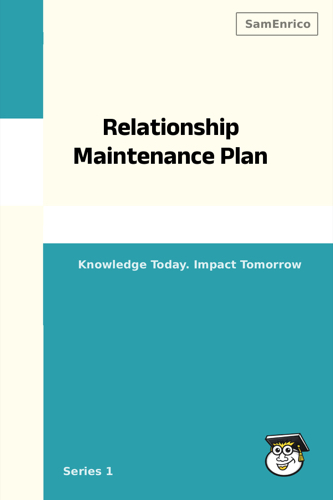
Relationship Maintenance Plan eBook
Stay in touch without being annoying.
Stay in touch without being annoying.
Formats
Free sample
Chapter 1: Timing Is Respect...--–- The first time Maya double-texted, she was sitting on her bathroom floor at 11:47 PM, convinced that her boyfriend of four months had died in a car accident. He hadn't. He was watching a documentary about submarines and had put his phone on silent. The second time Maya double-texted, she was at her desk at work, certain that she had said something unforgivable in a casual conversation about pizza toppings. She hadn't.
He was just in a meeting. The third, fourth, and fifth times blurred together—each one feeling less like a choice and more like a sneeze, an involuntary explosion of anxiety disguised as affection. By the time she reached her seventh double-text in two weeks, her boyfriend sent back a single line: "I feel like I can't breathe."Maya is not real. But her problem is, and you likely recognize it. Somewhere between the invention of the smartphone and the normalization of read receipts, we collectively forgot that timing is not a footnote to communication—it is the communication.
You can send the most perfectly crafted, emotionally intelligent, vulnerably honest message in the history of human language, and if you send it at 11:47 PM while someone is watching a submarine documentary, you have just become annoying. Not because you are annoying. Not because your message was bad. But because you ignored the invisible architecture of timing.This chapter is going to teach you something that most relationship books skip entirely: timing is a form of respect, and respect is the opposite of annoying. We will cover the science of attachment styles (why some of us panic and some of us flee), the concept of stress load (why your partner's bad day is not about you), and the single most practical rule you will ever learn—the 3-Second Rule versus the 3-Hour Rule.
By the end of this chapter, you will never send a message at the wrong time again without knowing exactly why it was wrong. And more importantly, you will stop confusing your own anxiety with their availability.The Attachment Styles That Run Your Thumb Before we can talk about timing, we have to talk about why timing is so hard for you in the first place. The answer lives in attachment theory, specifically the groundbreaking work of Levine and Heller in their book Attached. The simple version: every human being has a biological attachment system designed to keep us close to our caregivers, and later, our romantic partners. When that system detects distance, it activates anxiety to push us back toward connection.
In secure attachment, that system works like a well-calibrated thermostat—it notices distance, sends a gentle signal, and then relaxes. In insecure attachment, the thermostat is broken.There are two broken thermostat settings that matter for this chapter.The Anxious-Preoccupied Style. This is Maya. Anxious-preoccupied individuals have an attachment system that is hypersensitive. It detects distance everywhere, even when no distance exists.
A three-hour delay in a text reply feels like abandonment. A one-word answer feels like rejection. A missed goodnight text feels like the beginning of the end. The anxious brain does not experience these as possibilities—it experiences them as facts. And because the anxiety is so overwhelming, the only solution that works in the short term is to reach out.
To text again. To double-text. To call. To send a meme. To ask "Are you okay?" for the fourth time.
Each of these actions temporarily soothes the anxiety, which makes the behavior addictive. The anxious person is not trying to be annoying. They are trying to survive what feels like a threat to their very existence.The Avoidant Style. The avoidant person has the opposite problem. Their attachment system is hypo-sensitive.
It under-detects distance and over-detects closeness. Where the anxious person feels terror at being alone, the avoidant person feels suffocation at being together. A loving text feels like a demand. A request for connection feels like a trap. An expression of vulnerability feels like weakness.
The avoidant person's solution is to pull back, to delay replies, to keep conversations shallow, and to interpret their partner's anxiety as neediness rather than a bid for connection. Here is the cruel irony: avoidant and anxious people are magnetically attracted to each other. The anxious person's pursuit triggers the avoidant person's withdrawal, which triggers more anxious pursuit, which triggers more avoidant withdrawal. It is a dance where both partners are convinced they are the rational one.If you recognize yourself in either description, take a breath. Neither style is permanent, and neither makes you a bad partner.
But understanding your default setting is the first step to overriding it. The anxious person needs to learn that not every silence is a threat. The avoidant person needs to learn that not every text is a trap. And both need to learn the same thing: timing is the language through which attachment styles speak.The Stress Load Principle Here is a sentence that will change how you communicate: Your partner's availability is not about you.Most of us walk around assuming that if someone doesn't reply, it must be because of something we did. We said something wrong.
We texted too much. We aren't interesting enough. We are being punished. This is the anxious attachment brain talking, and it is almost always wrong. The truth is much more boring and much more liberating: people don't reply because they are tired, stressed, overwhelmed, distracted, hungry, or just not in the mood to talk.
None of those things have anything to do with you.This is the Stress Load Principle. Every person has a limited capacity for cognitive and emotional processing. Think of it as a cup. Work fills the cup. Family obligations fill the cup.
Traffic fills the cup. Health problems fill the cup. Financial worries fill the cup. By the time your partner gets to the end of their day, their cup might be completely full. When you send a message, you are asking them to engage, to process, to respond.
That is not a bad thing—connection requires engagement. But if their cup is already overflowing, your message does not land as a gift. It lands as an obligation. And obligations, repeated too often, become annoying.The solution is not to stop messaging. The solution is to calibrate your messages to their current stress load.
This requires you to do something that feels counterintuitive to the anxious brain: pay attention to their life, not just your feelings. Did they mention a big presentation at work? Their cup is full. Did they say they didn't sleep well? Their cup is full.
Did they just get back from a family visit? Their cup is full. Are they in the middle of their workday? Their cup is full. Sending a message that requires a thoughtful reply during any of these moments is not loving—it is demanding.
Sending a message that requires no reply, or a reply that can be a single emoji, is loving. We will cover those "no-reply" messages in detail in Chapter 9. For now, the only thing you need to know is this: before you text, ask yourself, "What…
This is the end of the free sample. Get the eBook to keep going. Buy now
About this book
Details
- Author
- Hastings Lacy
- Publisher
- SamEnrico
- Language
- English
- Genre
- Non-Fiction, Self-Help, Relationship Maintenance
- Released
- 2026-06-09
- Pages (approx.)
- 149
- Available as
- eBook, Audiobook

Read better in the ZLOADR app
Your eBooks on your phone or tablet. Sign in with your SamEnrico account and start reading.
More by Hastings Lacy
 Twelve Step Programs And Harm Reduction GuideHastings Lacy$11.99
 Stress Immune System RecoveryHastings Lacy$11.99
 Criminal Defense StressHastings Lacy$11.99
 Options Trading AddictionHastings Lacy$11.99
 Recording Embedded CommandsHastings Lacy$11.99
 Pet Keepsake IdeasHastings Lacy$11.99
 Anger After Betrayal HealingHastings Lacy$11.99
 Ymir's Bones: The World Born from a Giant's FallHastings Lacy$11.99
 The Green Pioneers: Black Naturalists Who Charted Africa’s Wild FrontiersHastings Lacy$11.99
 How to Produce Mobile Phone AccessoriesHastings Lacy$11.99
 A Collector's Handbook to the Pontiac Quality SixHastings Lacy$11.99
 US Minimum Wage Update GuideHastings Lacy$12.99