
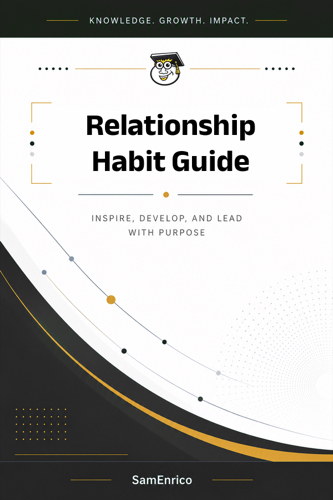
Non-FictionSelf-HelpRelationship Habits
Relationship Habit Guide eBook
Build daily connection rituals using atomic habits
Build daily connection rituals using atomic habits style tiny gestures.
Formats
Free sample
Chapter 1: The 86% Tipping Point--The most dangerous moment in your relationship is not the fight about money at 11 PM on a Tuesday. It is not the silent treatment after a holiday disaster. It is not even the affair, the betrayal, or the moment one of you says “I love you but I’m not in love with you.”The most dangerous moment is much smaller. It lasts three seconds. And you probably missed it today.Here is what happens in that moment: Your partner sighs while looking at their phone.
They glance up at you and say something like “Work was so stupid today” or “Did you see that thing on the news?” or simply “Huh.” That is not idle noise. That is a bid.A bid is any small attempt for attention, affection, or connection. It can be a question, a touch, a groan, a rolled eye, a hand on your shoulder, a comment about the weather, or a single word. It is a micro-request that says: “Are you there? Do you see me?
Do I matter in this exact second?”And how you answer that bid—in those three seconds—determines everything.John Gottman, the preeminent relationship psychologist, spent four decades studying thousands of couples. He observed their micro-interactions frame by frame. He tracked their heart rates, their facial expressions, and the tiny milliseconds of turning away. And he found a number so precise, so predictive, that it functions like a relationship GPS.Happy couples turn toward each other’s bids 86 percent of the time. Couples who eventually divorce turn toward each other’s bids only 33 percent of the time.Let that land.
In happy relationships, more than eight out of ten small bids get a response. In relationships heading for dissolution, only one out of three do. The difference is not grand romance, not compatibility scores, not shared hobbies, and not even how often you have sex. The difference is what you do in the three seconds after your partner sighs.This chapter is about that 53 percent gap. It is about why tiny gestures compound into unbreakable trust, why grand gestures are a trap, and why the 86 percent target is both achievable and forgiving.
You do not need to be perfect. You need to be present.The Grand Gesture Delusion We have been raised on a diet of cinematic romance. The hero runs through an airport. The lover appears with a boom box in the rain. The apology arrives via a five-page letter read aloud in a crowded room.
These moments are beautiful. They also have almost nothing to do with lasting love.Here is what the research says: Grand gestures do not predict relationship satisfaction. They do not repair chronic disconnection. They do not build trust. In fact, couples who rely on grand gestures often have worse daily connection because they treat the gesture as a substitute for the mundane.
“I bought you flowers” becomes “I did my job, now leave me alone.”The problem with grand gestures is baked into their structure. They are infrequent (once a month, once a year). They are high cost (money, time, emotional energy). They are usually performed by one partner for the other, creating a giver-and-receiver dynamic that subtly reinforces imbalance. And most damning of all, they are almost always offered instead of daily attention, not alongside it.The couple who takes a lavish anniversary trip but ignores each other at breakfast is not a strong couple.
They are a couple running on fumes and hoping a vacation will refill the tank. It never does. The tank is filled in one-second increments, not five-day increments.A client I’ll call Sarah learned this the hard way. She and her husband, Mark, had a yearly ritual of a “relationship reset weekend.” They would book a nice hotel, have long talks, make elaborate plans, and return home feeling renewed. Within two weeks, they would be back to grunting at each other over cereal.
The disconnect was not because they didn’t love each other. It was because they were trying to solve a daily problem with a monthly solution.When Sarah and Mark switched their focus from the weekend reset to the morning hello, everything changed. They committed to a sixty-second ritual every morning: eye contact, a hug, one acknowledgment. Within three weeks, their nightly fights dropped by half. The weekend trip became a bonus, not a crutch.Here is the distinction that matters.
A grand gesture is not evil. A surprise vacation is not bad. But if you are using grand gestures to compensate for missed daily bids, you are building a relationship on credit. Eventually, the bill comes due.What Is a Bid, Exactly?Before we go further, we need to get specific. A bid is any verbal or nonverbal attempt to connect.
It can be as obvious as “I love you” or as subtle as a small grunt that means “I am tired and I wish you would hold my hand.” Most bids are not dramatic. They are almost invisible. That is why they are so dangerous to miss.Gottman’s lab identified dozens of bid types. Here are the most common ones you probably overlook:The observational bid. Your partner says “Looks like it might rain” or “The neighbors got a new car.” This is not a weather report.
It is an attempt to share a moment of joint attention. The correct response is not a fact about precipitation. It is a turn toward: “Yeah, I was just thinking that. Do you want to sit on the porch and watch?”The emotional leak bid. Your partner sighs, rolls their eyes, or says “Ugh” under their breath.
This is not background noise. It is an invitation to inquire. The correct response is “What’s going on?” not silence.The physical bid. Your partner touches your arm, leans into you, or puts a hand on your back. This is not a request for sex.
It is a request for presence. The correct response is to lean back, not to ignore it or escalate it prematurely.The vulnerability bid. Your partner says “I’m really anxious about tomorrow” or “I don’t feel good about myself today.” This is the highest-stakes bid. It requires acknowledgment, not problem-solving. The correct response is “Tell me more” or “I’m here,” not “Here’s what you should do.”The shared memory bid.
Your partner says “Remember that trip to the beach?” This is not nostalgia. It is an attempt to co-create a positive emotional experience. The correct response is “Yes, that was the time you got sunburned and pretended you didn’t” not “Uh-huh” while scrolling.Most people miss bids not because they are malicious but because they are distracted. The phone is the single biggest bid-killer in modern relationships. A 2022 study found that couples who reported higher phone use during face-to-face interactions turned toward bids 41 percent less often than couples who kept phones away during reunion moments.
The phone does not just steal your attention. It steals your partner’s sense of mattering.The 86 Percent Target Is Not About Perfection Here is where most people get stuck. They hear “86 percent” and think “I…
This is the end of the free sample. Get the eBook to keep going. Buy now
About this book
Details
- Author
- Quinones Valentina
- Publisher
- SamEnrico
- Language
- English
- Genre
- Non-Fiction, Self-Help, Relationship Habits
- Released
- 2026-06-09
- Pages (approx.)
- 117
- Available as
- eBook, Audiobook

Read better in the ZLOADR app
Your eBooks on your phone or tablet. Sign in with your SamEnrico account and start reading.
More by Quinones Valentina
 Women in Media JournalismQuinones Valentina$11.99
 Effort Versus Talent GuideQuinones Valentina$11.99
 Distraction Proof Evening Routine GuideQuinones Valentina$11.99
 Ma Anand Sheela Prison InterviewQuinones Valentina$11.99
 Dubai Study Destination GuideQuinones Valentina$11.99
 Online Twelve Step MeetingsQuinones Valentina$11.99
 The Skykeepers of Meroë: Astronomy and the Wisdom of KushQuinones Valentina$11.99
 Washington’s Gamble: The Audacious Crossing at TrentonQuinones Valentina$11.99
 A Collector's Handbook to the Chevrolet Ea MasterQuinones Valentina$11.99
 How to Produce Sleeping AIDSQuinones Valentina$11.99
 Fulbright Scholarships for African StudentsQuinones Valentina$12.99
 Misused Words and Homophones GuideQuinones Valentina$12.99
You may also like
 Hong Kong Handover 1997Dunn Johnnie$11.99
 Zumba For Postnatal Recovery CourseNeal Christian$11.99
 Zumba for BeginnersLadner Nikia$11.99
 YouTube Comment Mining GuideHumes Pandora$12.99
 Worry Box MeditationCarlin Rudy$11.99
 Workplace Stress MeditationNguyen Lynn$11.99
 Workplace Stress and Sleep RepairHawley Ivory$11.99
 Workplace Perfectionism CureDelaney Jeffry$11.99
 Workplace Injustice Anger GuideWallen Isabelle$11.99
 Work Addiction and Burnout LinkGreenwood Ester$11.99
 Women in Yoga and WellnessBeattie Galina$11.99
 Women in Stand Up ComedyChun Evangeline$11.99