
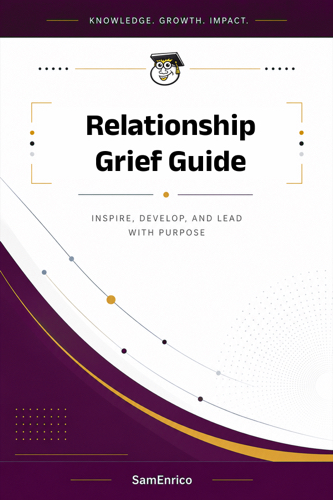
Relationship Grief Guide eBook
Applies grief models to romantic breakups, helping
Applies grief models to romantic breakups, helping you mourn what was lost.
Formats
Free sample
Chapter 1: The Unmourned Loss...--The first time I ever heard someone describe a breakup as a "death without a body," I was sitting across from a woman named Sarah in my therapy practice. She had just ended a four-year relationship with her fiancé, and she was drowning. Not in the way you might expect—not in sobbing fits or dramatic declarations. She was drowning in silence."It's been six weeks," she said, her voice flat. "My friends keep asking why I'm not over it yet.
My mom told me to 'get back out there.' My boss asked if I was 'feeling better now.' And I keep thinking... better? He was my person. We picked out baby names. I know what his coffee order is in three different languages.
And I'm supposed to be better in six weeks?"She paused, then whispered the sentence that would haunt me into writing this book."If he had died, they'd still be bringing me casseroles."That sentence is the key that unlocks everything. Because Sarah was right. And she was also wrong. She was right that society offers radically different support systems for death versus breakups. But she was wrong to think that one is inherently more painful than the other.
The truth is more complicated, and more hopeful: breakups are a form of grief that our culture has decided doesn't count.This book exists because that decision is destroying people.The Invisible Funeral Let me name what you might be feeling right now, even if you haven't said it out loud.You feel ridiculous for still being sad. You feel embarrassed when you cry in public. You feel ashamed when you check their Instagram for the tenth time today. You feel weak because your friend got over her divorce in three months and you can't get over your two-year situationship. You feel like you're failing at something everyone else seems to handle with ease.None of that is true.
But it feels true, and that feeling has a name.It's called disenfranchised grief.The term was coined by grief scholar Kenneth Doka in the 1980s, and it describes any loss that is not socially acknowledged, openly mourned, or publicly supported. When your grandmother dies, your boss gives you bereavement leave. When your dog dies, your friends send sympathy cards. But when your relationship ends? You get a timeline.
You get "plenty of fish in the sea." You get awkward silence or, worse, cheerful dismissal.Disenfranchised grief happens for three reasons, and breakups hit every single one:First, the relationship isn't legally recognized. Marriage comes with a script. Divorce comes with paperwork and lawyers and a clear before-and-after. But a breakup of a non-married relationship—whether it lasted six months or six years—has no official marker. No judge declares it over.
No document certifies the end. You are left to perform your own funeral without a license to mourn.Second, the loss is ambiguous. When someone dies, they are definitively gone. There is a body. There is a grave.
There is a finality that, while devastating, allows the brain to eventually accept what happened. But a breakup? They are still alive. They are still walking around. They might be at the grocery store.
They might text you at 2 AM. They might be happier without you, which is its own unique torture. Your brain cannot fully accept a loss that keeps showing up.Third—and this is the killer—society implies the loss is your fault. "You chose them." "You should have seen the red flags." "Maybe you're the problem." These messages are often unspoken, but they are everywhere. And they transform grief into shame.
You stop mourning the relationship and start interrogating yourself. What did I do wrong? Why wasn't I enough? The casserole becomes a cross-examination.This is why you feel crazy. Not because you are crazy.
Because you are grieving in a culture that has no ritual for your grief.The Shame Spiral Let me show you how disenfranchised grief actually works in your nervous system.When a loss is socially acknowledged, you are given permission to feel sad. That permission might come in the form of a funeral, a condolence card, or simply a friend saying "take all the time you need." Permission doesn't erase the pain, but it does something crucial: it prevents shame from attaching to the pain.When a loss is not socially acknowledged, something different happens. You feel sad, but then you feel bad about feeling sad. You cry, and then you think "I shouldn't still be crying." You miss them, and then you think "I'm pathetic for missing them." This is the shame spiral, and it is devastating because it adds a second layer of suffering on top of the original pain.Here is what the research shows: shame amplifies grief. It doesn't just make you feel worse; it actively prevents healing.
When you are ashamed of your grief, you hide it. When you hide it, you cannot process it. When you cannot process it, it gets stuck. And when it gets stuck, it becomes complicated grief—the kind that lasts for years instead of months.I have watched this happen hundreds of times. A client comes in, convinced they are "overreacting" to a breakup that ended "months ago." They have been hiding their tears, deleting their sad songs, pretending to be fine at brunch.
And underneath the performance is a ocean of unmourned loss that is slowly poisoning everything.The first step out of that ocean is not complicated. It is simply this: you have to name what you're experiencing as grief.Not drama. Not overreacting. Not weakness. Grief.Ambiguous Loss vs.
Concrete Loss Before we go further, I need to introduce a distinction that will run through this entire book. It comes from the work of family therapist Pauline Boss, who spent decades studying how people cope with losses that have no clear resolution.Concrete loss is what it sounds like: a loss that is definitive, observable, and final. The relationship structure is over. You are no longer together. They moved out.
The shared lease is terminated. The couple photos are in a box. This is real, and it hurts. But it is also clean. There is no ambiguity about whether you are still in a relationship.
You are not.Ambiguous loss is something else entirely. It happens when the person is physically absent but psychologically present—or physically present but psychologically absent. In the context of a breakup, ambiguous loss means: they are still alive. They could call you. They could want you back.
They might be suffering too. The door is not fully closed, and because it is not fully closed, your brain cannot fully accept the loss.Most breakups are both. The relationship structure is over (concrete), but the person is still out there (ambiguous). Your brain has to process two different kinds of loss at the same time, and they pull you in opposite directions. The concrete loss says "accept and move on." The ambiguous loss says "wait and watch."This is why you check their Instagram.
This is why you analyze their Venmo transactions. This is why you still have their old t-shirt. Your brain is…
This is the end of the free sample. Get the eBook to keep going. Buy now
About this book
Details
- Author
- Flowers Constance
- Publisher
- SamEnrico
- Language
- English
- Genre
- Non-Fiction, Self-Help / Grief
- Released
- 2026-06-06
- Pages (approx.)
- 118
- Available as
- eBook, Audiobook

Read better in the ZLOADR app
Your eBooks on your phone or tablet. Sign in with your SamEnrico account and start reading.
More by Flowers Constance
 Self Hypnosis for Fear of CostumesFlowers Constance$11.99
 Alcohol Recovery for TeachersFlowers Constance$11.99
 SWAT Team Commander StressFlowers Constance$11.99
 The DBT for Bipolar GuideFlowers Constance$11.99
 Intruder Theory EvidenceFlowers Constance$11.99
 Daily Listening ScheduleFlowers Constance$11.99
 COVID Booster Schedule OptimizerFlowers Constance$11.99
 Laughing Through the Storm: Trevor Noah's Rise in a Divided South AfricaFlowers Constance$11.99
 The Swiss Guard: Sentinels of the VaticanFlowers Constance$11.99
 Skye Terrier: Proud & RareFlowers Constance$11.99
 How to Produce Flute Cleaning RodsFlowers Constance$11.99
 A Collector's Handbook to the Bentley 4½-litre Mk VFlowers Constance$11.99
You may also like
 Hong Kong Handover 1997Dunn Johnnie$11.99
 Zumba For Postnatal Recovery CourseNeal Christian$11.99
 Zumba for BeginnersLadner Nikia$11.99
 YouTube Comment Mining GuideHumes Pandora$12.99
 Worry Box MeditationCarlin Rudy$11.99
 Workplace Stress MeditationNguyen Lynn$11.99
 Workplace Stress and Sleep RepairHawley Ivory$11.99
 Workplace Perfectionism CureDelaney Jeffry$11.99
 Workplace Injustice Anger GuideWallen Isabelle$11.99
 Work Addiction and Burnout LinkGreenwood Ester$11.99
 Women in Yoga and WellnessBeattie Galina$11.99
 Women in Stand Up ComedyChun Evangeline$11.99