
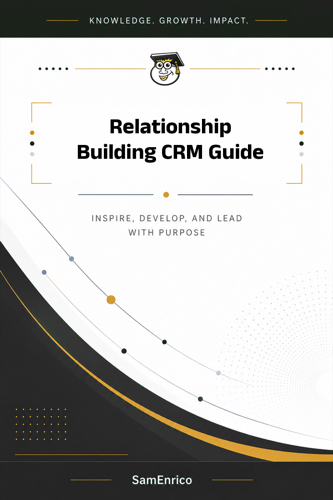
Relationship Building CRM Guide eBook
Use contact management software to remember detail
by Trice Jinny
Use contact management software to remember details and time follow-ups perfectly.
Formats
Free sample
Chapter 1: The $10,000 Forgotten Name---- Every professional has a version of this story. For Sarah, a regional sales director at a mid-sized software company, it happened on a Tuesday afternoon in March. She was sitting across from a prospective client, a senior vice president at a logistics firm, after six weeks of promising conversations. The deal was worth $210,000 in annual recurring revenue—roughly one-third of her quarterly quota. The meeting had been going well.
The VP had nodded along during her product demonstration, asked intelligent questions about implementation timelines, and even laughed at her admittedly mediocre joke about software integration headaches.Then the VP leaned back in his chair and said something that stopped Sarah cold."How are your twins doing? They must be, what, almost four now?"Sarah's stomach dropped. She had mentioned her twin daughters exactly once, in passing, during an initial discovery call seven weeks earlier. It had been a brief, almost accidental disclosure—"Sorry for the noise in the background, my twins are home sick today." She had forgotten she ever said it. The VP, apparently, had not.She had no memory of mentioning her children to him.
None. She certainly had not logged it anywhere. And now, sitting across from a man who had just demonstrated an almost unsettling level of personal attentiveness, she had nothing to offer in return. She could not ask about his children because she had never asked if he had any. She could not reference his recent vacation because she had not logged where he went.
She could not even remember which college his alma mater was, though he had mentioned it twice.The conversation became awkward. Not obviously, not catastrophically—but perceptibly. The VP's demeanor shifted from warm to professional. The deal did not die that day, but it entered a slow, agonizing limbo. Emails went unanswered.
Follow-ups were deflected. Three weeks later, Sarah lost the deal to a competitor whose sales representative had apparently done their homework.Afterward, in the post-mortem, her manager asked a reasonable question: "What happened? They seemed ready to sign."Sarah could not explain it. There was no single moment of failure, no aggressive counter-offer, no product flaw. There was only the slow erosion of trust that began when a client realized he had been paying more attention to her than she had been paying to him.The Forgotten Follow-Up That Cost a Promotion Sarah's story is not unusual.
It is not even remarkable. Every week, in every industry, professionals lose deals, damage relationships, and burn social capital not because they are incompetent or uncaring, but because their memory fails them at exactly the wrong moment.Consider David, a financial advisor in Chicago who forgot to follow up with a prospect whose mother had just been diagnosed with cancer. He had promised to "check in next week." He did not. When he finally called three weeks later, the prospect had already moved their portfolio to another advisor—one who sent a handwritten note the very next day.Consider Maria, a freelance graphic designer who lost a long-term retainer client because she forgot the name of the client's new dog. The dog had been mentioned exactly once, in an offhand comment about house-training struggles.
Three months later, when Maria asked "How is your labradoodle doing?" (wrong breed, wrong name), the client laughed it off but quietly started shopping for other designers.Consider James, a real estate agent who failed to send a closing gift to a couple who had just bought their first home. He meant to. He had the address. He even bought the gift—a nice bottle of champagne and a cutting board engraved with their names. But the gift sat on his kitchen counter for six weeks while he "got around to it." By the time it arrived, the couple had already recommended another agent to three friends.These are not stories of incompetence.
These are stories of normal, healthy, busy human beings who made the same mistake: they trusted their memory to do something it was never designed to do.The Psychology of Forgetting (And Why It Is Not Your Fault)Here is a truth that will either relieve you or terrify you, depending on how you react to evidence that contradicts your self-image: your memory is not unreliable because you are lazy, disorganized, or uncaring. Your memory is unreliable because it is doing exactly what evolution designed it to do.Hermann Ebbinghaus, a German psychologist who pioneered the study of memory in the late nineteenth century, discovered something that has been replicated in hundreds of studies since: the forgetting curve. Ebbinghaus taught himself lists of nonsense syllables—meaningless combinations like "ZOF" and "WUK"—and then tested himself at intervals to see how much he retained. What he found was brutal.Within one hour of learning new information, he had forgotten approximately fifty percent of it. Within twenty-four hours, that number rose to nearly seventy percent.
Within one week, without deliberate reinforcement, he had forgotten almost ninety percent of what he had learned.The curve is steep, universal, and unforgiving. Your brain is wired to prioritize survival-relevant information—where is the nearest exit, is that person a threat, have I eaten today—over the kind of social details that matter in professional relationships. Your brain does not care about your client's daughter's name. Your brain does not care about the work anniversary of a former colleague. Your brain certainly does not care about following up in exactly seven days unless you have built a deliberate system to make it care.This is not a moral failing.
It is biology.The Cost of Forgetting (Calculating Your Forgetting Tax)The problem with forgetting in professional relationships is not that it feels embarrassing, though it does. The problem is that it is expensive. Let us calculate your personal Forgetting Tax.Start with a simple question: how many professional relationships do you actively maintain? Not acquaintances—people you have met once or twice—but genuine relationships where ongoing communication matters to your income, career, or reputation. If you are in sales, business development, recruiting, account management, consulting, law, real estate, financial services, or any relationship-driven field, that number is likely between fifty and two hundred contacts.Now ask yourself: how many of those relationships are currently at risk because you have not followed up when you should have?
How many opportunities have you lost in the past twelve months because you forgot a detail, missed a timing window, or failed to personalize a message? How much revenue, how many referrals, how much social capital has leaked out of your network because your memory could not keep up with the demands of your relationships?For Sarah, the sales director, the Forgetting Tax on a single deal was $210,000. For David, the financial advisor, it was a long-term client worth roughly $15,000 annually in recurring fees. For James, the real estate agent, it was not a single dollar amount but a cascade of lost referrals from a couple who had been ready to become evangelists.Add up your own numbers. Be honest.
The total is almost certainly higher than you think.The Reframe: Logging Is Not Cold, It Is Caring Here is where…
This is the end of the free sample. Get the eBook to keep going. Buy now
About this book
Details
- Author
- Trice Jinny
- Publisher
- SamEnrico
- Language
- English
- Genre
- Non-Fiction, Self-Help, CRM Tools
- Released
- 2026-06-12
- Pages (approx.)
- 128
- Available as
- eBook, Audiobook

Read better in the ZLOADR app
Your eBooks on your phone or tablet. Sign in with your SamEnrico account and start reading.
More by Trice Jinny
 Loneliness Tennis Partner GuideTrice Jinny$11.99
 Self Awareness Development GuideTrice Jinny$11.99
 Hypnosis Meditation FusionTrice Jinny$11.99
 The Travel Tech Capital ForecastTrice Jinny$11.99
 Admitting Mistakes to BossTrice Jinny$11.99
 The Exhaustion Diary MethodTrice Jinny$11.99
 Kennedy CamelotTrice Jinny$11.99
 Bladder Cancer VictoryTrice Jinny$11.99
 The Ghost in the Machine: How AI Almost Triggered WWIIITrice Jinny$11.99
 The Timbuktu Gold Heist: The Philanthropic Gambit of the Songhai EmpireTrice Jinny$11.99
 The Jungle Alchemist: How a Forgotten Explorer Unlocked the Secrets of QuinineTrice Jinny$11.99
 How to Start a Credit or Finance Broking Business (Beginners Guide)Trice Jinny$11.99