
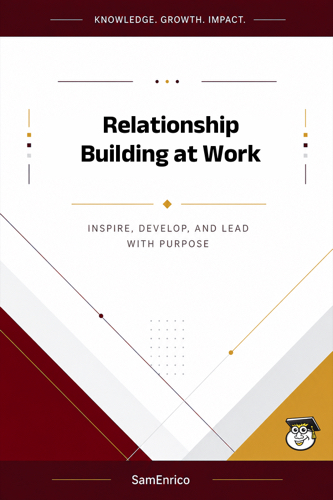
Relationship Building at Work eBook
Builds rapport with colleagues and supervisors.
Builds rapport with colleagues and supervisors.
Formats
Free sample
Chapter 1: The Hidden Currency--–- Every morning, Maria walked past the same fifty people on her way to her desk. She nodded at some, murmured “morning” to others, and avoided eye contact with a few. After three years at the firm, she knew exactly two things about most of her colleagues: their job titles and whether they preferred coffee or tea. She was brilliant at financial modeling, met every deadline, and had never missed a day of work. Yet when the senior manager role opened up, the promotion went to James—a man with weaker technical skills, slower Excel speed, and a habit of leaving at 4:30 PM to coach his daughter’s soccer team.Maria was furious, then confused, then finally curious.
What did James have that she lacked?The answer, she would discover over the following months, had nothing to do with spreadsheets and everything to do with something she had dismissed her entire career as “soft” and therefore secondary: relationships. James had not won the promotion because he was smarter or worked harder. He had won it because when the decision was made, five people in that room—people Maria had never bothered to know—spoke up for him. Not because he had asked them to. Because they genuinely wanted to.This book is for every Maria who has ever wondered why raw talent sometimes loses to warm rapport.
It is for the engineer who designs flawless products but cannot get leadership to listen. For the nurse who catches every medication error but feels invisible during shift changes. For the project manager who keeps every timeline but cannot seem to build the cross-functional alliance that would make her job half as stressful. And it is for the executive who has finally realized that strategy without trust is just a document nobody follows.This chapter will dismantle the myth that workplace relationships are “nice to have.” It will show you, with data and stories, that rapport is not a distraction from real work—it is the engine that makes real work possible. You will learn why a single strong work friendship reduces burnout by more than half, why upward rapport accelerates promotion speed by nearly 40 percent, and why organizations with high trust make decisions three times faster than their low-trust competitors.
You will also encounter the central framework that will guide you through the next eleven chapters: the distinction between relational capital and transactional exchange, and the five levels of maturity that every workplace relationship must climb if it is to become a source of career advantage rather than just another obligation.But first, let us tell you about the research that changed how we think about the modern workplace.The Quantifiable Edge: What Data Reveals About Relationships For decades, business schools taught that organizations were machines. Inputs went in, outputs came out, and people were interchangeable parts best managed through incentives and oversight. This mechanical view produced impressive efficiency gains but also created what organizational psychologist Edgar Schein called “the illusion of control”—the belief that if you just designed the right reporting lines and bonus structures, human messiness would disappear.It did not. And it never will.A landmark study by Gallup, analyzing data from more than 2.7 million employees across 100,000 teams, found that the single best predictor of productivity, retention, and safety was not salary, not benefits, not even job autonomy. It was a simple, almost embarrassingly human metric: whether an employee had a best friend at work.
Those who answered “yes” were 50 percent more likely to report being satisfied with their workplace, 35 percent more likely to report feeling engaged, and 27 percent more likely to report that they could access the resources needed to do their jobs well.A best friend at work. Not a mentor. Not a sponsor. Not a supervisor. A person you would text on a Saturday, invite to dinner, or call when life goes sideways.If that sounds too soft for your organization’s quarterly earnings report, consider this: Google’s famous Project Aristotle, which spent years analyzing what made their most effective teams successful, concluded that psychological safety—the belief that you will not be punished or humiliated for speaking up—was the number one differentiator.
Teams with high psychological safety generated more ideas, caught more errors, and retained talent longer. And psychological safety is not an abstract policy. It is built one conversation at a time, one micro-moment of trust at a time, one relationship at a time.The data gets even more specific when we look at career outcomes. A study tracking 1,300 MBA graduates over twenty years found that those who entered their careers with a clear “referral network”—people who would actively recommend them for opportunities—earned an average of 31 percent more than equally credentialed peers who lacked such networks. Another analysis, this one of 10,000 promotions across five Fortune 500 companies, revealed that 72 percent of upward moves were driven not by performance ratings alone but by a combination of performance and visibility.
And visibility, as we will explore in Chapter 9, is fundamentally relational. It requires someone to notice you, speak about you, and advocate for you when you are not in the room.Let us pause here and name what this means for the Marías of the world. You can be the most competent person on your team. You can deliver perfect work on impossible timelines. But if no one knows you, likes you, or trusts you, your competence will be perpetually overshadowed by someone like James—someone who may not be smarter but has figured out that work is not just about tasks.
It is about people doing tasks together.The Shift from Transactional to Relational Exchange To understand why workplace relationships matter so much, we need to understand the difference between two fundamentally different ways of interacting with others. The first is transactional exchange. This is the currency of contracts, invoices, and deadlines. You do something for me, I do something for you, and we keep score. Transactional relationships are efficient and predictable.
They are also brittle. When the transaction ends, the relationship ends. When one party feels the exchange was unequal, resentment builds quickly.The second is relational exchange. This is the currency of trust, goodwill, and mutual investment. You help me not because you expect an immediate favor in return, but because we are connected.
I support you not because I am tracking a ledger, but because your success matters to me. Relational exchanges do not require perfect reciprocity in the moment. They operate on a different logic: what goes around comes around, not necessarily from the same person or in the same form, but over time and across networks.Here is what the research shows about these two modes. Transactional relationships produce compliance. Relational relationships produce commitment.
When you manage transactionally, people do what you ask—and stop there. When you manage relationally, people look for ways to help you succeed without being asked.Consider the difference between two customer service representatives. The transactional one follows the script, resolves the ticket, and moves on. The relational one asks “What else can I help with?” and remembers your issue when you call back three months later. Which…
This is the end of the free sample. Get the eBook to keep going. Buy now
About this book
Details
- Author
- Dickinson Lecia
- Publisher
- SamEnrico
- Language
- English
- Genre
- Non-Fiction, Self-Help, Workplace
- Released
- 2026-06-06
- Pages (approx.)
- 140
- Available as
- eBook, Audiobook

Read better in the ZLOADR app
Your eBooks on your phone or tablet. Sign in with your SamEnrico account and start reading.
More by Dickinson Lecia
 Compassionate Inner VoiceDickinson Lecia$11.99
 Workplace Financial StressDickinson Lecia$11.99Workplace Financial StressDickinson Lecia$11.99
 Omega 3 Vegan SourcesDickinson Lecia$11.99
 Morning Nutrition GuideDickinson Lecia$11.99
 De escalation for BouncersDickinson Lecia$11.99
 Perfectionism and Fear LinkDickinson Lecia$11.99
 Serendipity Engine DesignDickinson Lecia$11.99
 The Unseen Trial: How a 19th-Century Courtroom Drama Reshaped Modern Privacy LawsDickinson Lecia$11.99
 The Selkie's Silent Bargain: Love, Loss, and the Shifting TidesDickinson Lecia$11.99
 Service Providers Guide to Foley ArtistsDickinson Lecia$11.99
 How to Produce Vital Signs MonitorsDickinson Lecia$11.99
You may also like
 Hong Kong Handover 1997Dunn Johnnie$11.99
 Zumba For Postnatal Recovery CourseNeal Christian$11.99
 Zumba for BeginnersLadner Nikia$11.99
 YouTube Comment Mining GuideHumes Pandora$12.99
 Worry Box MeditationCarlin Rudy$11.99
 Workplace Stress MeditationNguyen Lynn$11.99
 Workplace Stress and Sleep RepairHawley Ivory$11.99
 Workplace Perfectionism CureDelaney Jeffry$11.99
 Workplace Injustice Anger GuideWallen Isabelle$11.99
 Work Addiction and Burnout LinkGreenwood Ester$11.99
 Women in Yoga and WellnessBeattie Galina$11.99
 Women in Stand Up ComedyChun Evangeline$11.99