
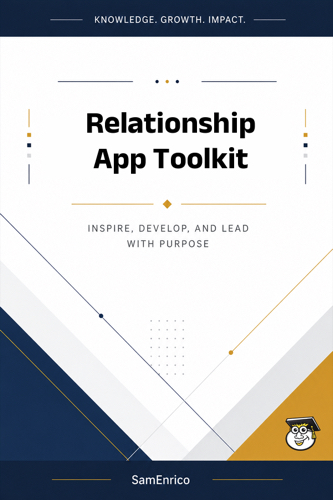
Relationship App Toolkit eBook
Uses digital tools to manage couple stress.
Uses digital tools to manage couple stress.
Formats
Free sample
Chapter 1: The Third Partner--–- Megan and Jake had been married for eleven years. They had two children, a mortgage, and a dog they both secretly resented. By every external metric, they were a successful, stable couple. But for the past eight months, they had been fighting every single night. The fights were not about money, infidelity, or the usual suspects.
They were about a text message. Specifically, a text message Jake had not replied to.The incident that broke the camel’s back was mundane to the point of absurdity. Megan had texted Jake at 3:47 PM: “Running late. Can you grab milk?” Jake saw the message at 3:48 PM. He was in back-to-back meetings until 5:15 PM.
He replied at 5:17 PM: “Got it. See you soon.” Thirty seconds later, his phone rang. It was Megan. She was crying.“You ignored me,” she said.“I didn’t ignore you. I was in meetings.”“For an hour and a half?
You saw it at 3:48. I saw the read receipt.”“I was going to reply. I was in the middle of something.”“You were in the middle of choosing your phone over me.”That night, they slept in separate rooms. Megan scrolled Instagram for two hours, watching other husbands surprise their wives with flowers, other couples laughing at candlelit dinners, other families who seemed to have no trouble replying to text messages. Jake, in the other room, worked on his laptop until midnight, answering emails, convincing himself that the fight was irrational and that he had done nothing wrong.Neither of them realized they were not fighting about milk.
They were not even fighting about text messages. They were fighting about a third entity that had silently moved into their relationship years ago, unpacked its bags, and taken a seat at the dinner table. That third entity was the smartphone. And it was winning.The Diagnosis If you are reading this book, there is a high probability that you have experienced some version of Megan and Jake’s fight. Perhaps the details are different—maybe it was a missed call, an ignored photo in a family group chat, or a partner who scrolled Tik Tok while you were trying to tell them about your day.
But the underlying architecture is the same. You are not fighting with your partner. You are fighting with the device in your pocket, and your partner just happens to be holding it.This chapter makes a provocative claim, one that will sound extreme only to those who have not yet confronted its truth: the average modern couple has three entities in the relationship—Partner A, Partner B, and the smartphone. And of these three, the smartphone is often the most attended to, the most protected, and the least likely to be asked to leave.Drawing on recent data from Pew Research (2023), the American Psychological Association, and the foundational work in Digital Exhaustion and Connected & Engaged, this chapter identifies the three primary digital stressors that directly predict relationship dissatisfaction. These stressors are not minor annoyances.
They are chronic, low-grade toxins that accumulate over time, eroding trust, intimacy, and patience until the smallest spark ignites a wildfire.The Three Digital Stressors The first stressor is Digital Exhaustion. This is the fatigue that comes from constant notifications, infinite decision-making, and the unspoken pressure to be “always on.” The average smartphone user receives 46 push notifications per day. Each notification is a micro-interruption, a tiny demand for attention. The brain, evolved to respond to threats and opportunities, cannot ignore them. Over the course of a day, these 46 interruptions fragment attention into shards.
By the time you sit down with your partner in the evening, you have already made hundreds of tiny decisions—should I check that email? Should I like that post? Should I reply now or later?—and your cognitive reserves are depleted. You are not irritable because you are a bad partner. You are irritable because you are exhausted.The second stressor is The Comparison Trap.
Social media feeds are not windows into other people’s lives. They are carefully curated highlight reels, edited for maximum appeal and minimum authenticity. But the human brain does not process highlight reels as fiction. It processes them as data. When you see a friend’s vacation photos, anniversary posts, or candid “morning coffee with my love” shots, your brain silently notes: They are happier than you.
Their relationship is better than yours. You are failing.This is not a character flaw. It is a feature of how social comparison works. Psychologists have known for decades that humans evaluate themselves by comparing themselves to others. The problem is that for most of human history, the “others” we compared ourselves to were our immediate neighbors, coworkers, and family members—people whose lives we could see in full, warts and all.
Social media has expanded the comparison pool to millions of strangers who show us only their best moments. The result is a steady drip of inadequacy. And because inadequacy is painful, many couples respond by pulling away from each other—less vulnerability, less honesty, less “I feel lonely”—and retreating further into the very apps that caused the pain.The third stressor is The Availability Stressor. This is the invasion of work and obligation into home life. Before smartphones, leaving the office meant leaving the office.
Emails stayed on the desktop. Slack messages were not invented. Work stress was contained within work hours. Today, the average professional receives work communications between 7 PM and 9 PM on weeknights, and many report feeling obligated to respond within the hour. The result is a state of chronic low-grade hypervigilance.
You are never truly off. You are never truly home. And your partner, sitting across from you, becomes just another notification competing for attention you no longer have.When these three stressors combine—digital exhaustion, the comparison trap, and availability stress—they create what this book calls ambient stress. Ambient stress is not caused by any single event or argument. It is the background hum of the digital environment, the constant low-level static that makes every interaction slightly harder, every conversation slightly more fragile, and every misunderstanding slightly more explosive.Ambient stress is the invisible third partner in your relationship.
And unlike your actual partner, it never sleeps, never apologizes, and never stops demanding attention.The Phubbing Effect In 2023, researchers at the University of Arizona published a longitudinal study on a behavior they called “phubbing”—a portmanteau of “phone” and “snubbing.” Phubbing occurs when one partner uses their phone in the presence of the other partner, particularly during moments that would otherwise be opportunities for connection: dinner, bedtime, a conversation, or even just sitting together on the couch.The results of the study were alarming. Couples who reported higher rates of phubbing were 80% more likely to report relationship dissatisfaction one year later. But the damage was not just emotional. The researchers also measured cortisol levels (a stress hormone) and oxytocin levels (a bonding hormone). In couples with frequent phubbing, cortisol was significantly elevated and oxytocin was significantly depressed.
In other words, phubbing was not just annoying. It was physiologically toxic.Consider what happens when your partner looks at their phone while you are…
This is the end of the free sample. Get the eBook to keep going. Buy now
About this book
Details
- Author
- Coffman Randee
- Publisher
- SamEnrico
- Language
- English
- Genre
- Non-Fiction, Self-Help, Apps
- Released
- 2026-06-06
- Pages (approx.)
- 128
- Available as
- eBook, Audiobook

Read better in the ZLOADR app
Your eBooks on your phone or tablet. Sign in with your SamEnrico account and start reading.
More by Coffman Randee
 Memory Palace Studying GuideCoffman Randee$11.99
 Career Transition After RelocationCoffman Randee$11.99
 Citation Rules Spaced Repetition CourseCoffman Randee$11.99
 Laci Peterson Home VideosCoffman Randee$11.99
 Upwork Job Search AutomationCoffman Randee$11.99
 Boundaries For High AchieversCoffman Randee$11.99
 Carnegie Gospel WealthCoffman Randee$11.99
 GST Registration for Service Providers HandbookCoffman Randee$11.99
 The Silent Code: When Language Died in the Black DeathCoffman Randee$11.99
 The Last Broadcast: The Day Radio Saved the WorldCoffman Randee$11.99
 The Forgotten Surgeon: Dr. Frances Hesselbein and the Battlefield Nurses of WWIICoffman Randee$11.99
 The Complete Guide to the Paleo Diet For AthletesCoffman Randee$11.99
You may also like
 Morning Routine App GuideHowerton Iraida$11.99
 App Usage ReviewButterfield Lesha$11.99
 The TM App Usage GuideKinney Dodie$11.99
 The Sober App GuideBurnside Prince$11.99
 The Beginner's App GuideAshmore Morgan$11.99
 Anger Management Apps GuideThomson Lucina$11.99
 Sex Addiction App Blockers GuideWoodward Lenora$11.99
 Nightmare Rescripting App GuideWolf Glayds$11.99
 Anger App RecommendationsRivas Yesenia$11.99
 Self Hypnosis Smartphone AppsBunn Missy$11.99
 Anger Thought Record App GuideSimons Ardath$11.99
 Teen Self Esteem App GuidePetty Vanda$11.99