
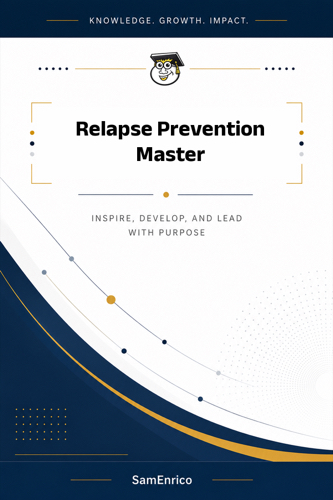
Non-FictionHealth & WellnessComplete
Relapse Prevention Master eBook
Complete reference for medical and psychological r
Complete reference for medical and psychological relapse prevention.
Formats
Free sample
Chapter 1: The Prediction Paradox--–- You are not reading this book because you are weak. You are reading it because you are smart enough to know that willpower is not enough. Let me say that again, because it matters: the fact that you have relapsed before—or that you are afraid you might relapse again—does not mean you have failed. It means you have finally understood something that most people never grasp: relapse is not an event. It is a process.
And processes can be predicted, mapped, and interrupted.This is the Prediction Paradox. The more you understand about how relapse actually works, the less power it has over you. Most people believe that relapse happens in a moment of weakness—a sudden, explosive failure of character that comes out of nowhere. They imagine a person doing fine for weeks or months, and then one night, something snaps, and they use. But that is not what the data shows.
Not even close.Decades of research, from Gorski's CENAPS model to Marlatt's cognitive-behavioral studies to the neuroscience of craving, have revealed a different truth. Relapse is a slow, predictable process that unfolds over days or weeks. It begins with small changes—subtle shifts in thinking, feeling, and behavior that seem harmless on their own. By the time the person actually uses, the decision was made long ago. The physical act of using is just the final step in a chain that started perhaps two weeks earlier.That is good news.
Because if relapse is predictable, it is preventable.This book is about becoming a master of that prediction. Not through fear, not through rigid control, but through understanding. You will learn the architecture of your own recovery. You will learn to see the warning signs that appear long before a crisis. You will build skills that work with your brain, not against it.
And you will learn a truth that the recovery world often forgets: you are not broken. You are learning.The Myth of the Sudden Relapse Let us start by dismantling the most dangerous myth in addiction recovery: the idea that relapse is a sudden, unpredictable event.If you ask a hundred people who have relapsed what happened, most will say something like, "I don't know. It just happened. I was doing fine, and then..." But when researchers actually track relapse in real time—using daily diaries, smartphone check-ins, and ecological momentary assessment—a different picture emerges. Relapse is almost never sudden.
It is the end of a process that the person themselves could have seen, if they knew what to look for.Terence Gorski, who developed the CENAPS model of relapse prevention, was one of the first to describe this process in detail. He identified three distinct phases of relapse: emotional, mental, and physical. The emotional phase comes first, often weeks before any substance use. During this phase, the person is not thinking about using at all. Instead, they are experiencing difficult emotions: anxiety, irritability, boredom, loneliness, or resentment.
They might be sleeping poorly. They might be isolating from supportive people. They might be skipping meetings or therapy sessions. They do not feel like they are in danger. They just feel...
off.Then comes the mental phase. Now the person starts thinking about using. Not necessarily craving—just thinking. Memories of use come back. The person might romanticize the past, remembering the good times while forgetting the consequences.
They might start planning, just hypothetically, how they would use if they ever did. They might test themselves, thinking, "I could probably handle one." This phase can last days or weeks. The person is now in genuine danger, but they often do not realize it because they are not actually using.Finally, the physical phase. The person uses. And to everyone—including the person themselves—it looks like a sudden collapse.
But it was not sudden. It was the predictable end of a long process.Here is the most important insight from this research: you can interrupt the process at any point. The earlier you catch it, the easier it is. If you catch it in the emotional phase, you might just need to get some sleep or call a friend. If you catch it in the mental phase, you might need to actively challenge your thoughts or go to a meeting.
But if you wait until the physical phase, you are relying on willpower at the exact moment when willpower is weakest.This book will teach you to catch it early. That is what it means to become a Relapse Prevention Master.Words Matter: A Unified Vocabulary Before we go any further, we need to be precise about our language. In the recovery world, people use words like "slip," "relapse," "lapse," and "fall" interchangeably. That creates confusion. It also creates shame.
If every mistake is called a relapse, then every mistake feels like starting over from zero. That is not true, and it is not helpful.Throughout this book, we will use a unified vocabulary. These definitions are drawn from the clinical literature and are designed to reduce shame while increasing precision.Lapse (also called a slip): A single episode of substance use lasting less than twenty-four hours, followed by a return to recovery efforts. A lapse is a mistake. It is not a relapse.
If you use once, stop, and come back to your recovery plan the next day, you have had a lapse. You have not lost everything. You have not returned to square one. You have made a mistake, and mistakes are data.Relapse: A return to a pattern of dysfunctional use lasting seven days or more. A relapse represents a genuine breakdown of recovery skills.
It is not a moral failure, but it is a signal that something in your recovery plan needs to change. If you use for a week straight, you are no longer in a lapse. You are in a relapse. The distinction matters because the interventions are different.Collapse: Complete physical, psychological, or social breakdown requiring acute intervention. This is an overdose, a psychotic episode, a hospitalization, or a complete loss of housing or relationships.
Collapse is what happens when relapse goes untreated. It is the crisis point.Why does this distinction matter? Because shame thrives on ambiguity. When you do not have clear language, your brain will default to the worst possible interpretation. A single use feels like a complete failure.
That feeling of failure triggers the Abstinence Violation Effect (which we will cover in depth in Chapter 8), which then leads to more use. The spiral begins.But if you have clear language, you can interrupt that spiral. You can say, "That was a lapse. It lasted three hours. I am not starting over.
I am continuing from right here." That is not denial. That is accuracy. And accuracy is the foundation of mastery.Throughout this book, when we talk about early warning signs, we will be focusing on the emotional and mental phases—the period before a lapse or relapse occurs. When we talk about crisis management in Chapter 8, we will focus on the first twenty-four hours after a lapse. When we talk about post-relapse learning in Chapter 12…
This is the end of the free sample. Get the eBook to keep going. Buy now
About this book
Details
- Author
- Ledbetter Gussie
- Publisher
- SamEnrico
- Language
- English
- Genre
- Non-Fiction, Health & Wellness, Complete
- Released
- 2026-06-08
- Pages (approx.)
- 154
- Available as
- eBook, Audiobook

Read better in the ZLOADR app
Your eBooks on your phone or tablet. Sign in with your SamEnrico account and start reading.
More by Ledbetter Gussie
 Anki For Language MaintenanceLedbetter Gussie$11.99
 Spin Low Impact RideLedbetter Gussie$11.99
 The Mindfulness Sobriety GuideLedbetter Gussie$11.99
 The Divorce Financial StressLedbetter Gussie$11.99
 Voice Picking Warehouse TechLedbetter Gussie$11.99
 Six Sigma Creative ThinkingLedbetter Gussie$11.99
 Distraction Management for SalesLedbetter Gussie$11.99
 Whispers in the Static: The Last Broadcast of KBFSLedbetter Gussie$11.99
 The Sky Wolves of Khalkhin-Gol: Stalin's Secret Aerial BlitzLedbetter Gussie$11.99
 10 Ways to Use Anise (Recipe Book)Ledbetter Gussie$11.99
 The Essential Guide to J-punkLedbetter Gussie$11.99
 South Africa Business Credit Collection Recovery GuideLedbetter Gussie$12.99
You may also like
 Hong Kong Handover 1997Dunn Johnnie$11.99
 Zumba For Postnatal Recovery CourseNeal Christian$11.99
 Zumba for BeginnersLadner Nikia$11.99
 YouTube Comment Mining GuideHumes Pandora$12.99
 Worry Box MeditationCarlin Rudy$11.99
 Workplace Stress MeditationNguyen Lynn$11.99
 Workplace Stress and Sleep RepairHawley Ivory$11.99
 Workplace Perfectionism CureDelaney Jeffry$11.99
 Workplace Injustice Anger GuideWallen Isabelle$11.99
 Work Addiction and Burnout LinkGreenwood Ester$11.99
 Women in Yoga and WellnessBeattie Galina$11.99
 Women in Stand Up ComedyChun Evangeline$11.99