
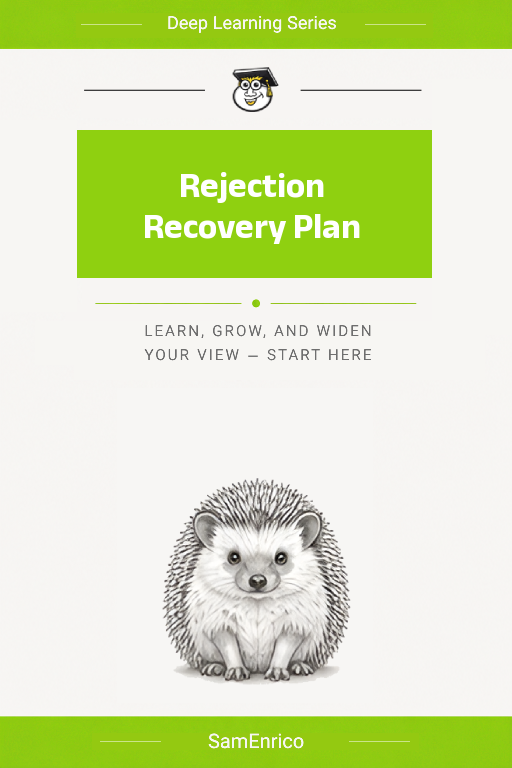
Non-FictionProfessional's Cheat SheetRejection
Rejection Recovery Plan eBook
Handle promotion rejection professionally and buil
Handle promotion rejection professionally and build stronger case for next cycle.
Formats
Free sample
Chapter 1: The Phantom Punch--You are not weak because it hurts.Let me say that again, because your brain is about to tell you the opposite. You are not weak because a promotion rejection feels like a physical assault. You are not fragile because you cannot "just shake it off." And you are not broken because three days later, you are still replaying the conversation in your head at 2 a.m., finding new ways you should have argued your case, new data points you should have mentioned, new evidence that would have surely changed their minds.You are human. And your humanity is not a design flaw. It is the starting point of recovery.Here is what is actually happening inside your skull right now.
Neuroscientists have placed people inside f MRI machines and watched their brains respond to social rejection—being left out of a virtual ball-tossing game, being told no one wanted to work with them, being passed over for a hypothetical promotion. The same neural regions that light up when you stub your toe or burn your hand—the anterior cingulate cortex, the dorsal anterior cingulate, the anterior insula—blaze with activity during rejection. Your brain literally cannot tell the difference between a broken bone and a broken promise.This is not a metaphor. This is biology.The anterior cingulate cortex, in particular, is an ancient piece of your neural architecture. It evolved to detect discrepancies between expectation and reality.
You expected the promotion. Reality delivered a "not this time." That mismatch triggers an alarm system designed to keep you safe from predators and outcasts. In evolutionary terms, being rejected by your tribe meant death. No shelter. No shared food.
No protection from the saber-toothed cat. Your brain still operates on that operating system, even though you are sitting in a climate-controlled office staring at a politely worded email.So when your manager says, "It was a very close call," and your chest tightens, your throat constricts, and you feel the hot shame rising up your neck—that is not a character flaw. That is your limbic system doing exactly what it evolved to do. The problem is not the feeling. The problem is what you do with it in the next 72 hours.Most people make the same disastrous mistake.
They fight the feeling. They tell themselves to be professional. They paste on a smile, say "I understand," and walk back to their desk where they proceed to spiral in silence. They send passive-aggressive emails. They withdraw from collaboration.
They stop volunteering for projects. They update their resume in a fury, apply to three competitors, and then lose momentum when the anger fades. Or worse, they do nothing. They swallow the rejection like a stone and carry it around for months, growing heavier, until it calcifies into cynicism.This book exists because there is a better way. Not the toxic positivity way—"Just be grateful you have a job!"—which ignores biology and insults your intelligence.
Not the revenge way—"I'll show them!"—which burns energy on resentment rather than results. And not the denial way—"It didn't matter anyway"—which robs you of the very feedback you need to grow.The better way is systematic. It is forensic. It is strategic. And it begins with a radical acceptance of exactly where you are right now: hurting, confused, and probably a little angry.
Good. That hurt is data. That confusion is a question. That anger is fuel. You are going to use all of it.But first, you have to survive the next 24 hours without doing permanent damage to your career.
This chapter is your emergency room. It will not fix the rejection. It will not hand you a strategy for the next promotion cycle. That comes later. Right now, your only job is to contain the blast, protect your professional relationships, and reset your nervous system so that you can think clearly tomorrow.
Everything else can wait.The Three Lies Your Brain Is Telling You Right Now In the hours following a rejection, your brain will feed you a series of distorted, catastrophic conclusions. These are not truths. They are neurological artifacts. And you need to name them before you can defuse them.Lie Number One: This is permanent."I will never get promoted." "My career is stalled forever." "This company will never see my potential."This is your brain collapsing time. Rejection feels permanent because your brain processes social pain as a survival threat, and survival threats are, by definition, urgent and enduring.
But promotion cycles repeat. Companies have quarterly reviews, annual cycles, and off-cycle exceptions. The person who got the role this time may leave in six months. A new budget may open. A reorganization may create a new position with your name on it.Write this down: "This is one decision in one quarter of one year of a multi-decade career."Read it again.
The rejection is a moment. It is not a life sentence.Lie Number Two: This is pervasive."Everything is wrong." "I am failing at everything." "If I lost this, I must be bad at my whole job."This is your brain generalizing from a single data point. You were rejected for one role. That role may have had fifty candidates. The decision may have come down to a single competency you have not yet developed—or a piece of corporate politics you could not have controlled.
Meanwhile, there are likely three, five, or ten areas where you are performing at or above expectations.Write down three things you are still good at today. Not last year. Today. They can be small. "I meet my deadlines." "My team trusts me." "I solved a problem for a client yesterday." Do not argue with the list.
Just write it.Lie Number Three: This is personal."I am a failure." "I am not good enough." "They don't like me."This is your brain confusing outcomes with identity. The promotion decision involved multiple variables: your performance, the other candidates' performance, budget availability, headcount approval, the manager's political capital, the timing of the fiscal year, the strategic priorities of the quarter, and sometimes pure randomness. Unless you have access to the full decision matrix—and you do not—you cannot know what percentage of the outcome was actually about you.Ask yourself this question: "What percentage of this decision was truly within my control?" You will likely find that a significant portion was not. That is not an excuse to avoid accountability. It is an invitation to stop carrying blame that was never yours to carry.The 24-Hour Pity Party Protocol You cannot skip the pain.
Anyone who tells you to "just move on" has either never experienced real rejection or has forgotten what it feels like. But you can contain the pain. You can build a fence around it and say, "You get 24 hours. Then you leave."Here is the protocol. Follow it exactly.Hours 0–6: Full permission.Go somewhere private.
Your car. A walk-in closet. An empty conference room. Set a timer for six hours. During this window, you are allowed to do anything that does not permanently damage your career or relationships.You can cry.…
This is the end of the free sample. Get the eBook to keep going. Buy now
About this book
Details
- Author
- Dehart Tameka
- Publisher
- SamEnrico
- Language
- English
- Genre
- Non-Fiction, Professional's Cheat Sheet, Rejection
- Released
- 2026-06-01
- Pages (approx.)
- 146
- Available as
- eBook, Audiobook

Read better in the ZLOADR app
Your eBooks on your phone or tablet. Sign in with your SamEnrico account and start reading.
More by Dehart Tameka
 Sleep Meditation WorkbookDehart Tameka$11.99
 The Caregiver Medication Management GuideDehart Tameka$11.99
 Perimenopause Fertility GuideDehart Tameka$11.99
 The Canadian Arctic TraverseDehart Tameka$11.99
 Veterinary Surgeon Stress GuideDehart Tameka$11.99
 The Quantum Leap That Changed Everything: How Bell Labs’ 1989 Breakthrough Rewrote RealityDehart Tameka$11.99
 The Last Stand of the Spartan QueenDehart Tameka$11.99
 Understanding Fingerprints Absence Syndactyly MiliaDehart Tameka$17.99
 Tax InternDehart Tameka$11.99
 US LLC Operating GuideDehart Tameka$12.99
You may also like
 Hong Kong Handover 1997Dunn Johnnie$11.99
 Zumba For Postnatal Recovery CourseNeal Christian$11.99
 Zumba for BeginnersLadner Nikia$11.99
 YouTube Comment Mining GuideHumes Pandora$12.99
 Worry Box MeditationCarlin Rudy$11.99
 Workplace Stress MeditationNguyen Lynn$11.99
 Workplace Stress and Sleep RepairHawley Ivory$11.99
 Workplace Perfectionism CureDelaney Jeffry$11.99
 Workplace Injustice Anger GuideWallen Isabelle$11.99
 Work Addiction and Burnout LinkGreenwood Ester$11.99
 Women in Yoga and WellnessBeattie Galina$11.99
 Women in Stand Up ComedyChun Evangeline$11.99