
Non-FictionBusiness BriefCorporate Actions
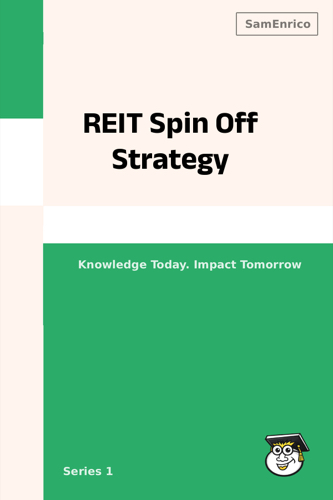
REIT Spin Off Strategy
Teaches investing in REITs created from corporate
Teaches investing in REITs created from corporate real estate spin offs.
Formats
About this book
Free sample
Chapter 1: The Unseen Asset--–- Most investors spend their entire careers looking at the wrong side of the balance sheet.They obsess over earnings per share, revenue growth, and quarterly beats. They study price-to-earnings ratios and analyst upgrades. They chase the next hot stock tip from a cable television pundit. And in doing so, they completely miss one of the most predictable, repeatable, and historically profitable opportunities in public markets: the corporate real estate spin-off.This book is not about buying REITs generally. It is not about diversifying across apartment complexes, office buildings, or healthcare facilities.
It is about a very specific, niche strategy that has produced some of the most extraordinary returns of the past decade for those who understand it. It is about identifying when a non-real estate company—a retailer, a restaurant chain, a casino operator, a telecommunications giant—quietly separates its property assets into a new, standalone REIT, and then profiting from the chaos, confusion, and mispricing that inevitably follows.Before we dive into mechanics, valuation, and case studies, we must first understand the fundamental question that drives this entire strategy: Why would any company willingly give away its real estate?The answer reveals everything about how Wall Street thinks, how corporate executives are compensated, and where the smart money positions itself before the crowd catches on.The Asset That Wall Street Punishes Imagine you own a successful regional grocery chain. You have fifty locations, all in prime real estate. Your stores are profitable. Your brand is respected.
And your balance sheet shows that you own every single piece of land and every single building outright.To a traditional investor, this sounds wonderful. You own your assets free and clear. You have no landlord to answer to. You have built equity over decades.But to Wall Street analysts, your real estate ownership is not a strength. It is a problem.Here is why.
Wall Street values companies based on their ability to generate returns on invested capital. If you own a grocery chain with $500 million in real estate assets that generate $50 million in operating…
This is the end of the free sample. Get the eBook to keep going. Buy now
Contents
- Chapter 1
- Chapter 2
- Chapter 3
- Chapter 4
- Chapter 5
- Chapter 6
- Chapter 7
- Chapter 8
- Chapter 9
- Chapter 10
- Chapter 11
- Chapter 12
Details
- Author
- Mccaskill Lacie
- Publisher
- SamEnrico
- Language
- English
- Genre
- Non-Fiction, Business Brief, Corporate Actions
- Released
- 2026-06-06
- Pages (approx.)
- 135
- Available as
- eBook, Audiobook

Read better in the ZLOADR app
Your eBooks on your phone or tablet. Sign in with your SamEnrico account and start reading.
More by Mccaskill Lacie
 Waking Hypnosis Trance GuideMccaskill Lacie$11.99
 The Empathy and BurnoutMccaskill Lacie$11.99
 Creative Imagery GuideMccaskill Lacie$11.99
 Suicide Warning Signs MenMccaskill Lacie$11.99
 Bedtime Routine SuggestionMccaskill Lacie$11.99
 Parental Anxiety Management GuideMccaskill Lacie$11.99
 ED Natural Supplements GuideMccaskill Lacie$11.99
 Laughing Through the Revolution: Egypt's Sitcom PioneersMccaskill Lacie$11.99
 Falklands 1982: The Frozen War That Defined a DecadeMccaskill Lacie$11.99
 How to Start a Film Producer (own Account) Business (Beginners Guide)Mccaskill Lacie$11.99
 How to Produce Roaches (Control Products)Mccaskill Lacie$11.99
 A Collector's Handbook to the Alvis 12Mccaskill Lacie$11.99
You may also like
 Hong Kong Handover 1997Dunn Johnnie$11.99
 Zumba For Postnatal Recovery CourseNeal Christian$11.99
 Zumba for BeginnersLadner Nikia$11.99
 YouTube Comment Mining GuideHumes Pandora$12.99
 Worry Box MeditationCarlin Rudy$11.99
 Workplace Stress MeditationNguyen Lynn$11.99
 Workplace Stress and Sleep RepairHawley Ivory$11.99
 Workplace Perfectionism CureDelaney Jeffry$11.99
 Workplace Injustice Anger GuideWallen Isabelle$11.99
 Work Addiction and Burnout LinkGreenwood Ester$11.99
 Women in Yoga and WellnessBeattie Galina$11.99
 Women in Stand Up ComedyChun Evangeline$11.99