
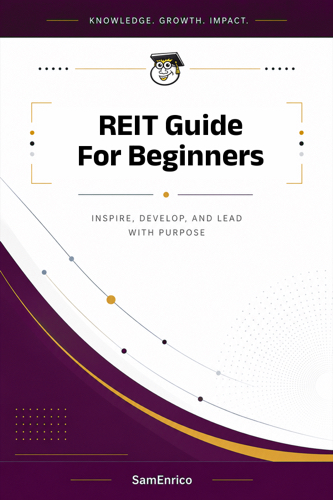
Non-FictionBusiness BriefInvesting 101
REIT Guide For Beginners eBook
Complete starter guide to public REIT investing fo
Complete starter guide to public REIT investing for newcomers.
Formats
Free sample
Chapter 1: The Hidden Bargain--–- Every year, millions of Americans write a check to their landlord. That check pays for someone else’s mortgage, someone else’s property taxes, someone else’s future wealth. The tenant wakes up thirty years later with nothing but memories. The landlord wakes up with a paid-off building worth millions. This is not fair, but it is the system.
And for most of the twentieth century, that system was locked tight. If you wanted to own commercial real estate—the skyscrapers, shopping centers, warehouses, and apartment complexes that generate the country’s wealth—you needed to be rich. Not just comfortable. Not just upper-middle-class. Truly, institutional-level rich.
You needed millions for a down payment, decades of banking relationships, and the legal team to structure the deal. The average person was shut out.Then came 1960, and with it, one of the most overlooked pieces of legislation in American financial history. Tucked inside an obscure tax bill called the Cigar Excise Tax Extension was a provision that would quietly democratize real estate ownership. That provision created the Real Estate Investment Trust, or REIT. It was not announced with a presidential signing ceremony.
It did not make the front page of most newspapers. But for anyone who has ever rented an apartment, worked in an office building, or shopped at a mall, the REIT changed everything. It took the closed world of commercial real estate and cracked the door open wide enough for a schoolteacher in Ohio, a nurse in Texas, or a mechanic in Michigan to walk through with as little as fifty dollars.This chapter tells the story of that door: how it came to exist, why almost no one knows about it, and why understanding this history is the first step toward becoming a passive landlord. The history of REITs is not a dry academic exercise. It is the origin story of a legal hack that allows you to collect rent checks from some of the largest properties in America without ever fixing a leaky faucet or evicting a late-paying tenant.
By the end of this chapter, you will understand not just what a REIT is, but why the 90 percent rule—the obscure legal requirement that forces REITs to pay out almost all their income—is the single most important feature of this investment vehicle. And you will see why the REIT industry, after six decades of evolution, is perfectly positioned for the next generation of income-seeking investors.The World Before REITs: Real Estate as a Rich Person's Game To appreciate the revolution that REITs represent, you have to understand how real estate investing worked before 1960. The answer is simple: it did not work for ordinary people. Commercial real estate—office buildings, shopping centers, industrial warehouses, apartment complexes with more than a handful of units—was the domain of wealthy families, insurance companies, pension funds, and a small network of private developers. The barriers to entry were not accidental.
They were structural.First, there was the capital requirement. A typical commercial property in the 1950s cost hundreds of thousands of dollars—the equivalent of millions today. Even with a mortgage requiring 30 or 40 percent down, an investor needed a sum that dwarfed the life savings of most Americans. Second, there was the liability. Owning real estate directly meant unlimited personal exposure.
If a tenant slipped on an icy sidewalk and won a lawsuit, the owner’s personal assets were at risk. Third, there was the expertise. Commercial real estate required negotiating leases, managing maintenance, handling property taxes, and navigating zoning laws. It was a job, not a passive investment.The few attempts to pool money from small investors were riddled with fraud and mismanagement. In the 1920s, real estate investment trusts existed in a primitive form, but they were largely unregulated.
Many collapsed during the Great Depression after promoters pocketed investor money and left them with worthless shares. By the 1950s, the memory of those failures was still fresh. The Securities and Exchange Commission viewed pooled real estate investments with deep suspicion. If you were not already rich, the message was clear: real estate was not for you.This exclusion mattered because real estate has historically been one of the most reliable wealth-building assets. It produces current income through rent.
It appreciates over time, often keeping pace with or exceeding inflation. And it has a low correlation with stocks and bonds, meaning that when the stock market crashes, your apartment building does not go bankrupt (though its value may temporarily fall). The wealthy understood this. They parked money in prime office towers and regional shopping malls, collecting rent checks while their tenants—lawyers, doctors, small business owners—did the work of paying down the mortgage. The system was self-perpetuating.
Wealth bought real estate, and real estate produced more wealth.The Accidental Revolution: How the Cigar Excise Tax Created the REITThe Real Estate Investment Trust was not born from a grand economic theory or a populist movement. It emerged from a tax fight over cigars. In 1960, Congress was considering a routine piece of legislation called the Cigar Excise Tax Extension. The bill did exactly what its name suggested: it extended existing taxes on cigars and other tobacco products. But a creative group of tax lawyers and real estate executives saw an opportunity.
For years, they had been pushing for legislation that would allow small investors to pool money for commercial real estate, similar to how mutual funds allowed small investors to pool money for stocks. Their previous attempts had gone nowhere. The cigar bill was their opening.The lobbyists drafted a provision that would create a new legal entity: the Real Estate Investment Trust. Under the proposal, a REIT would be treated like a mutual fund for real estate. If it distributed at least 90 percent of its taxable income to shareholders, it would pay no corporate income tax.
The tax would instead flow through to the shareholders, who would pay at their individual rates. This was the same treatment that mutual funds already enjoyed. The lobbyists argued that real estate deserved equal footing.The provision passed. On September 14, 1960, President Dwight D. Eisenhower signed the Cigar Excise Tax Extension into law.
Tucked inside was Public Law 86-779, the Real Estate Investment Trust Act of 1960. The birth of a multi-trillion-dollar industry was a footnote to a tobacco tax bill.The REIT structure was deliberately modeled on the mutual fund. The idea was that small investors could pool their money, hire professional managers to buy and operate real estate, and receive a pro-rata share of the income. The REIT itself would be a passive vehicle—it could not operate hotels or run its own development companies. It was designed to own real estate, collect rent, and distribute that rent to shareholders.
The tax exemption was the carrot. The 90 percent distribution rule was the stick. If a REIT wanted to avoid corporate tax, it had to send almost every dollar of income back to its shareholders.The 90 Percent Rule: The Engine of High Dividends The 90 percent rule is the single most important feature of REIT investing, and it is worth pausing to understand it completely. Most corporations pay corporate…
This is the end of the free sample. Get the eBook to keep going. Buy now
About this book
Details
- Author
- Barnhart Nickole
- Publisher
- SamEnrico
- Language
- English
- Genre
- Non-Fiction, Business Brief, Investing 101
- Released
- 2026-06-05
- Pages (approx.)
- 135
- Available as
- eBook, Audiobook

Read better in the ZLOADR app
Your eBooks on your phone or tablet. Sign in with your SamEnrico account and start reading.
More by Barnhart Nickole
 Parental Stress And DivorceBarnhart Nickole$11.99
 Fear Of Earthquakes GuideBarnhart Nickole$11.99
 Leftovers Transformation GuideBarnhart Nickole$11.99Leftovers Transformation GuideBarnhart Nickole$11.99
 Validation for Eating DisordersBarnhart Nickole$11.99
 The Flow State ProtectorBarnhart Nickole$11.99
 Gym Consistency TriggerBarnhart Nickole$11.99
 Naturopathy Master GuideBarnhart Nickole$11.99
 The Goryeo Gambit: How a Korean Dynasty Almost Defeated the MongolsBarnhart Nickole$11.99
 Iron and Steam: The Titans of the Industrial RevolutionBarnhart Nickole$11.99
 How to Produce Rolling PIN AccessoriesBarnhart Nickole$11.99
 Pinterest VA Account Audit ServiceBarnhart Nickole$12.99
You may also like
 Hong Kong Handover 1997Dunn Johnnie$11.99
 Zumba For Postnatal Recovery CourseNeal Christian$11.99
 Zumba for BeginnersLadner Nikia$11.99
 YouTube Comment Mining GuideHumes Pandora$12.99
 Worry Box MeditationCarlin Rudy$11.99
 Workplace Stress MeditationNguyen Lynn$11.99
 Workplace Stress and Sleep RepairHawley Ivory$11.99
 Workplace Perfectionism CureDelaney Jeffry$11.99
 Workplace Injustice Anger GuideWallen Isabelle$11.99
 Work Addiction and Burnout LinkGreenwood Ester$11.99
 Women in Yoga and WellnessBeattie Galina$11.99
 Women in Stand Up ComedyChun Evangeline$11.99