
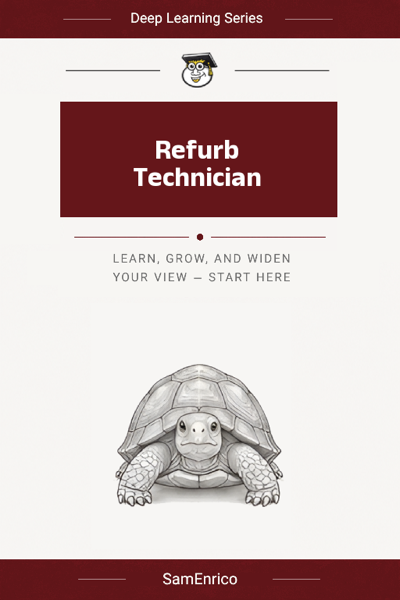
Non-FictionInformativeEducational
Refurb Technician eBook
A Coursebook on Refurb Technician
by Wilke Adam
A Coursebook on Refurb Technician
Formats
Free sample
Chapter 1: The Circular Imperative--The device in your hands has a story. Before it arrived on your bench—cracked screen, sticky power button, a battery that swells like a wounded animal—it traveled thousands of miles, consumed precious resources, and embodied the labor of hundreds of workers across three continents. That story is not yet over. As a refurb technician, you are not merely fixing a broken gadget. You are intervening in one of the most pressing environmental and economic crises of our time.
You are extending the life of a product that was designed, often deliberately, to die.This chapter establishes the philosophical and economic foundation for your entire career as a refurb technician. We will explore the staggering scale of global e-waste, the shift from a linear "take-make-dispose" economy to a circular model of reuse and refurbishment, the political landscape of the Right to Repair movement, and the international standards that allow a used device to be certified "as good as new." Most importantly, we will define what it truly means to be a refurb technician—a role that transcends the hobbyist tinkerer and enters the realm of professional quality gatekeeping within the circular economy.The E-Waste Crisis: A Mountain of Discarded Potential Let us begin with a number that is difficult to comprehend: 50 million metric tons. That is the approximate amount of electronic waste generated globally each year. To visualize this, imagine a line of fully loaded garbage trucks stretching bumper-to-bumper around the equator. That line would wrap the entire planet.
Every year. Of this staggering total, less than twenty percent is formally recycled. The remaining eighty percent ends in one of three places: landfills, where toxic heavy metals like lead, mercury, and cadmium leach into groundwater; incinerators, where burning plastics release dioxins into the atmosphere; or informal dismantling operations in developing countries, where workers—sometimes children—smash circuit boards over open flames to extract a few cents worth of copper, breathing in toxic fumes with every breath.The problem is accelerating. As emerging middle classes in India, Brazil, and Africa gain access to smartphones and laptops for the first time, the global installed base of electronics is exploding. Meanwhile, in developed nations, replacement cycles have shortened dramatically.
In 2010, the average American kept a smartphone for two and a half years. By 2025, that figure has dropped to eighteen months. Laptops once expected to last five years are now replaced in three. This is not because the devices are failing faster in any physical sense. It is because they are being designed to be replaced, not repaired.Every single device that crosses your refurbishment bench represents a victory against this tide.
When you restore a laptop to working order, you prevent the extraction of approximately three hundred kilograms of CO₂ equivalent that would have been emitted manufacturing a new one. When you refurbish a smartphone, you save roughly eighty kilograms. These are not abstract environmental figures. They are real, quantifiable reductions that corporate sustainability departments track on their balance sheets, that carbon credit markets trade, and that government regulators are beginning to mandate. The refurb technician sits at the exact intersection where environmentalism meets commerce—where doing the right thing for the planet also happens to be profitable.The Linear Economy Versus the Circular Economy To understand your role, you must first understand the system you are disrupting.
The dominant economic model for the past century has been linear: take, make, use, dispose. Raw materials are extracted from the earth, manufactured into products, shipped across oceans, sold to consumers, used for a brief period, and then discarded. In a linear economy, value is created only at the point of sale. Once the product leaves the store, it begins a long, inevitable decline toward the landfill. The manufacturer has no financial incentive to make that product repairable or durable.
In fact, the opposite is true. A product that lasts ten years generates one sale. A product that lasts two years generates five sales. Planned obsolescence is not a conspiracy theory—it is a documented business strategy.The circular economy offers a radical alternative. In this model, waste is designed out of the system.
Products are kept in use for as long as possible through repair, refurbishment, and remanufacturing. At the end of their useful life, materials are recycled back into new products, closing the loop. The circular economy has seven levels of value retention, often visualized as a ladder. At the bottom is recycling—breaking down a product into raw materials, which is energy-intensive and loses value at every step. Above recycling are remanufacturing (rebuilding a product to original specifications) and repurposing (turning an old product into something new, like a laptop converted into a digital photo frame).
Above those, and where you operate, are repair and refurbishment.What is the difference? Repair fixes a specific fault while leaving the rest of the device untouched. A cracked screen is replaced; the rest of the phone remains as it was. Refurbishment is more comprehensive. A refurbished device is taken apart, cleaned, tested, and any worn components—batteries, fans, thermal paste, connectors—are replaced whether they have failed yet or not.
The device is then tested against a standard and certified as "qualified as good as new." This distinction is critical. A repaired device may still have hidden degradation. A refurbished device has been proactively renewed.The Right to Repair Movement: A Political Awakening For decades, manufacturers have erected barriers to repair, and for decades, consumers have accepted them passively. That era is ending. The Right to Repair movement, which began in the early 2000s among agricultural equipment owners who were legally prohibited from fixing their own tractors, has expanded to cover every category of electronics.
The core demand is simple: if you own a device, you should have the right to repair it yourself or take it to an independent technician of your choice, without being forced to use the manufacturer's authorized service network.Manufacturers have fought this demand with three primary tactics. The first is parts pairing. When you replace a screen on a modern smartphone, the device checks the serial number of the new screen against a database stored on the manufacturer's servers. If the serial number does not match the one that shipped with the phone—even if the new screen is an identical, genuine part—the phone disables features. The fingerprint reader stops working.
True Tone display calibration fails. The user sees a pop-up warning that the screen is "non-genuine," even when it is. There is no technical reason for this. It is a software lock designed to force consumers into authorized repair centers that charge three times the independent rate.The second tactic is software locks at the firmware level. Many laptop batteries now contain a small chip that tracks cycle count and logs whether the battery has ever been opened.
If the chip detects that the battery has been disconnected from the original motherboard, it permanently locks itself, rendering a perfectly functional battery useless. The same technology exists for ink cartridges, coffee machines, and even tractor engine control units. The third tactic is restrictive repair documentation. Manufacturers make service manuals, schematics, and diagnostic software available…
This is the end of the free sample. Get the eBook to keep going. Buy now
About this book
Details
- Author
- Wilke Adam
- Publisher
- SamEnrico
- Language
- English
- Genre
- Non-Fiction, Informative, Educational
- Released
- 2026-06-02
- Pages (approx.)
- 127
- Available as
- eBook, Audiobook

Read better in the ZLOADR app
Your eBooks on your phone or tablet. Sign in with your SamEnrico account and start reading.
More by Wilke Adam
 HGH and Nail HealthWilke Adam$11.99
 Parent of Autistic Child GuideWilke Adam$11.99
 The Mobile Game Addiction FixWilke Adam$11.99
 The Parent Trigger IdentificationWilke Adam$11.99
 AI Video Editing Keyboard ShortcutsWilke Adam$11.99
 The Last Broadcast: The Mystery of Orson Welles' War of the WorldsWilke Adam$11.99
 Vasco da Gama and the Spice Route Revolution: A Voyage That Changed the WorldWilke Adam$11.99
 Proof Of Funds For StudentsWilke Adam$12.99
 Automated Financial Close HandbookWilke Adam$12.99
 How to Start a Rubber (vulcanized, Unvulcanized or Hardened) Business (Beginners Guide)Wilke Adam$11.99
 Understanding Buerger's DiseaseWilke Adam$17.99
You may also like
 Hong Kong Handover 1997Dunn Johnnie$11.99
 Zumba For Postnatal Recovery CourseNeal Christian$11.99
 Zumba for BeginnersLadner Nikia$11.99
 YouTube Comment Mining GuideHumes Pandora$12.99
 Worry Box MeditationCarlin Rudy$11.99
 Workplace Stress MeditationNguyen Lynn$11.99
 Workplace Stress and Sleep RepairHawley Ivory$11.99
 Workplace Perfectionism CureDelaney Jeffry$11.99
 Workplace Injustice Anger GuideWallen Isabelle$11.99
 Work Addiction and Burnout LinkGreenwood Ester$11.99
 Women in Yoga and WellnessBeattie Galina$11.99
 Women in Stand Up ComedyChun Evangeline$11.99