
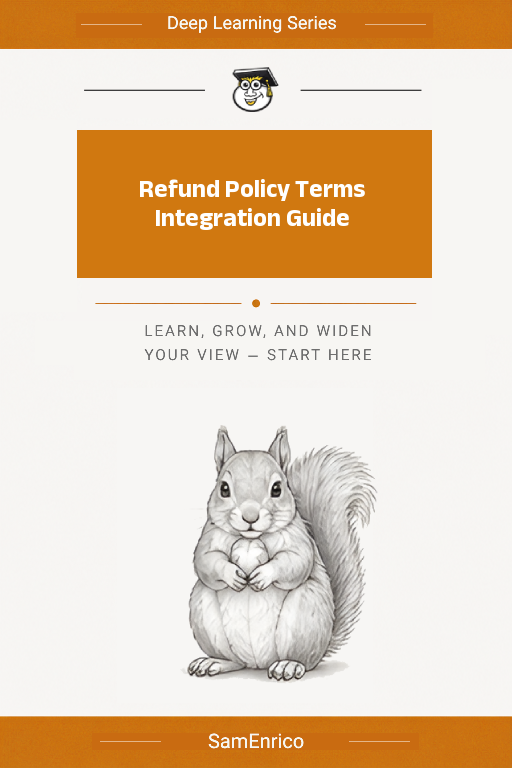
Non-FictionFirst 30 DaysReturns
Refund Policy Terms Integration Guide eBook
Embed clear refund, return, and exchange policies
by Moon Cherise
Embed clear refund, return, and exchange policies within your Terms of Service. Match your actual business practices.
Formats
Free sample
Chapter 1: The Golden Rule--Every refund policy is a promise. And every broken promise costs you more than money.The founder of a high-end bicycle company learned this lesson the hard way. He had built a loyal following around custom-built road bikes, each one priced at an average of $4,200. His Terms of Service, drafted by a competent but generic legal service, stated a standard "30-day return window for unused products in original packaging." That seemed reasonable. That seemed standard.
That seemed safe.Then a customer called on day 45.The bike had a manufacturing defect in the derailleur—a small but critical component that shifts gears. The customer lived in a rural area without a local bike shop. He had waited two weeks for a friend to help him unbox and assemble the bike. By the time he discovered the defect, the 30-day window had expired.The founder checked his TOS. The policy gave him every legal right to deny the refund.
The window was clear. The packaging had been opened. Under the strict letter of the policy, this customer was out of luck.But the founder also checked his warehouse. His operations team, as a matter of practice, had been accepting returns for up to 60 days for "quality issues" because "that's what felt fair." No one had updated the TOS to reflect this reality. The warehouse team had been operating under one rule; the legal document said another; the customer experienced confusion and frustration.The founder denied the refund based on the TOS.
The customer left a one-star review on Google, then a second on Trustpilot, then a third on a cycling forum with 50,000 active members. Within three months, the founder estimated he had lost over $200,000 in future sales from forum members who saw the review and bought elsewhere.The policy was legally correct. It was also a business disaster.This chapter establishes the single most important principle in this entire book, a principle that every subsequent chapter will reference but never need to re-explain. It is simple enough to write on a sticky note and profound enough to save your business from the fate of the bicycle founder. Here it is: Match your written policy to your operational reality.
Nothing more. Nothing less.Call it the Golden Rule of Refunds. Your Terms of Service must describe exactly what your warehouse, your customer service team, and your finance department actually do—not what a lawyer copied from a template, not what a competitor claims to offer, and certainly not what you wish were true.The rest of this chapter will give you the tools to apply this Golden Rule to your specific business. You will learn the Four Corners framework for categorizing your operations. You will run the Litmus Test, a five-minute exercise that exposes every gap between your policy and your reality.
And you will understand what makes a policy clause truly "integrated"—a word that appears throughout this book and now receives its full definition.By the end of this chapter, you will never look at a refund policy the same way again.The Copy-Paste Trap Revisited Before we build something new, we must understand what breaks the old approach.The bicycle founder fell into what this book calls the Copy-Paste Trap. He did not write his refund policy. He did not adapt a template to his specific operations. He paid a lawyer who pulled a standard clause from a database of "ecommerce Terms of Service" and inserted his company name. The clause was legally sound.
It was also completely detached from how his warehouse actually worked.The Copy-Paste Trap has three predictable consequences, each one worse than the last.First, it creates customer confusion. When your TOS promises one thing and your customer service team does another, customers receive inconsistent messages. The customer who reads "30-day returns" on your website but hears "we can extend to 60 days" from a support agent learns that your policies are unreliable. Reliability is the foundation of trust. Unreliable policies destroy trust faster than any other business practice.Second, it enables friendly fraud.
Vague language is an invitation to abuse. When your policy says "reasonable time" without defining what that means, a determined customer will argue that 90 days is reasonable. When your policy says "like new condition" without specifying whether tags must be attached, a serial returner will interpret that to mean "worn once is fine." Every ambiguous phrase in your TOS is a loophole that someone will exploit. The bicycle founder's policy said "original packaging" but did not define whether that meant the factory box, the plastic wrapping, or simply a cardboard box of similar size. Customers argued all three interpretations.Third, it increases support tickets.
The most expensive customer service interaction is the one that requires a manager escalation. When your frontline agents cannot answer a refund question from the TOS alone, they must ask a supervisor. The supervisor may have to ask legal or operations. The customer waits. The ticket sits.
The cost multiplies. In the bicycle founder's case, his support team spent an average of twenty-two minutes on every refund inquiry because the TOS was so disconnected from warehouse reality that agents could not give confident answers.The solution to all three problems is the Golden Rule. Match your text to your truth. Write only what you actually do.The Four Corners Framework Before you write a single word of your refund policy, you must understand your business in four dimensions. The Four Corners framework provides a systematic way to categorize your operations so that your policy reflects reality from the very first draft.Corner One: What You Sell The nature of your product determines the fundamental shape of your refund policy.
The chapter breaks products into four categories, though many businesses will straddle multiple categories and need hybrid policies.Physical goods are tangible products that ship from a warehouse to a customer. Clothing, electronics, furniture, books, and tools all fall into this category. Physical goods have the advantage of being returnable—you can inspect them, restock them, or resell them as open-box items. They also have the disadvantage of shipping costs, which must be allocated either to you or to the customer. The key question for physical goods is: can you resell the returned item at full price, or must you discount it or liquidate it?Digital goods are intangible products delivered electronically.
E-books, software licenses, online courses, stock photography, and music files are all digital goods. The fundamental challenge of digital goods is that they cannot be "un-delivered." Once a customer downloads an MP3 or clicks a course link, you cannot retrieve that file from their hard drive. This asymmetry means that digital goods policies must be built around access revocation, not physical return. If you can deactivate a license or remove login credentials, you have options. If you cannot, your policy must be structured very differently.Perishable goods are products that expire or degrade.
Food, flowers, event tickets, and personalized items all fall into this category. The key constraint is time. A ticket to a concert that happened last night has zero value. A birthday cake ordered for a specific date cannot be resold the next…
This is the end of the free sample. Get the eBook to keep going. Buy now
About this book
Details
- Author
- Moon Cherise
- Publisher
- SamEnrico
- Language
- English
- Genre
- Non-Fiction, First 30 Days, Returns
- Released
- 2026-06-01
- Pages (approx.)
- 132
- Available as
- eBook, Audiobook

Read better in the ZLOADR app
Your eBooks on your phone or tablet. Sign in with your SamEnrico account and start reading.
More by Moon Cherise
 Journaling for Work AnxietyMoon Cherise$11.99
 MBSR For Grief And Loss CourseMoon Cherise$11.99
 Volcano Visualization Release GuideMoon Cherise$11.99
 The Arthur Ashkin Optical TweezersMoon Cherise$11.99
 PCOS Specialist FinderMoon Cherise$11.99
 The Levees of Denial: How New Orleans Drowned in Debt Before KatrinaMoon Cherise$11.99
 How to Start a Choppers Business (Beginners Guide)Moon Cherise$11.99
 Understanding Osteopetrosis LethalMoon Cherise$17.99
 Advanced English for Chinese LearnersMoon Cherise$12.99
 Transportation PlannerMoon Cherise$11.99
You may also like
 Hong Kong Handover 1997Dunn Johnnie$11.99
 Zumba For Postnatal Recovery CourseNeal Christian$11.99
 Zumba for BeginnersLadner Nikia$11.99
 YouTube Comment Mining GuideHumes Pandora$12.99
 Worry Box MeditationCarlin Rudy$11.99
 Workplace Stress MeditationNguyen Lynn$11.99
 Workplace Stress and Sleep RepairHawley Ivory$11.99
 Workplace Perfectionism CureDelaney Jeffry$11.99
 Workplace Injustice Anger GuideWallen Isabelle$11.99
 Work Addiction and Burnout LinkGreenwood Ester$11.99
 Women in Yoga and WellnessBeattie Galina$11.99
 Women in Stand Up ComedyChun Evangeline$11.99