
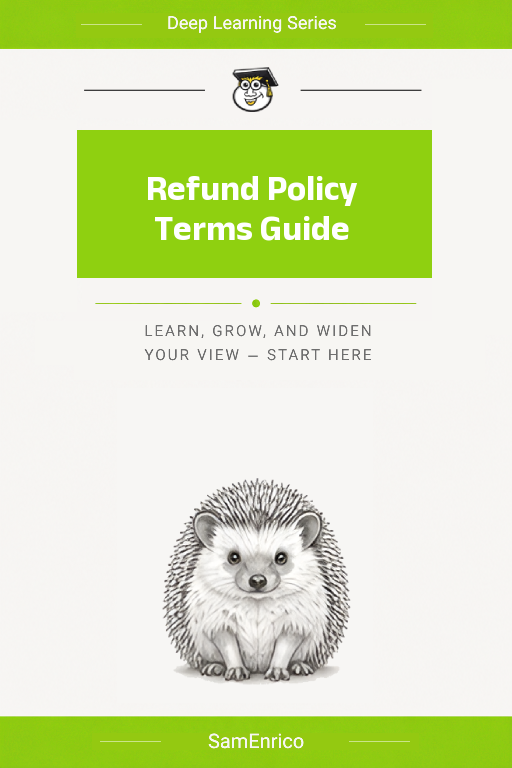
Refund Policy Terms Guide eBook
Integrate refund and return policies into your ter
by Bader Bo
Integrate refund and return policies into your terms of service with time limits, condition requirements, and restocking fees.
Formats
Free sample
Chapter 1: The Profit Paradox--When Brian, the founder of a mid-sized online apparel store, called me for advice, his voice carried the unmistakable fatigue of someone who had just lost another round to the fine print. His return rate had climbed to 18% over the past quarter, his warehouse was overflowing with opened packages, and his payment processor had just sent a warning about excessive chargebacks. His instinct, like most business owners, was to tighten the policy. Shorter window. Higher fees.
More restrictions. But when he implemented those changes, something unexpected happened: cart abandonment rose 12% in two weeks, and customer service emails quadrupled. Brian had fallen into the most expensive trap in ecommerce – treating the refund policy as a cost to be minimized rather than an asset to be optimized.This book exists because of Brian. And because of the thousands of business owners I have advised over the past decade who shared the same misunderstanding. They viewed their return policy as a necessary evil, a legal shield to be deployed only when customers complained.
What they failed to see – what this chapter will prove beyond any doubt – is that your refund policy is the single most powerful marketing tool you are not using. It sits at the intersection of customer psychology, operational efficiency, and legal protection. When designed correctly, it reduces fraud, increases conversion rates, builds brand loyalty, and lowers your cost of customer acquisition – all while protecting your margins. When designed poorly, it bleeds revenue, invites chargebacks, angers customers, and sends them to your competitors.The Economics of the Return Policy To understand why refund policies matter so much, you must first understand the data. In a comprehensive study of over 1,500 online retailers, researchers found that 67% of shoppers visit the returns page before making a purchase.
Let that number sink in. Two out of three potential customers actively seek out your refund policy before they decide to buy from you. They are not hunting for loopholes or planning to abuse your generosity. They are looking for a signal – a signal that you stand behind your products, that you will treat them fairly if something goes wrong, that you are not hiding behind fine print. A vague, hostile, or missing refund policy is a signal of risk.
And risk sends customers elsewhere.The same study revealed that retailers with clearly communicated, fair return policies saw conversion rates 8-12% higher than those with restrictive or unclear policies. For a business doing one million dollars in annual revenue, that represents an additional 80,000to80,000 to 80,000to120,000 in sales – not from new marketing campaigns or discounts, but simply from removing friction in the existing customer journey. Conversely, retailers with punitive return policies experienced cart abandonment rates 15% above the industry average. Customers will add items to their cart, proceed to checkout, and then – in the final moments before entering their credit card information – they will click that returns link. If what they find confuses or alarms them, they will close the tab.
You never even knew you lost them.The cost of this lost revenue is staggering. Across the entire ecommerce industry, poor return policies are estimated to cause over $300 billion in lost annual sales. That is not a typo. Three hundred billion dollars evaporates each year because customers cannot find clear answers to simple questions: How long do I have to return this? Who pays for shipping?
Will I be charged a fee? Your competitors are not winning because their products are better. They are winning because their policies are clearer.Chargebacks Versus Voluntary Returns Before we go further, we must understand the two distinct paths a dissatisfied customer can take – and why one is dramatically more expensive than the other. The first path is the voluntary return. The customer contacts you, explains the issue, follows your return procedure, ships the item back, and receives a refund minus any applicable fees.
You control the process. You can inspect the item. You can deduct restocking fees. You can refuse returns that violate your conditions. The cost to you is the refunded amount, the return shipping (if you paid for it), and the labor to process the return.
Annoying, but manageable.The second path is the chargeback. The customer bypasses you entirely and contacts their credit card issuer, claiming that the transaction was unauthorized, the item was never received, or the product was significantly different from what was described. The credit card company then withdraws the funds from your merchant account – plus a chargeback fee typically ranging from 15to15 to 15to50 – and places the burden of proof on you. You must provide shipping tracking, delivery confirmation, customer communication records, and your refund policy to prove the chargeback is invalid. Even if you win, you have spent hours of staff time and risked your merchant account standing.
If you lose, you forfeit the product, the revenue, and the chargeback fee, and your chargeback ratio increases.Here is the critical insight that most business owners miss: a clear, fair, visible refund policy dramatically reduces chargebacks. When customers understand your return process, when they see that you have a reasonable window and a straightforward procedure, they will use the voluntary return path. When your policy is hidden, confusing, or punitive, frustrated customers default to the chargeback. They do not see it as fraud. They see it as their only remaining option.
Your policy either channels customers toward cooperation or pushes them toward conflict.Consider the math. A voluntary return on a 100itemwitha15100 item with a 15% restocking fee costs you 100itemwitha1585 in refunded revenue plus perhaps 7inreturnshipping–totalcostof7 in return shipping – total cost of 7inreturnshipping–totalcostof92. You still have the item to resell. A chargeback on that same 100itemcostsyouthe100 item costs you the 100itemcostsyouthe100 revenue, a 25chargebackfee,andtheproduct–totalcostof25 chargeback fee, and the product – total cost of 25chargebackfee,andtheproduct–totalcostof125 plus the product value. You lose twice as much money, and you permanently lose the customer.
Every ambiguous clause in your refund policy is a standing invitation for a chargeback.The Serial Returner Versus the Fraudulent Actor One of the most common fears business owners express is that a generous return policy will invite abuse. And it is true – some customers will take advantage. But the data shows that the vast majority of returns fall into two categories that look similar but require completely different responses. Understanding this distinction is essential to designing a policy that protects your margins without alienating legitimate customers.The serial returner is a customer who returns items frequently but does so within your policy rules. They might buy three dresses to try on at home, planning to keep one and return two.
They might order two sizes of the same shoe, intending to keep the pair that fits. These customers are often your most valuable repeat buyers – they have high purchase frequency, high average order values, and low fraud risk. They are not trying to cheat you. They are using your return policy as designed. In fact, studies show that serial returners have lifetime customer values 30-50% higher than customers who never return anything.
They are simply more active shoppers. Penalizing them with restrictive policies drives away your best customers.The fraudulent actor, by contrast, operates outside…
This is the end of the free sample. Get the eBook to keep going. Buy now
About this book
Details
- Author
- Bader Bo
- Publisher
- SamEnrico
- Language
- English
- Genre
- Non-Fiction, First 30 Days
- Released
- 2026-06-01
- Pages (approx.)
- 151
- Available as
- eBook, Audiobook

Read better in the ZLOADR app
Your eBooks on your phone or tablet. Sign in with your SamEnrico account and start reading.
More by Bader Bo
 Home Staging for Boomer SellersBader Bo$11.99
 The Evernote Memory Capture GuideBader Bo$11.99
 Redis Cloud Failure ProtocolBader Bo$11.99
 Affirmation Breath Counting MethodBader Bo$11.99
 Stress Proof Your Marriage GuideBader Bo$11.99
 The Last Chronometer: When Time Stood StillBader Bo$11.99
 Startup Visa Driving License GuideBader Bo$12.99
 Quality Site SpecialistBader Bo$11.99
 Understanding Von Willebrand DiseaseBader Bo$17.99
 How to Start a Blocks for The Manufacture of Smoking Pipes Business (Beginners Guide)Bader Bo$11.99
You may also like
 Hong Kong Handover 1997Dunn Johnnie$11.99
 Zumba For Postnatal Recovery CourseNeal Christian$11.99
 Zumba for BeginnersLadner Nikia$11.99
 YouTube Comment Mining GuideHumes Pandora$12.99
 Worry Box MeditationCarlin Rudy$11.99
 Workplace Stress MeditationNguyen Lynn$11.99
 Workplace Stress and Sleep RepairHawley Ivory$11.99
 Workplace Perfectionism CureDelaney Jeffry$11.99
 Workplace Injustice Anger GuideWallen Isabelle$11.99
 Work Addiction and Burnout LinkGreenwood Ester$11.99
 Women in Yoga and WellnessBeattie Galina$11.99
 Women in Stand Up ComedyChun Evangeline$11.99