
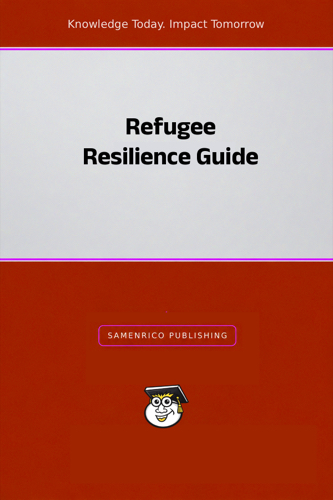
Refugee Resilience Guide eBook
Rebuild life and hope after displacement and traum
by Coats Frieda
Rebuild life and hope after displacement and trauma.
Formats
Free sample
Chapter 1: The Shattering Mirror--–- The first time you realized you would never go home, what did you do with your hands? Did you press them flat against a wall, feeling for something solid? Did you wrap them around a child who would not stop crying? Did you simply watch them shake, unable to command them to be still? The question matters not because your answer reveals weakness, but because it reveals something more important: you are still here, and your hands are still yours.Displacement is not a moment.
It is not the sound of the last bomb, the stamp on your passport at the border, or the closing of a door behind you. These are events, and events end. Displacement is what happens after the events end. It is the ongoing condition of living in a body that remembers a home that no longer exists, in a present that refuses to feel real, and in a future that looks like a blank wall. This chapter is called The Shattering Mirror because that is what displacement does: it holds up a reflection of who you were, shows you that person is gone, and asks you to build a new face without any instructions.Let us be honest from the first page.
This book will not tell you that everything happens for a reason. It will not tell you to be grateful for what you still have, as if gratitude could fill an empty stomach or bring back the dead. It will not offer you five easy steps to happiness, because there are no easy steps and happiness is not the goal. The goal is simpler and harder: to survive with your dignity intact, and then to build something that resembles a life, and then, if you are very lucky and very stubborn, to help someone else do the same.Before we go anywhere, we need to name what has happened to you. Not the surface facts—the war, the persecution, the flight, the border—but the deeper damage that no one talks about because it sounds too dramatic or too strange.
It is not too dramatic. It is not too strange. It is the truth, and naming it is the first act of rebuilding.THE LOSS OF SOCIAL ROLEYou were someone before you left. That sentence sounds simple, but it contains multitudes. You were a parent who provided food, a child who was protected, a professional who solved problems, a neighbor who was known, an elder whose stories mattered.
Every society is a web of roles, and every role comes with invisible power: the power to be useful, the power to be recognized, the power to be missed.Displacement cuts every thread of that web simultaneously.Consider the father who drove a taxi in Damascus. He knew the city's shortcuts, which passengers were dangerous, which cafes would let him use the bathroom without buying tea. He was not rich, but he was competent. Now he stands in a camp in Lebanon or a city in Germany, and his competence means nothing. The streets have different names.
The currency confuses him. His children watch him ask for directions in broken phrases, and he sees something change in their eyes—not disrespect, but a painful dawning awareness that the man who knew everything now knows nothing. The taxi driver has not changed. The world around him has. But the result is the same: his social role has collapsed.Or consider the grandmother who raised seven children and buried two.
Her authority in the village came from decades of surviving famines, wars, and family crises. She knew which herbs stopped bleeding, which disputes to mediate and which to ignore, which prayers to say at which hour. Now she sits on a plastic chair in a refugee settlement, and a nineteen-year-old aid worker with a clipboard tells her how many bars of soap her family is allowed per month. The grandmother has not become stupid. The aid worker is not evil.
But the grandmother's social role—the hard-won authority of age and experience—has been rendered invisible by a system that sees only case numbers.This loss is not merely psychological. It has physical consequences. Studies of displaced populations consistently show that the loss of social role correlates more strongly with depression and suicide than exposure to violence does. A person can survive bombing. A person struggles to survive irrelevance.THE EROSION OF AGENCYAgency is the sense that your actions matter—that you can cause things to happen in the world, that your choices have consequences, that you are a subject of your own life rather than an object acted upon by others.
Agency is so fundamental to human functioning that we usually do not notice it, just as we do not notice the air until we are choking.Displacement takes agency slowly, then all at once.In the beginning, during the flight itself, you may have had tremendous agency. You decided when to leave, what to carry, which route to take, who to trust. Those decisions saved lives. But then you arrived somewhere, and the systems took over. You learned that your shelter is assigned, not chosen.
Your food rations are determined by a formula, not by your appetite or your cooking traditions. Your children's education depends on the goodwill of strangers. Your legal status—whether you can work, whether you can be deported, whether you can ever feel safe—is in the hands of officials who will never know your name.The most insidious erosion of agency happens in small moments. When you stand in a line that does not move for three hours, and you cannot leave because leaving means losing your place, and you cannot complain because complaining marks you as difficult, and you cannot solve the problem because the problem is not yours to solve—in that moment, you learn something. You learn that your time does not matter.
Your discomfort does not matter. Your will does not matter. Learn that enough times, and you stop trying.This is not weakness. This is learning, and the lesson is true: in many displacement contexts, your individual agency is genuinely limited. The problem is that the lesson generalizes.
After a hundred lines that do not move, you stop standing in lines at all, even the ones that might lead somewhere good. After a hundred officials who do not listen, you stop speaking. After a hundred plans that fail because the world will not cooperate, you stop planning.The shattering mirror shows you a person who has stopped. And you do not recognize that person.THE PSYCHOLOGICAL TIMELINE OF EXILEDisplacement follows a psychological timeline, though the timeline is not linear. You will move forward and backward, sometimes in the same day.
Understanding the stages will not prevent you from feeling them, but it will prevent you from feeling crazy. And that matters.Stage One: Numbness In the first days or weeks after displacement, many people experience a kind of emotional anesthesia. You function—you find food, you secure shelter, you keep children alive—but you do not feel much. Joy is inaccessible. Grief is inaccessible.
Even fear is muted, which is dangerous because fear keeps you alert to threats. This numbness is your brain's protective…
This is the end of the free sample. Get the eBook to keep going. Buy now
About this book
Details
- Author
- Coats Frieda
- Publisher
- SamEnrico
- Language
- English
- Genre
- Non-Fiction, Self-Help, Refugee
- Released
- 2026-06-10
- Pages (approx.)
- 139
- Available as
- eBook, Audiobook

Read better in the ZLOADR app
Your eBooks on your phone or tablet. Sign in with your SamEnrico account and start reading.
More by Coats Frieda
 Muscle Relaxation GuideCoats Frieda$11.99
 Italian Abyssinian DisasterCoats Frieda$11.99
 Parenting Stress From Child LyingCoats Frieda$11.99
 Forest Breathing VisualizationCoats Frieda$11.99
 Stay at Home Parent AngerCoats Frieda$11.99
 Foreign Tax Credit Optimization GuideCoats Frieda$11.99
 Rhythms of the Forgotten Gods: The Dance That Defied TimeCoats Frieda$11.99
 Ashes of the Underworld: The Beirut Arson Conspiracy (1929)Coats Frieda$11.99
 How to Start a Electronic Valve Business (Beginners Guide)Coats Frieda$11.99
 How to Produce Swing Sets and PlaysetsCoats Frieda$11.99
 How to Produce Health Care SuppliesCoats Frieda$11.99
 Mastering The Art of Shinkendo (真剣道)Coats Frieda$11.99
You may also like
 Hong Kong Handover 1997Dunn Johnnie$11.99
 Zumba For Postnatal Recovery CourseNeal Christian$11.99
 Zumba for BeginnersLadner Nikia$11.99
 YouTube Comment Mining GuideHumes Pandora$12.99
 Worry Box MeditationCarlin Rudy$11.99
 Workplace Stress MeditationNguyen Lynn$11.99
 Workplace Stress and Sleep RepairHawley Ivory$11.99
 Workplace Perfectionism CureDelaney Jeffry$11.99
 Workplace Injustice Anger GuideWallen Isabelle$11.99
 Work Addiction and Burnout LinkGreenwood Ester$11.99
 Women in Yoga and WellnessBeattie Galina$11.99
 Women in Stand Up ComedyChun Evangeline$11.99