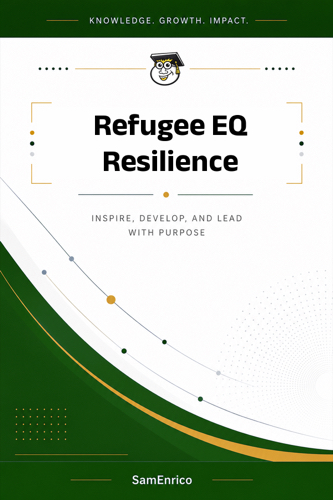
Refugee EQ Resilience eBook
Heal from displacement trauma using emotional inte
Heal from displacement trauma using emotional intelligence.
Formats
Free sample
Chapter 1: The Geography of Loss--There is a particular kind of exhaustion that comes from losing not just your home, but the map by which you understood yourself. It is deeper than fatigue, sharper than sadness, and more confusing than fear. It is the exhaustion of waking up in a place where nothing smells familiar, where the sounds outside your window are wrong, where your own name sounds different when spoken in an accent that is not your own. This exhaustion is the first marker of displacement trauma, and this book is written for everyone who carries it.If you are holding this book, you have likely survived what no one should have to survive. You have left behind a country, a language, a community, a way of life.
You have crossed borders under conditions that most people cannot imagine—or perhaps you are still waiting to cross, stuck in a camp or a detention center or a friend’s overcrowded apartment, unsure when or whether you will ever arrive anywhere that feels like safety. You have been asked, repeatedly, to tell your story to officials who seem bored or suspicious, to prove that your suffering is real enough to deserve help, to be grateful for crumbs while starving for a meal. And you have been told, directly or indirectly, that you should be moving on, getting over it, pulling yourself together.This chapter has one argument: you cannot heal what you cannot name.Before any of the emotional intelligence skills in this book will work, you need a vocabulary for what you have lost. You need a map of the strange territory you now inhabit—a territory that does not appear on any standard atlas because its borders are drawn not in geography but in grief. This chapter provides that map.
It names the phases of displacement trauma, distinguishes the refugee experience from ordinary PTSD, introduces the seven dimensions of forced migration loss, and invites you to begin charting your own emotional journey. By the end of this chapter, you will have words for experiences that may have felt unspeakable. And with those words, you will have taken the first step toward rebuilding.The Three Phases of Displacement Trauma Displacement is not a single event. It is a process that unfolds over time, often years, and each phase carries its own emotional signature. Understanding these phases helps answer a question that haunts many refugees: “Why am I struggling now, when I was fine during the dangerous part?” The answer is that different phases demand different kinds of strength, and what kept you alive during flight may be what keeps you stuck during resettlement.Phase One: Pre-Flight The first phase begins before you leave.
Pre-flight trauma includes witnessing violence, experiencing persecution, living under constant threat, and the agonizing decision to flee—often made in hours or minutes. For some refugees, this phase lasts years: the slow erosion of safety, the daily humiliations of a regime that has decided you do not belong, the whispered warnings from neighbors who disappear the next day. For others, it is sudden and violent: a knock on the door at 3 a.m., a phone call telling you to run, a bombardment that levels your street.What makes pre-flight trauma unique is the absence of clear choices. Many refugees describe this period as a tightening noose: each day offers fewer options, less information, more danger. The decision to leave is rarely a clean yes or no; it is a slow realization that staying means death and leaving means everything else.
This is not a choice. It is an ultimatum disguised as a choice.Emotionally, pre-flight is characterized by chronic hypervigilance—the nervous system permanently braced for threat. Sleep becomes shallow and interrupted. Small sounds trigger adrenaline surges. Trust becomes impossible because anyone could be an informant.
Many refugees describe this period as a kind of living death: going through the motions of daily life while knowing that any moment could be the last moment of normalcy.Phase Two: Flight The second phase is the journey itself. Flight trauma encompasses dangerous crossings, detention in camps or holding centers, separation from family members, exploitation by smugglers, and the physical exhaustion of walking for days or weeks. For some refugees, flight means a single harrowing border crossing; for others, it means years of moving from one unsafe place to another, never knowing which country will offer temporary shelter and which will push you back.Flight trauma has a distinctive emotional signature: the suspension of personhood. On the move, you are no longer a teacher, a farmer, a doctor, a parent, a child. You are a body to be moved, fed, hidden, or discarded.
Your documents—if you have them—matter more than your memories. Your ability to pay matters more than your need. People who were professionals in their home countries find themselves begging, bartering, or selling the last valuable thing they own.The most destructive aspect of flight trauma is the fragmentation of families. Some family members make it across; others do not. Some are left behind deliberately because someone had to stay with the grandmother who could not walk.
Some are lost in the chaos of a border crossing and never found. Some are taken by authorities and never heard from again. This fragmentation creates a unique wound: the inability to grieve fully because you do not know whether your loved ones are alive or dead, safe or suffering, coming soon or gone forever.Phase Three: Resettlement The third phase begins when you arrive somewhere that might, eventually, become home. Resettlement trauma is the most misunderstood phase because it looks, from the outside, like safety. You have a roof over your head.
Your children are in school. You have a caseworker who is supposed to help. But resettlement brings its own wounds, and they can be more disorienting than the dangers of flight because they are not supposed to exist.Cultural bereavement is the grief of losing your entire cultural environment. It is not the grief for a person who died but for a way of life that has been destroyed. There is no funeral for a homeland.
There is no mourning period for a language no longer spoken daily, no ceremony for the loss of professional status, no ritual for the disappearance of the smells, sounds, and tastes that once told you where you belonged. This ambiguous loss—loss without closure—produces a unique form of suffering. You are expected to be grateful for survival while simultaneously grieving everything that survival cost.Identity loss compounds cultural bereavement. In your home country, you were someone specific: a skilled worker, a respected elder, a community leader, a loving parent, a diligent student. In the resettlement country, you are a refugee.
Your resume means nothing because your credentials are not recognized. Your status means nothing because no one knows your village or your family name. Your experience means nothing because the systems here work differently. Many refugees describe feeling like they have become children again—unable to speak the language, unable to navigate basic tasks, dependent on strangers for necessities.The bureaucratic maze adds humiliation to disorientation. To access housing, you need…
This is the end of the free sample. Get the eBook to keep going. Buy now
About this book
Details
- Author
- Gainey Annelle
- Publisher
- SamEnrico
- Language
- English
- Genre
- Non-Fiction, Self-Help, Refugee, Trauma
- Released
- 2026-06-12
- Pages (approx.)
- 146
- Available as
- eBook, Audiobook

Read better in the ZLOADR app
Your eBooks on your phone or tablet. Sign in with your SamEnrico account and start reading.
More by Gainey Annelle
 Indian Immigrant Tech BillionaireGainey Annelle$11.99
 The No Gym Home Workout GuideGainey Annelle$11.99
 Gaslighting Self Trust GuideGainey Annelle$11.99
 The Burning of the Ballarat Goldfields: Espionage and Fire in Colonial AustraliaGainey Annelle$11.99
 Remote Performance Review ToolsGainey Annelle$12.99
 Jadarite MiningGainey Annelle$11.99
 Learn to Play the GeomungoGainey Annelle$11.99
 How to Become a Gas-check-pad MakerGainey Annelle$11.99