
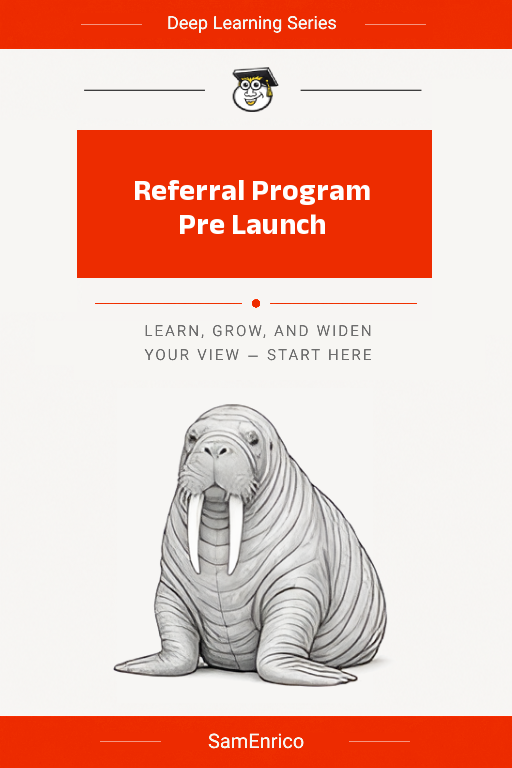
Referral Program Pre Launch eBook
Run referral program to grow pre-launch community.
by Hartman Son
Run referral program to grow pre-launch community. Incentives and viral sharing mechanics.
Formats
Free sample
Chapter 1: The Post-Scarcity Shift--The most dangerous sentence in business is also the most common: "If we build it, they will come."This phrase, whispered in boardrooms and shouted from crowdfunding campaigns, has probably cost entrepreneurs more money than any recession, any bad hire, or any failed product launch in history. And yet, founders repeat it to themselves like a prayer every single morning. They believe that engineering excellence, feature completeness, or product superiority will somehow magically attract an audience. They believe that the world is waiting with bated breath for their solution.The world is not waiting.In fact, the world is actively ignoring you. Not because you're unworthy, but because the average person is now exposed to over 5,000 marketing messages per day.
Your product launch will land in an inbox alongside 299 other emails. Your social media announcement will appear between a friend's baby photos and a viral cat video. Your paid ad will compete with 18 other ads for the same millisecond of attention.The old model—build a product, launch it with a press release, then market it to a cold audience—is not merely outdated. It is financially catastrophic. According to data from CB Insights, 35% of startups fail because there is "no market need" for their product.
But here is the uncomfortable truth that most founders avoid: in the majority of those cases, the market need actually existed. The problem was not the product. The problem was that nobody knew about it in time. The problem was that the founders waited until launch day to start building their audience.This book makes a radical argument: the pre-launch phase is not an administrative chore for collecting emails. It is the single most strategic asset you can build.
It is a moat. It is a war chest of attention. And when engineered correctly, it can grow itself—without paid advertising, without begging influencers, and without luck.Welcome to the post-scarcity shift.The Infinite Supply Problem To understand why pre-launch referral programs have become the most powerful growth lever of the past decade, you must first understand the economic reality of the digital age. For most of human history, scarcity was the default state. There were limited goods, limited shelf space, limited distribution channels, and limited attention spans constrained by geography.
If you owned a bakery on Main Street, your only competitors were the two other bakeries within walking distance. Your biggest problem was supply: could you bake enough bread to meet demand?The internet destroyed that scarcity.Today, supply is effectively infinite. Anyone can launch a competing product with a few thousand dollars and a Shopify account. Anyone can reach a global audience with a Facebook ad. Anyone can distribute software to millions of users with a single server deployment.
The barriers to entry have collapsed so completely that the term "barrier to entry" now feels almost quaint.When supply is infinite, the only constraint that matters is attention. And attention is not merely scarce—it is brutally, ruthlessly, expensively scarce. The average cost per thousand impressions (CPM) on Facebook has increased by over 400% in the last five years. The average open rate for marketing emails has dropped below 20%. The average click-through rate for display ads is hovering around 0.35%.You cannot buy your way out of this problem.
You cannot outspend your competitors indefinitely, because the moment you stop spending, the attention stops flowing. The only durable solution is to build an asset that generates attention for free. That asset is a pre-launch referral program.The Harry's Razors Case Study: 100,000 Sign-Ups in One Week No case study illustrates the power of pre-launch referrals more vividly than Harry's Razors. In 2013, two entrepreneurs—Jeff Raider and Andy Katz-Mayfield—decided to challenge Gillette's dominance of the razor industry. Gillette controlled over 70% of the market.
Gillette had billions of dollars in marketing budget. Gillette had shelf space in every pharmacy, grocery store, and big-box retailer in America.Raider and Katz-Mayfield had none of those things. What they had was a hypothesis: if they could build a waitlist of 100,000 people before they ever shipped a single razor, they could launch directly to an audience that was already excited, already engaged, and already ready to buy.They built a simple landing page. It had a headline, a subheadline, an email capture field, and a promise: "Get early access and a free trial." That was it. No product photos.
No pricing. No demo videos. Just a vision and a call to action.Then they added a twist. After someone signed up, they were taken to a referral dashboard. The dashboard showed them their unique referral link, a leaderboard showing how many people they had referred, and a progress bar toward escalating rewards.
One referral unlocked free shipping. Five referrals unlocked free shaving cream. Fifty referrals unlocked free razors for an entire year.The results were staggering. In one week, Harry's amassed 100,000 email sign-ups. But here is the number that should stop you cold: 77% of those sign-ups came from referrals.
Not from paid ads. Not from PR. Not from influencer partnerships. From ordinary people sharing a link with their friends, family, and colleagues.Let me repeat that: 77% of 100,000 people—seventy-seven thousand human beings—signed up because someone they knew sent them a link. They were not convinced by a billboard.
They were not persuaded by a Super Bowl commercial. They trusted a friend.When Harry's finally launched, they had over 100,000 customers waiting to buy. They sold out of their initial inventory in 48 hours. They became a billion-dollar company. And they did it without ever outspending Gillette.The lesson is not that Harry's had a great product (they did) or great branding (they did).
The lesson is that Harry's understood that during the pre-launch phase, the referral program was the product. The razors were secondary. The community was primary.Scarcity Versus Exclusivity: A Critical Distinction Before we go any further, we need to clarify a concept that most marketers get embarrassingly wrong. The concept is scarcity, and the mistake is believing that it works the same way as exclusivity.Scarcity is the principle that limited availability increases desirability. "Only 10 left in stock." "Sale ends at midnight." "Last chance to buy." These are scarcity tactics, and they work reasonably well for products that already have established demand.
But scarcity has a dark side: it creates anxiety. It signals that something is running out, which implies that something might be defective, unwanted, or about to be discontinued. Scarcity works on the lizard brain's fear of missing out, but it does not build loyalty, status, or long-term brand affinity.Exclusivity is fundamentally different. Exclusivity says: "You cannot have this unless you are invited." Exclusivity says: "This is not for everyone." Exclusivity does not create anxiety; it creates status.The most powerful example of exclusivity in recent technology history is Clubhouse, the audio-based social network that exploded in popularity in 2020. Clubhouse did not allow users to sign up freely.
Instead, every existing user received a limited number of invites to give to friends. To join Clubhouse, you had to be invited by someone who was already a member.The result was not merely viral growth; it was cultural mania. Clubhouse became the most coveted…
This is the end of the free sample. Get the eBook to keep going. Buy now
About this book
Details
- Author
- Hartman Son
- Publisher
- SamEnrico
- Language
- English
- Genre
- Non-Fiction, Startup Guide, Waitlist Strategy
- Released
- 2026-05-30
- Pages (approx.)
- 135
- Available as
- eBook, Audiobook

Read better in the ZLOADR app
Your eBooks on your phone or tablet. Sign in with your SamEnrico account and start reading.
More by Hartman Son
 Remote Procrastination FixHartman Son$11.99
 Five Senses MindfulnessHartman Son$11.99
 Lonely Introvert Connection PlanHartman Son$11.99
 Teresa's Ecstasy DescriptionHartman Son$11.99
 The Hypnosis Audio Equipment GuideHartman Son$11.99
 Black Gold and Broken Chains: The Untold Saga of Queen Zingha of NdongoHartman Son$11.99
 Portfolio Projects from MOOCsHartman Son$12.99
 Learn to Play the Steirische HarmonikaHartman Son$11.99
 Area Vice PresidentHartman Son$11.99
 How to Become a Garde MangerHartman Son$11.99
You may also like
 Webinar Pre Launch CommunityDouglass Rudolf$12.99
 Twitter Pre Launch CommunityEpperson Nickolas$12.99
 Slack Pre Launch CommunityProvost Sherita$12.99
 Reddit Pre Launch CommunityHarkins Tresa$12.99
 Product Hunt Pre LaunchBlanchette Elicia$12.99
 Pre Launch SEO StrategyChapa Herlinda$12.99
 Pre Launch PR GuideRush Clemmie$12.99
 Pre Launch Community SuccessThibodeaux Juliann$12.99
 LinkedIn Pre Launch CommunityMckeown Cristine$12.99
 Lead Magnet Pre LaunchPollard Jacqualine$12.99
 Gamification Pre LaunchCloutier Marhta$12.99
 Facebook Group Pre LaunchBingham Rasheeda$12.99