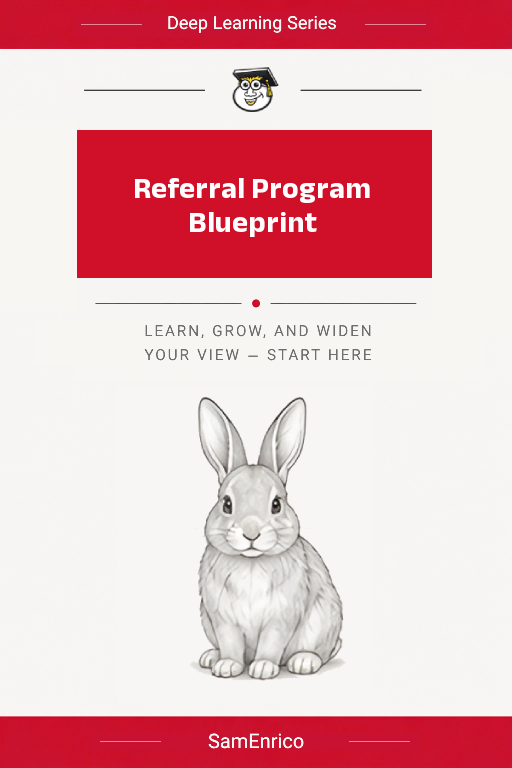
Referral Program Blueprint eBook
Design a viral referral loop with incentives, trac
by Teel Angeles
Design a viral referral loop with incentives, tracking, and promotion on a single page.
Formats
Free sample
Chapter 1: The One-Page Heresy--–- Most people build referral programs backward. They start with a dashboard, then add a landing page, then a signup form, then a share menu, then a rewards tracker, then an FAQ, then a terms page. By the time they finish, the user has to click through seven pages just to invite a single friend. And then they wonder why nobody shares.Let me tell you something that will sound like heresy to every marketer who has ever built a “comprehensive” referral system: the only page that matters is the one where the friend lands. Everything else is noise.
The dashboard, the settings, the history, the leaderboard for logged-in users—none of that belongs in the referral capture flow. It belongs somewhere else, on a different day, for a different purpose.This book is built on a single, aggressive, non-negotiable premise: you will design your entire referral program to fit on one page. Not a dashboard with tabs. Not a multi-step wizard. One scrolling page that loads in under three seconds, contains exactly one primary call-to-action, and forces you to make the hard decisions about what actually matters.I call this the One-Page Imperative.
And if you follow it, you will outperform 99% of referral programs that have more pages, more features, and more budget than you.The Problem with Multi-Page Thinking Every time you add a page to your referral flow, you lose 20 to 50 percent of your users. This is not speculation. This is math. It comes from decades of e-commerce and Saa S conversion data, validated by companies like Amazon, Google, and Unbounce. A user who clicks from your homepage to a “Refer a Friend” page is already in a fragile state of mind.
They have goodwill, but it is shallow. Every additional click tests whether that goodwill survives.Consider a typical multi-page referral flow:User visits homepage Clicks “Programs” in navigation Clicks “Referrals” from dropdown Lands on dashboard with charts and history Clicks “Invite Friends” button Popup form appears User fills in friend’s email Clicks “Submit”“Thank you” page loads User must click “Share Again” to continue That is ten steps. At each step, a portion of your users will abandon. Even if each step retains 90 percent of users (which is optimistic), you lose 65 percent of your potential referrals by the end. But real-world abandonment is worse.
The first click from homepage to “Programs” loses 30 percent. The second click loses another 20 percent. By the time you reach the popup form, you are working with less than half of your original users.Now imagine the opposite. One page. One form.
One button. The user sees the page, enters their friend’s email, and submits. That is two steps. With the same 90 percent retention, you keep 81 percent of your users. In practice, the one-page flow often retains 85 to 90 percent because there is nowhere to get lost.The multi-page approach is not just inefficient.
It is a confession that you do not know what matters. When you spread your referral program across multiple pages, you are telling the user: “We have so many features and options that we could not fit them on one screen.” But the user does not want options. They want to invite a friend and get a reward. Everything else is a distraction.What the One-Page Constraint Forces You to Do The one-page constraint sounds limiting. That is the point.
Limitations force clarity. When you have infinite space, you fill it with mediocre content. When you have one screen, you fight for every pixel.Here is what the one-page constraint forces you to answer before you write a single line of code:First, what is the single action we want the user to take? This seems obvious, but most referral programs fail to answer it. Do you want the user to enter their own email?
Their friend’s email? Do you want them to share on social media? Do you want them to copy a link? Choose one. Just one.
The winning answer for most programs is “enter your friend’s email address.” That is the atomic unit of referral. Everything else—social sharing, link copying, dashboard views—comes after or belongs on a different page.Second, what is the single reward we are promising? Not two rewards. Not “you get this and your friend gets that” in the headline. One reward, stated clearly, attached to one action.
The reciprocal reward (both sides get something) can be explained in one sentence, but the headline should focus on what the friend receives. “Sarah Jones invited you to get $20 off your first order.” That is one reward. The referrer’s reward is implied or shown elsewhere on the page, but the primary promise is singular.Third, what is the single piece of social proof that proves this works? Do not list ten testimonials. Do not show thirty logos.
Pick one metric that matters: “1,234 people earned rewards today” or “Average referral earns $47.” If you have a live leaderboard, that is social proof. If you have a recent referrals ticker, that is social proof. But you do not need both on the same page. Choose the one that best matches your product and audience.These three questions are uncomfortable because they force tradeoffs. You cannot promise a $20 reward and a free t-shirt and a charity donation and a leaderboard badge in the same headline.
You cannot ask for an email address and a phone number and a social media follow and a survey response. You cannot show a leaderboard and a testimonial carousel and a trust badge section and a video testimonial. The one-page constraint says: choose.And here is the secret that most marketers never learn: users prefer fewer choices. When you give them one clear action, one clear reward, and one clear proof, they convert at higher rates than when you give them three of each. This is not opinion.
It is the paradox of choice, studied by psychologists and validated by conversion rate optimizers for twenty years.The Attention Ratio: Your New Favorite Metric There is a metric you have probably never tracked that will predict your referral page’s success better than anything else. It is called the Attention Ratio, coined by the team at Unbounce after analyzing thousands of landing pages.The Attention Ratio is calculated as:Number of clickable elements on the page divided by the number of conversion goals.A clickable element is any link, button, or interactive element that takes the user somewhere else or triggers an action. Your logo linking to the homepage is a clickable element. Your navigation menu is multiple clickable elements. Social media icons are clickable elements.
Even a “Learn More” link is a clickable element.A conversion goal is the primary action you want the user to take. On a referral capture page, that is almost always “submit a friend’s email address.” That is one conversion goal.A standard homepage has an attention ratio of 50:1 or worse. Fifty things to click, one thing you actually want the user to do. A good referral page aims for 1:1. Exactly one clickable element for every conversion goal.
In practice, that means the only clickable thing on the page should be the submit button. No navigation. No footer…
This is the end of the free sample. Get the eBook to keep going. Buy now
About this book
Details
- Author
- Teel Angeles
- Publisher
- SamEnrico
- Language
- English
- Genre
- Non-Fiction, Business Brief, Viral Marketing
- Released
- 2026-06-01
- Pages (approx.)
- 144
- Available as
- eBook, Audiobook

Read better in the ZLOADR app
Your eBooks on your phone or tablet. Sign in with your SamEnrico account and start reading.
More by Teel Angeles
 Self Hypnosis for Labor PainTeel Angeles$11.99
 Forest Relaxation VisualizationTeel Angeles$11.99
 Acupuncture for Frozen ShoulderTeel Angeles$11.99
 Instagram Post Templates CanvaTeel Angeles$11.99
 Fencer Self Hypnosis GuideTeel Angeles$11.99
 Take Stairs HabitTeel Angeles$11.99
 Virtual Team Building CommunicationTeel Angeles$11.99
 Ophidiophobia Snake FearTeel Angeles$11.99
 The Ghost in the Machine: How a Forgotten Programmer Sabotaged the Stock MarketTeel Angeles$11.99
 Ben Enwonwu: The Sculptor Who Defied ColonialismTeel Angeles$11.99
 How to Produce DesiccantsTeel Angeles$11.99
 Stoats: ErmineTeel Angeles$11.99