
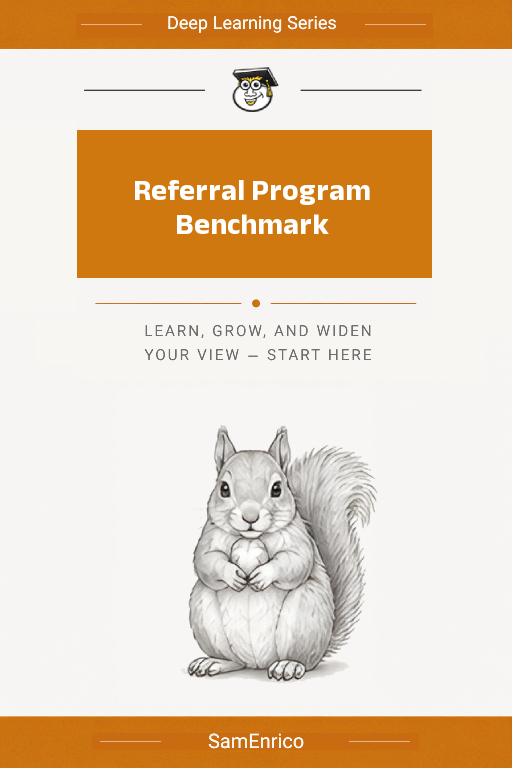
Non-FictionStrategic AtlasReferrals
Referral Program Benchmark eBook
Compares referral programs from top performers inc
Compares referral programs from top performers including incentives, double-sided rewards, and ambassador tiers.
Formats
Free sample
Chapter 1: The $100,000 Mistake--–- Maya Chen stared at her laptop screen, the blue light reflecting off her tired eyes. It was 11:47 PM on a Tuesday, and she had just pulled up the quarterly performance report for her company's referral program. The numbers were devastating. Over the last ninety days, her team had spent 47,300onreferralincentives,emailcampaigns,andtechnicalmaintenance.Inreturn,theyhadgeneratedexactlytwelvenewcustomers.Twelve.Themathwasbrutal:nearly47,300 on referral incentives, email campaigns, and technical maintenance. In return, they had generated exactly twelve new customers.
Twelve. The math was brutal: nearly 47,300onreferralincentives,emailcampaigns,andtechnicalmaintenance.Inreturn,theyhadgeneratedexactlytwelvenewcustomers.Twelve.Themathwasbrutal:nearly4,000 per referred customer, more than triple her target cost per acquisition. Maya closed the laptop, walked to her kitchen, and poured a glass of wine that she knew she shouldn't be drinking on a Tuesday. Somewhere in her apartment, her phone buzzed with another notification from her customer support platform. She ignored it.
She already knew what it would say: "I love your products! Best purchase I've made all year." Another satisfied customer who would never, ever tell a friend.This was the paradox that haunted Maya. Her skincare brand, Aura, had a 94% customer satisfaction rating. Her Net Promoter Score was 72, a number that consultants would call "world-class." Her customers regularly sent handwritten thank-you notes, tagged Aura in Instagram stories, and left five-star reviews that read like love letters. But when it came to actually sharing a referral link?
Less than 3% of her customers had ever done so. Aura was beloved, but it was not being shared. And Maya was bleeding cash trying to fix a problem she couldn't quite name.She was not alone.The Silent Satisfaction Epidemic Across the country, in boardrooms and coffee shops and co-working spaces, thousands of founders and marketing leaders were staring at identical dashboards. Their customers were happy. Their products were good.
Their referral programs were failing. The data told a sobering story: less than 30% of satisfied customers ever refer anyone to the brands they love. Not because they are unwilling. Not because they are selfish. But because satisfaction, it turns out, is not a reliable predictor of advocacy.
This is what the academic literature calls the "silent satisfied" phenomenon, and it is the single greatest destroyer of referral program ROI in existence.Consider the math for a moment. If your average customer has a lifetime value of 5,000,andthatcustomerreferszeropeople,youareleaving5,000, and that customer refers zero people, you are leaving 5,000,andthatcustomerreferszeropeople,youareleaving5,000 on the table not once, but repeatedly, across your entire customer base. A business with 1,000 customers at 5,000LTVhasapotentialreferralassetworth5,000 LTV has a potential referral asset worth 5,000LTVhasapotentialreferralassetworth5 million. But if only 3% of those customers refer, you are capturing just 150,000ofthatvalue.Theremaining150,000 of that value. The remaining 150,000ofthatvalue.Theremaining4.85 million evaporates, not because your customers don't like you, but because you have not built a system that makes referring feel natural, rewarding, and obvious.This chapter is about understanding why that gap exists.
It is about diagnosing the specific, predictable mistakes that cause referral programs to underperform. And it is about laying the foundation for a fundamentally different approach—one that moves from transactional asking to relational earning. By the end of this chapter, you will understand why your current program is probably failing, and you will have a clear framework for what to do instead.The Broken Logic of "If You Build It, They Will Come"Maya had fallen into the same trap that catches most founders. When she launched Aura two years earlier, she assumed that if she built a great product, customers would naturally tell their friends. This assumption is so common, and so deeply ingrained in startup culture, that it deserves to be named: the Field of Dreams Fallacy.
Named after the famous movie line "If you build it, they will come," this fallacy holds that quality alone drives word-of-mouth. It is seductive because it feels true. We all have products we love and have recommended to friends. But the data tells a different story.In a landmark study of consumer behavior, researchers asked 10,000 customers who had recently rated a product 9 or 10 out of 10 whether they had recommended that product to anyone in the last month. Only 28% said yes.
Of those, only half had done so using a referral link or code. The rest had mentioned the product casually in conversation—"Oh, I love that brand"—without any mechanism to track or reward the referral. This means that even among your happiest customers, the vast majority are not actively referring. They are passively satisfied. And passive satisfaction is not a growth strategy.The problem is structural, not personal.
Human beings are not wired to spontaneously promote products, even products they love. The cognitive friction is too high. Remembering a referral link, finding the right moment to share it, and explaining the value to a friend requires mental effort that most people will not expend without a trigger. This is why the most successful referral programs in history—Dropbox, Pay Pal, Tesla—did not rely on customer goodwill. They relied on carefully designed systems that made referring feel like the path of least resistance.
Dropbox did not ask users to share because they loved the product. Dropbox gave users 500 megabytes of free storage for every friend they invited. The incentive was immediate, specific, and tied directly to the value of the product. Users did not refer because they were satisfied. They referred because the math was obvious.Maya had not built a system.
She had built a page on her website with a referral link and a promise of 10% off for both parties. Then she had sent a few emails and hoped for the best. This is not a strategy. This is a prayer.The LTV-to-Referral Gap To understand the scale of the problem, we need a diagnostic tool. Let me introduce the LTV-to-Referral Gap.
This is a simple calculation that reveals how much referral value you are leaving on the table. Here is how it works.First, calculate your average customer lifetime value. If you do not know this number, stop everything and calculate it now. For the sake of example, let us use 5,000,whichistypicalfora B2BSaa Scompanyorahigh−end D2Cbrandwithrepeatpurchases.Second,multiplythatnumberbyyourtotalnumberofcustomers.Forabusinesswith1,000customers,thatis5,000, which is typical for a B2B Saa S company or a high-end D2C brand with repeat purchases. Second, multiply that number by your total number of customers.
For a business with 1,000 customers, that is 5,000,whichistypicalfora B2BSaa Scompanyorahigh−end D2Cbrandwithrepeatpurchases.Second,multiplythatnumberbyyourtotalnumberofcustomers.Forabusinesswith1,000customers,thatis5 million in total LTV. Third, estimate what percentage of your customers have ever referred anyone. If you have a referral program, your analytics will tell you. If you do not, assume a baseline of 5% for most businesses. This means that of your 5millionintotal LTV,only5 million in total LTV, only 5millionintotal LTV,only250,000 is attached to customers who have referred.
The remaining $4.75 million is sitting in the accounts of customers who have not referred. That is the LTV-to-Referral Gap.Now consider the opportunity cost. If you could increase your referral rate from 5% to 20%, you would move 750,000fromthe"non−referring"columntothe"referring"column.Andbecausereferredcustomerstypicallyhave25750,000 from the "non-referring" column to the "referring" column. And because referred customers typically have 25% higher lifetime value than non-referred customers, the actual revenue impact…
This is the end of the free sample. Get the eBook to keep going. Buy now
About this book
Details
- Author
- Stallworth Joi
- Publisher
- SamEnrico
- Language
- English
- Genre
- Non-Fiction, Strategic Atlas, Referrals
- Released
- 2026-06-01
- Pages (approx.)
- 129
- Available as
- eBook, Audiobook

Read better in the ZLOADR app
Your eBooks on your phone or tablet. Sign in with your SamEnrico account and start reading.
More by Stallworth Joi
 HIIT With Joint Issues GuideStallworth Joi$11.99
 Sleep Meditation TestimonialsStallworth Joi$11.99
 Assertiveness with RoommatesStallworth Joi$11.99
 Double Bass Giant StoriesStallworth Joi$11.99
 The OCD Hoarding GuideStallworth Joi$11.99
 Tutu & Tulle: The Fashion Revolution of Ballet’s Golden AgeStallworth Joi$11.99
 Guest AmbassadorStallworth Joi$11.99
 Music Streaming Free to PaidStallworth Joi$12.99
 The Breeder's Guide to Highland CattleStallworth Joi$11.99
 How to Become a Oxygen-plant OperatorStallworth Joi$11.99
You may also like
 Hong Kong Handover 1997Dunn Johnnie$11.99
 Zumba For Postnatal Recovery CourseNeal Christian$11.99
 Zumba for BeginnersLadner Nikia$11.99
 YouTube Comment Mining GuideHumes Pandora$12.99
 Worry Box MeditationCarlin Rudy$11.99
 Workplace Stress MeditationNguyen Lynn$11.99
 Workplace Stress and Sleep RepairHawley Ivory$11.99
 Workplace Perfectionism CureDelaney Jeffry$11.99
 Workplace Injustice Anger GuideWallen Isabelle$11.99
 Work Addiction and Burnout LinkGreenwood Ester$11.99
 Women in Yoga and WellnessBeattie Galina$11.99
 Women in Stand Up ComedyChun Evangeline$11.99