
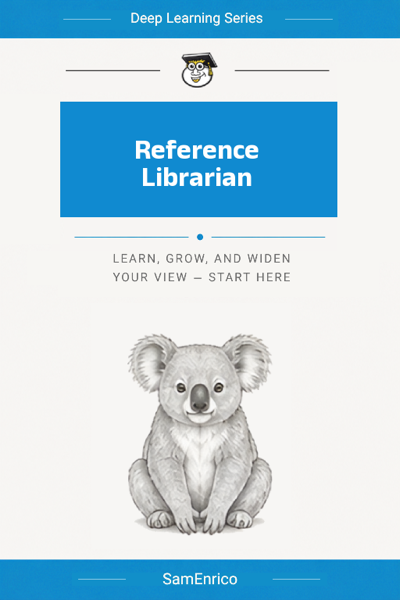
Reference Librarian eBook
A Coursebook on Reference Librarian
by Gant Nubia
A Coursebook on Reference Librarian
Formats
Free sample
Chapter 1: The Invisible Gateway...--The woman had been standing in the reference area for eleven minutes. I knew because I had been watching her from behind my computer screen, pretending to type, waiting for her to approach. She was in her late sixties, wearing a worn winter coat despite it being September, and she kept pulling a crumpled piece of paper from her pocket, looking at it, then folding it away again. Eleven minutes. She had walked past the reference desk three times.
Each time, she glanced at me, then looked down, then kept walking.This is the moment that separates a good reference librarian from an average one. The average librarian waits. The good librarian approaches.I stood up, stepped out from behind the desk—a physical barrier that unconsciously signals "don't bother me"—and walked toward her. Not quickly, not with the aggressive cheerfulness of a department store salesperson, but with the calm, open posture of someone who has time and interest. I stopped about four feet away, angled my body slightly to the side (less confrontational than a direct face-on stance), and said the seven most powerful words in the reference lexicon: "Excuse me, can I help you find something?"She looked at me.
Looked at the paper in her hand. Looked back at me. "I don't want to be a bother," she said."You're not a bother," I said. "That's what I'm here for."She unfolded the paper. It was a printout of a Google search result for "property tax exemption veterans disability." The printout was dated three years earlier.
She had been carrying this question for three years.This chapter is about the invisible gateway that every reference librarian must learn to open. It is not about sources. It is not about search strategies. It is not about databases or Boolean logic or the Dewey Decimal System. Those things come later.
This chapter is about something more fundamental and, in many ways, more difficult to teach: how to become the kind of person a stranger trusts with their confusion.The Four Walls of Reference Work Before we can understand the skills of the reference librarian, we must understand the environments in which those skills are practiced. Reference work does not happen in a vacuum. It happens in specific institutional contexts, each with its own culture, its own patron expectations, and its own hidden rules. There are four primary types of libraries where reference librarians work, and while the core skills transfer across all of them, the way you apply those skills will shift dramatically depending on which wall you are standing behind.Academic libraries are perhaps the most complex environment. You serve three overlapping populations simultaneously: undergraduate students (many of whom have never conducted real research and are terrified of looking stupid), graduate students (who know more than you do in their narrow specialty but less than you do about everything else), and faculty (who often expect you to be invisible until they need something obscure immediately).
The academic reference desk is a site of intense anxiety. Undergraduate students, in particular, will do almost anything to avoid asking for help. They will stare at a database search screen for forty-five minutes, typing variations of the same failed search over and over, rather than walk fifteen feet to the librarian. They have been socialized to believe that asking for help is a confession of failure. Your job is to unteach that belief in the thirty seconds after you first make eye contact.Public libraries are the opposite.
Here, the challenge is not under-asking but over-asking. Public library patrons will ask you anything, often without any filter. They will ask for help with their unemployment applications, their divorce paperwork, their tax forms, their resume, their mother's possible dementia symptoms, their child's homework, their computer that won't turn on, and their suspicion that the government is monitoring them through the library's Wi-Fi. The public library reference desk is the front line of the social safety net. You will be a librarian, yes, but you will also be a social worker, a technology teacher, a literacy coach, a citizenship tutor, and sometimes the only kind person a patron speaks to all day.
The skills you need here are not just informational but emotional. You must learn to say "I can't give you legal advice, but I can show you where to find the landlord-tenant statute" without sounding like you are rejecting the patron.Special libraries include corporate libraries (where you serve employees who need market research, competitive intelligence, or industry reports), legal libraries (where you serve lawyers and paralegals who need case law and statutes with zero margin for error), and medical libraries (where you serve doctors, nurses, and researchers who need clinical evidence and systematic reviews). In special libraries, the patrons are professionals. They know their domains deeply. But they often do not know how to search effectively, and they have no time to learn.
The special librarian is a research concierge. The standards are higher—a mistake in a medical library could theoretically affect patient care—and the funding is better. But the fundamental skill remains the same: understanding what the patron actually needs, not what they first ask for.School libraries (K-12) are where reference work meets developmental psychology. A seven-year-old asking for "books about space" does not have the same cognitive tools as a sixteen-year-old asking for "peer-reviewed articles on black hole event horizons." The school librarian must know not just sources but stages: what a child can reasonably be expected to understand, what search vocabulary they have, how long they can sustain attention. This is reference work at its most pedagogical.
Every interaction is a teaching interaction because the ultimate goal is not just to answer today's question but to equip the student to answer tomorrow's question on their own.The Great Historical Shift If you had walked into a library in 1950 and asked for help, the reference librarian would have done something very different from what a librarian would do today. The 1950s librarian was a keeper. The library was a temple. The books were sacred objects, and the librarian's primary duty was to protect them from the public. Reference service was something grudgingly offered, usually from behind a high desk, with the implicit message that your question was interrupting important work.That model is dead.
It died in the 1970s and 1980s, killed by the combination of declining public trust in institutions, the rise of self-service retail (patrons began expecting to be helped, not tolerated), and the first stirrings of what would become the information revolution. By the 1990s, the profession had formally adopted a new model: the librarian as facilitator. The library was no longer a temple of books but a community information center. The librarian's job was no longer to guard knowledge but to help patrons find it, evaluate it, and use it.Then the internet happened. And everything changed again.For a terrifying decade—roughly 1995 to 2005—many people predicted the end of reference librarians entirely.
Why ask a person when you can ask Google? Why wait for an expert when you can search millions of pages in milliseconds? The…
This is the end of the free sample. Get the eBook to keep going. Buy now
About this book
Details
- Author
- Gant Nubia
- Publisher
- SamEnrico
- Language
- English
- Genre
- Non-Fiction, Informative, Educational
- Released
- 2026-05-11
- Pages (approx.)
- 133
- Available as
- eBook, Audiobook

Read better in the ZLOADR app
Your eBooks on your phone or tablet. Sign in with your SamEnrico account and start reading.
More by Gant Nubia
 Retirement Identity ReinventionGant Nubia$11.99
 Cord Accident Loss GuideGant Nubia$11.99
 Body Scan for PostpartumGant Nubia$11.99
 Reddit Compulsive Browsing GuideGant Nubia$11.99
 Falklands: The War That Wasn't Supposed to HappenGant Nubia$11.99
 How to Become a Palletizer Operator IGant Nubia$11.99
 How to Produce AdhesiveGant Nubia$11.99
 Data Privacy Remote Work PrimerGant Nubia$12.99