
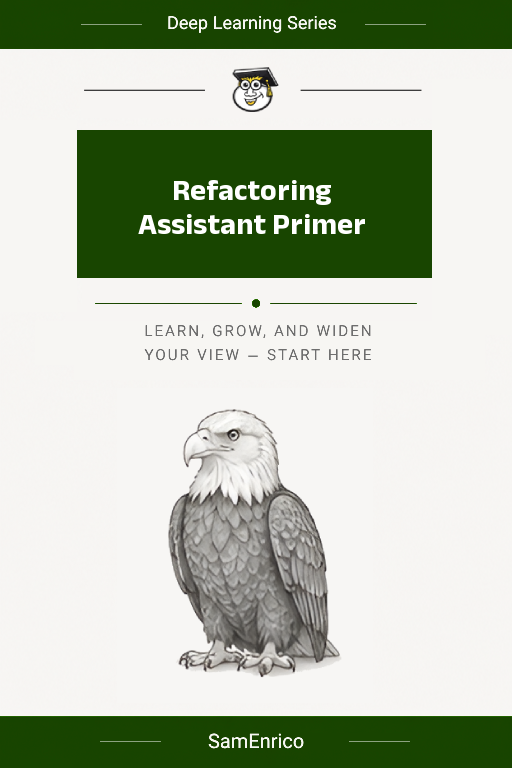
Non-FictionAI OperatorSoftware CraftRefactoring Guide
Refactoring Assistant Primer Audiobook
Identify code smells and apply safe refactoring pa
Identify code smells and apply safe refactoring patterns using AI analysis. Includes complexity reduction prompts, duplicate extraction, and performance optimization suggestions.
Formats
Free sample
Chapter 1: The Debt Ceiling...--–- The morning of March 15th started like any other for Sarah, a senior engineer at a fast-growing fintech startup. She grabbed her coffee, opened Slack to 147 unread messages, and saw the notification that changed her quarter: "Payment processing is down. All transactions failing. Pager Duty is melting."By 10:00 AM, she had traced the root cause to a function called validate_transaction. It was a function she had never seen before, living in a module she didn't know existed, written by an AI assistant three weeks earlier by a junior developer who had since left the company.
The function looked correct at a glance. It had proper error handling. It passed all the unit tests. It even had comments.But inside, buried in a nested conditional that only triggered for transactions between 499.99and499.99 and 499.99and500.01, was a silent bug. The AI had generated a comparison using float equality instead of a tolerance check.
For most transactions, this never mattered. But for transactions exactly at the 500threshold—whichhappenedtobethestartup′smostpopularpricingtier—thefunctionreturned‘false‘whenitshouldhavereturned‘true‘.Thebughadbeenlivefor19days.Thecompanylost500 threshold—which happened to be the startup's most popular pricing tier—the function returned `false` when it should have returned `true`. The bug had been live for 19 days. The company lost 500threshold—whichhappenedtobethestartup′smostpopularpricingtier—thefunctionreturned‘false‘whenitshouldhavereturned‘true‘.Thebughadbeenlivefor19days.Thecompanylost47,000 in failed transactions and another $12,000 in overtime debugging.Sarah's post-mortem presentation had a single slide that haunted her: "Time to write code: 2 hours (AI-generated). Time to debug: 34 person-hours.
Time to refactor properly: Still ongoing."This chapter is for every Sarah. For every engineer who has looked at AI-generated code and felt a creeping sense of unease. For every team that shipped faster than ever and then spent twice as long cleaning up the mess. And for everyone who suspects that the "productivity miracle" of AI coding assistants might be a deal with the devil—fast now, expensive later.We are living through the Shortcut Paradox.The Productivity Mirage Let us begin with a number that the AI tool vendors do not want you to see. In 2024, Git Hub reported that Copilot users accepted approximately 30% of AI-generated code suggestions.
Microsoft claimed productivity gains of 55% for certain tasks. These numbers are not lies, but they are incomplete. They measure the time from prompt to commit. They do not measure the time from commit to production stability, nor the time from…
This is the end of the free sample. Get the Audiobook to keep going. Buy now
About this book
Details
- Author
- Cisneros Heriberto
- Publisher
- SamEnrico
- Language
- English
- Genre
- Non-Fiction, AI Operator, Software Craft, Refactoring Guide
- Released
- 2026-05-30
- Pages (approx.)
- 133
- Available as
- eBook, Audiobook

Listen in the VoxFlicks app
Audiobooks and audio dramas wherever you go. Sign in with your SamEnrico account and press play.
More by Cisneros Heriberto
 MBSR for InsomniaCisneros Heriberto$11.99
 Exercise Based Burnout Recovery GuideCisneros Heriberto$11.99
 Mirza Ghulam Ahmad AccountCisneros Heriberto$11.99
 AI Technical Documentation StandardsCisneros Heriberto$11.99
 Body Image and Intimacy Recovery GuideCisneros Heriberto$11.99
 The Last Supper of the Viking King: A Feast of SecretsCisneros Heriberto$11.99
 Air Traffic ControllerCisneros Heriberto$11.99
 SaaS in Manufacturing GuideCisneros Heriberto$12.99
 How to Start a Hobby in ShoppingCisneros Heriberto$11.99
 Understanding Kobberling–dunnigan SyndromeCisneros Heriberto$17.99
You may also like
 Hong Kong Handover 1997Dunn Johnnie$11.99
 Zumba For Postnatal Recovery CourseNeal Christian$11.99
 Zumba for BeginnersLadner Nikia$11.99
 YouTube Comment Mining GuideHumes Pandora$12.99
 Worry Box MeditationCarlin Rudy$11.99
 Workplace Stress MeditationNguyen Lynn$11.99
 Workplace Stress and Sleep RepairHawley Ivory$11.99
 Workplace Perfectionism CureDelaney Jeffry$11.99
 Workplace Injustice Anger GuideWallen Isabelle$11.99
 Work Addiction and Burnout LinkGreenwood Ester$11.99
 Women in Yoga and WellnessBeattie Galina$11.99
 Women in Stand Up ComedyChun Evangeline$11.99