
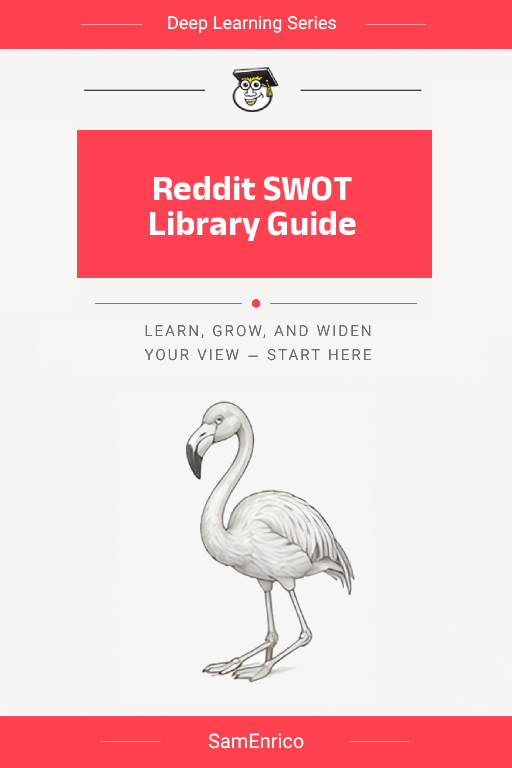
Non-FictionStrategic AtlasSocial Media
Reddit SWOT Library Guide eBook
Analyze community platform, user-generated content
Analyze community platform, user-generated content, AI training data licensing, and monetization challenges.
Formats
Free sample
Chapter 1: The Authenticity Trap--–- On a humid summer evening in 2005, two University of Virginia roommates sat in a Cambridge coffee shop, nursing lukewarm lattes and a hangover from a failed startup idea called “My Mobile Menu.” Paul Graham, the legendary founder of Y Combinator, had just rejected their pitch. The idea—ordering food via text message—was too early, too niche, and frankly, too boring. Graham leaned across the table and said something that would inadvertently shape the next two decades of the internet: “You should build the front page of the internet instead.”That throwaway line became Reddit. And the question that has haunted every executive, investor, and moderator since is not whether Alexis Ohanian and Steve Huffman succeeded in building that front page—they did, spectacularly—but whether any community built on raw, unfiltered human expression can survive the relentless pressure to monetize that expression.This chapter argues that Reddit’s greatest strength—authenticity—is also its most dangerous liability. The same hands-off, engineer-driven culture that created fierce user loyalty and generated the most valuable conversational data on the web also permitted toxic subcultures to flourish, scared away billions in advertising revenue, and planted the seeds of a reputational crisis that continues to haunt the platform as it enters the public markets.
Understanding this contradiction is not merely historical curiosity; it is the prerequisite for every strategic decision Reddit will make in the AI era.The Birth of Authenticity Reddit launched in June 2005 as a simple, almost primitive website. There were no images, no profiles, no algorithms. Just links, text, and two arrows: one pointing up, one pointing down. The design was deliberately ugly—gray background, Courier font, minimal CSS. That ugliness was a feature, not a bug.
It signaled that Reddit was not a polished corporate product but a raw, unmediated public square.Huffman, the technical half of the duo, built the site with an almost religious commitment to neutrality. “We didn’t want to be the arbiters of what was good or bad,” he later told a reporter. “That was the community’s job.” Ohanian, the charismatic frontman, framed it in more grandiose terms: “We were giving the internet back to the people.”For the first few years, this philosophy worked brilliantly. Reddit grew organically, without marketing budgets or growth hacks. Early users described the experience as “electric”—a place where you could argue with strangers about programming languages, share obscure scientific papers, and watch memes born in real time.
The upvote system ensured that the most interesting content rose to the top, not the most profitable. There were no promoted posts, no sponsored trends, no algorithmic manipulation. Just humans voting.This period—roughly 2005 to 2010—is often romanticized by Reddit’s most loyal users as the “Golden Age.” And from a business perspective, it was also the age of blissful irrelevance. Reddit was a subsidiary of Condé Nast, which had acquired the company in 2006 for a reported 10to10 to 10to20 million. The母公司 treated Reddit as a quirky side project, a hedge against the decline of print magazines.
There was no pressure to generate significant revenue, no quarterly earnings calls, no Wall Street analysts asking about user growth. Reddit could afford to be authentic because it didn’t need to be profitable.That luxury would not last.The Free Speech Absolutism Experiment To understand Reddit’s authenticity, one must understand the subculture from which it emerged: the early internet’s free speech absolutism. This was the era of 4chan, Something Awful, and the Something Awful forums—spaces where the only rule was that there were no rules. The founding generation of Reddit users were refugees from these more chaotic platforms, seeking a slightly more organized version of the same ethos.Huffman and Ohanian absorbed this ideology without fully examining its consequences. In their telling, censorship was the enemy of innovation.
Any attempt to moderate content, ban users, or remove subreddits would betray the founding vision. “The community would police itself,” Huffman argued repeatedly. “Bad content would be downvoted into oblivion.”This assumption proved catastrophically naive.The downvote system, it turned out, was no match for coordinated bad actors. A small group of dedicated users could upvote racist content faster than the community could downvote it. More troubling, certain subreddits became echo chambers where toxic views were not just tolerated but celebrated.
r/jailbait, a subreddit dedicated to sexually suggestive photos of minors, operated openly for years before Condé Nast finally shut it down under threat of legal action. r/The_Donald became a hub for racist rhetoric, harassment campaigns, and conspiracy theories, growing to over 700,000 members before Reddit quarantined it in 2020.The problem was not that Reddit had bad people. Every large platform has bad people. The problem was that Reddit’s founding philosophy prevented it from developing the tools, policies, and institutional will to remove them. When journalists discovered r/jailbait in 2011, the ensuing scandal forced Ohanian to issue a tearful apology and ban the subreddit—but the damage was done.
Reddit was now associated with child exploitation content in the public imagination. Advertisers took notice.The Reputational Spiral Between 2011 and 2015, Reddit entered what can only be described as a reputational death spiral. Every few months, a new scandal would erupt: a subreddit dedicated to “creepshots” (non-consensual photos of women in public); the r/fatpeoplehate controversy (which led to Reddit’s first major ban wave in 2015); the Gamergate harassment campaign, which coordinated largely on Reddit. Each scandal would trigger a wave of negative press, which would cause advertisers to pause campaigns, which would put pressure on Condé Nast, which would cause Reddit leadership to issue a half-hearted apology, which would anger the user base, which would lead to more toxic behavior—and the cycle would begin again.The financial impact was real and measurable. In 2014, Reddit reportedly generated less than 8millioninannualrevenuedespitehavingover100millionmonthlyactiveusers.Bycomparison,Facebook’srevenueperuserwas8 million in annual revenue despite having over 100 million monthly active users.
By comparison, Facebook’s revenue per user was 8millioninannualrevenuedespitehavingover100millionmonthlyactiveusers.Bycomparison,Facebook’srevenueperuserwas12.50 in the same period. Reddit’s was $0.08.Advertisers articulated two specific fears, both rooted in Reddit’s authenticity problem. First, brand safety: no major brand wanted its ads displayed next to racist, misogynist, or violent content. A Coca-Cola ad appearing in r/The_Donald would spark a boycott. Second, audience quality: even in safe subreddits, advertisers worried that Reddit’s anonymous, argumentative user base was not the receptive, purchase-ready audience they could find on Facebook or Instagram.
Why pay to reach a user who might call your product “crap” in the comments?The Authenticity Paradox Here we arrive at the central contradiction that this chapter calls the Authenticity Paradox: Reddit’s value derives entirely from unfiltered human expression, but that same unfiltered expression makes the platform commercially unviable at scale.Consider the two sides of the paradox.Side A (Strength): Reddit’s authenticity creates unparalleled user loyalty and data quality. Users confess their deepest insecurities, share unvarnished opinions, and engage in lengthy, substantive debates. No other platform captures this raw human texture. A Reddit user’s post history is a psychological profile more accurate than any marketing segment Facebook could construct. This authenticity is why AI companies now pay $60 million per…
This is the end of the free sample. Get the eBook to keep going. Buy now
About this book
Details
- Author
- Akins Fermina
- Publisher
- SamEnrico
- Language
- English
- Genre
- Non-Fiction, Strategic Atlas, Social Media
- Released
- 2026-05-30
- Pages (approx.)
- 150
- Available as
- eBook, Audiobook

Read better in the ZLOADR app
Your eBooks on your phone or tablet. Sign in with your SamEnrico account and start reading.
More by Akins Fermina
 Assertive Communication for Social AnxietyAkins Fermina$11.99
 Back Pain Stretching WorkoutAkins Fermina$11.99
 Imposter Syndrome In TrainingAkins Fermina$11.99
 Unloved Child Self Worth CourseAkins Fermina$11.99
 The Twitter Envy Scroll WorkbookAkins Fermina$11.99
 The Weavers of the Forgotten Tapestry: Unraveling the Secrets of the Bayeux EmbroideryAkins Fermina$11.99
 Citation Rules for ESL StudentsAkins Fermina$12.99
 Collecting KnivesAkins Fermina$11.99
 Understanding MyositisAkins Fermina$17.99
 How to Start a Pace-makers (wholesale) Business (Beginners Guide)Akins Fermina$11.99
You may also like
 Hong Kong Handover 1997Dunn Johnnie$11.99
 Zumba For Postnatal Recovery CourseNeal Christian$11.99
 Zumba for BeginnersLadner Nikia$11.99
 YouTube Comment Mining GuideHumes Pandora$12.99
 Worry Box MeditationCarlin Rudy$11.99
 Workplace Stress MeditationNguyen Lynn$11.99
 Workplace Stress and Sleep RepairHawley Ivory$11.99
 Workplace Perfectionism CureDelaney Jeffry$11.99
 Workplace Injustice Anger GuideWallen Isabelle$11.99
 Work Addiction and Burnout LinkGreenwood Ester$11.99
 Women in Yoga and WellnessBeattie Galina$11.99
 Women in Stand Up ComedyChun Evangeline$11.99