
Non-FictionSelf-HelpOnline Behavior
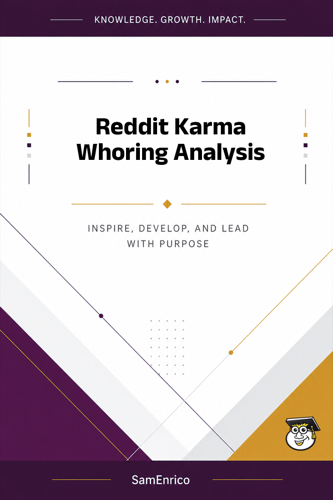
Reddit Karma Whoring Analysis eBook
Reveals how seeking upvotes distorts authentic pos
by Ralston Cori
Reveals how seeking upvotes distorts authentic posting behavior.
Formats
Free sample
Chapter 1: The Skinner Box...–- On July 23, 2005, a simple arrow-shaped button changed the nature of human conversation forever. That was the day Reddit launched its voting system—a feature so seemingly innocuous that its designers believed they were building a better mousetrap for quality content. Instead, they built a digital Skinner box, and we have been pressing that lever for points ever since.The founding myth of Reddit is almost utopian in its innocence. Co-founders Steve Huffman and Alexis Ohanian envisioned a platform where the community would serve as its own editor. The best content would rise to the top; the worst would sink into oblivion.
Every user would have an equal voice. Every post would be judged on its merits. The upvote and downvote buttons were supposed to be the instruments of digital democracy—a way for collective wisdom to triumph over noise, spam, and mediocrity.What actually happened defied every assumption of that utopian vision. Within two years of Reddit’s launch, researchers began documenting a strange behavioral shift. Users were not voting on content quality.
They were voting on emotional resonance. They were not contributing original thoughts. They were repeating what had already succeeded. They were not behaving like citizens in a democratic forum. They were behaving like rats in an experimental chamber, pressing a lever for a dopamine pellet that arrived on an unpredictable schedule.This is the central paradox that this book will unravel: a system designed to reward the best content ended up systematically rewarding the worst behaviors.
The Karma point—that seemingly trivial integer attached to every post and comment—did not measure quality. It measured something far more primitive. And once we understood what it actually measured, we could not stop ourselves from chasing it.The Birth of Econometrization Before Reddit, social approval was qualitative. You received compliments, nods, laughter, or silence. You felt accepted or ignored, but you could not measure acceptance with any precision.
The upvote changed everything by introducing what sociologists would later call econometrization—the transformation of subjective social approval into a measurable, cumulative, hoardable currency.The term comes from the work of digital media scholars Annemarie Richterich and Karin Wenz, who studied Reddit’s Karma system as a case study in peer-production dynamics. Their 2014 analysis, published in the journal Information, Communication & Society, was among the first to recognize that Karma was not merely a gamification feature but a fundamental restructuring of social interaction. When approval has a number, you can compare it. You can compete over it. You can optimize for it.
And once optimization becomes possible, authenticity becomes a liability.Consider what the upvote actually represents. In Reddit’s official documentation, the upvote means "I think this contributes to the community." In practice, the upvote means approximately seventeen different things, most of which have nothing to do with contribution. It means "I agree." It means "This made me laugh." It means "I feel the same way." It means "This confirms my existing beliefs." It means "I want others to see this." It means "I like the person who posted this." It means, most damning of all, "I have already seen this before and I remember liking it."Each of these meanings produces a different voting pattern. Agreement voting produces echo chambers. Laughter voting produces memes.
Emotional voting produces outrage cycles. Confirmation voting produces tribalism. Recognition voting produces reposts. None of these patterns produce the one thing the system was supposed to produce: the best content rising to the top based on its informational value.The econometrization of approval did not just change how users voted. It changed why users posted.
Before Karma, you posted because you had something to say. After Karma, you posted because you had something to gain. The intrinsic motivation to share, teach, question, and connect was gradually supplanted by the extrinsic motivation to accumulate points. And because extrinsic motivation is easier to measure and compare, it quickly dominated the platform’s incentive structure.The Self-Post Disaster: A Natural Experiment If you want proof that behavior follows the points, look no further than Reddit’s self-post policy change of July 2008. For the first three years of Reddit’s existence, text-based submissions—called "self-posts"—did not generate Karma.
Only link posts did. The logic was straightforward: links pointed to external content that could be evaluated; self-posts were just people talking, and anyone could talk.The result was catastrophic for authentic discourse. Users who wanted to ask a genuine question, share a personal story, or start a nuanced discussion had to choose between receiving Karma (by posting a link) or receiving no Karma (by posting text). They chose Karma. Self-posts became the ghost towns of Reddit—inhabited only by those who either did not care about points or had not yet learned the system’s rules.Then, in July 2008, Reddit announced a policy change: self-posts would now generate Karma.
The announcement was met with cautious optimism. Surely, the thinking went, this would encourage more thoughtful, original content. Users would no longer have to choose between authenticity and reward.What happened instead was one of the most instructive behavioral shifts in internet history. Self-posts exploded overnight—not because people suddenly had more to say, but because the points had moved. The same users who had abandoned text submissions for link submissions reversed course within weeks.
The type of content did not change; the incentive structure did. And behavior followed incentives like a compass follows magnetic north.This natural experiment reveals something profound about human motivation on social platforms. We like to believe that we post because we have something to contribute. The data suggests otherwise. We post because the system rewards posting.
When the rewards move, we move. When the rewards disappear, so do we. The content is almost incidental—a vehicle for point acquisition rather than an end in itself.The Skinnerian Feedback Loop To understand why Karma is so effective at shaping behavior, we need to leave sociology for a moment and enter the laboratory of B.F. Skinner. In the 1950s, Skinner discovered something remarkable about animal learning: rewards delivered on an unpredictable schedule produce the most persistent behavior.
A rat that receives a food pellet every time it presses a lever will press the lever frequently, but it will stop pressing quickly when the food stops coming. A rat that receives a food pellet sometimes when it presses the lever—unpredictably, irregularly, without pattern—will press the lever obsessively, compulsively, long after the food has stopped entirely.This is called variable ratio reinforcement, and it is the most powerful behavioral conditioning mechanism ever discovered. Casinos use it. Slot machines use it. Notification badges use it.
And Reddit’s Karma system is a textbook implementation of variable ratio reinforcement.Consider what happens when you post on Reddit. You do not know if you will receive upvotes or downvotes. You do not know how many. You do not know when they will arrive. The first upvote might come in three seconds or three hours.
The tenth might never come at all. This unpredictability is not a bug; it is the engine of addiction. Your brain releases dopamine not when you receive a reward, but…
This is the end of the free sample. Get the eBook to keep going. Buy now
About this book
Details
- Author
- Ralston Cori
- Publisher
- SamEnrico
- Language
- English
- Genre
- Non-Fiction, Self-Help, Online Behavior
- Released
- 2026-06-05
- Pages (approx.)
- 144
- Available as
- eBook, Audiobook

Read better in the ZLOADR app
Your eBooks on your phone or tablet. Sign in with your SamEnrico account and start reading.
More by Ralston Cori
 Hoffa Case Federal Judge Unsealed FilesRalston Cori$11.99
 Eye Contact Mastery GuideRalston Cori$11.99
 Atomic Habits For FocusRalston Cori$11.99
 Trello Member Mention StrategiesRalston Cori$11.99
 Tourniquet Application StepsRalston Cori$11.99
 Remote Work Focus MusicRalston Cori$11.99
 Relaxation TrainingRalston Cori$11.99
 The Last Pharaoh's Gambit: Cleopatra's Forgotten HeirRalston Cori$11.99
 The Unstoppable Will of Antonio Pettigrew: The 1996 Atlanta Olympics' Hidden HeroRalston Cori$11.99
 How to Produce Trade Show ServicesRalston Cori$11.99
 Growing BroussonetiaRalston Cori$11.99
 EU VAT Grouping Rules GuideRalston Cori$12.99
You may also like
 Hong Kong Handover 1997Dunn Johnnie$11.99
 Zumba For Postnatal Recovery CourseNeal Christian$11.99
 Zumba for BeginnersLadner Nikia$11.99
 YouTube Comment Mining GuideHumes Pandora$12.99
 Worry Box MeditationCarlin Rudy$11.99
 Workplace Stress MeditationNguyen Lynn$11.99
 Workplace Stress and Sleep RepairHawley Ivory$11.99
 Workplace Perfectionism CureDelaney Jeffry$11.99
 Workplace Injustice Anger GuideWallen Isabelle$11.99
 Work Addiction and Burnout LinkGreenwood Ester$11.99
 Women in Yoga and WellnessBeattie Galina$11.99
 Women in Stand Up ComedyChun Evangeline$11.99