
Non-FictionSelf-HelpOnline Validation
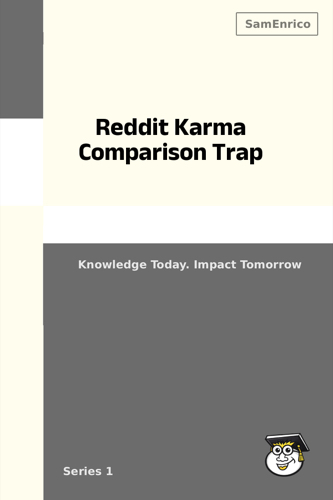
Reddit Karma Comparison Trap eBook
Stop seeking validation through upvotes and commen
by Giles Nestor
Stop seeking validation through upvotes and comment karma on Reddit threads.
Formats
Free sample
Chapter 1: The Invisible Scoreboard--–- The first time you checked your karma today, you probably did not even notice you were doing it. Maybe you were standing in line for coffee, your thumb already opening the app before your brain had fully woken up. Maybe you were sitting on your couch, the television playing something you had already stopped watching, and your fingers found the orange icon by muscle memory alone. Maybe you were lying in bed at 11:47 PM, telling yourself you would close the app after just one more scroll, and then you saw the number—up three points since your last check—and you felt something small but real. A flicker of validation.
A tiny hit of dopamine. Enough to keep you refreshing for another hour.This is not a moral failure. This is not a sign of weakness or poor character. This is the predictable result of a human brain encountering a reward system designed by engineers who understand exactly how to keep you hooked. The shame you feel about checking your karma is not the solution—it is the second trap, the one that convinces you that your addiction is a personal failing rather than a design feature.
You cannot shame yourself into freedom any more than a pigeon can shame itself into ignoring the lever. The lever was built to be irresistible. The only way out is to understand the lever, to see the invisible scoreboard for what it is, and to choose a different game.This chapter is about that scoreboard. It is about why you cannot stop looking at it, why it feels so personal when the number goes down and so hollow when it goes up, and how the validation economy of Reddit has convinced millions of intelligent, thoughtful people that their worth can be measured in points. By the time you finish this chapter, you will see the karma system differently.
Not as a neutral tool for sorting comments, but as a psychological architecture that has quietly hijacked your relationship with one of the most valuable resources you possess: your attention.The Great Masquerade Let us begin with a question that seems simple but is not: What is karma, really?If you ask Reddit, karma is a reputation system. Upvotes indicate that a post or comment is valuable to the community. Downvotes indicate that it is not. Over time, users who consistently post valuable content accumulate karma, which signals to others that they are trustworthy, knowledgeable, or entertaining. This is the official story.
It is printed in Reddit’s FAQ, repeated by moderators, and believed by millions of users who have never stopped to ask whether it is true.It is not true.Karma is not a reputation system. It is a gamification layer disguised as a reputation system. The difference is not academic. A reputation system rewards behavior that benefits the community over the long term. A gamification layer rewards behavior that benefits the platform in the short term, regardless of its long-term value to anyone—including you.Consider how actual reputation systems work.
On e Bay, seller ratings reflect whether buyers received their items as described and on time. A seller with a high rating is statistically more likely to deliver a good experience. The rating is predictive. On Reddit, karma is not predictive of anything except your ability to produce content that the hivemind upvotes. A user with 500,000 karma might be a brilliant essayist, or they might be a bot that reposts the top memes from six months ago.
The number tells you nothing about the quality of their next post. It only tells you about their past success at playing the game.Worse, karma actively discourages the kind of behavior that builds genuine community. A thoughtful, controversial, or nuanced post might receive fewer upvotes than a low-effort joke. A user who admits they were wrong—one of the most valuable contributions any community can receive—might be downvoted for changing their position. A question from a beginner, asked in good faith, might be buried because it has been asked before.
The karma system does not reward what is true, or helpful, or brave. It rewards what is popular in this moment, in this subreddit, with this particular crowd.And because what is popular changes constantly, the game never ends. You cannot "win" at karma. There is no finish line. There is only the next post, the next refresh, the next tiny hit of dopamine.The Three-Second High To understand why karma is so addictive, you must understand the neuroscience of variable rewards.
In the 1950s, psychologist B.F. Skinner placed pigeons in boxes with levers. When the pigeon pecked the lever, it sometimes received a food pellet. Skinner discovered that the pattern of reward dramatically affected how often the pigeon pecked.When the lever delivered a pellet every single time, the pigeon pecked regularly but stopped quickly when the food ran out. The behavior was efficient but not obsessive.When the lever delivered a pellet on an unpredictable schedule—sometimes after one peck, sometimes after ten, sometimes after fifty—the pigeon pecked obsessively.
It pecked long after the food stopped coming. It pecked until it collapsed from exhaustion. The unpredictability had hijacked its brain.Your brain is the pigeon. The "post" button is the lever. The orange envelope is the pellet.You check your karma obsessively not because you are weak, but because your brain is wired to find unpredictable rewards irresistible.
When you post a comment, you have no idea whether it will receive five upvotes or five thousand. That uncertainty triggers a dopamine spike before any reward arrives. Then, when the reward does arrive—or when it does not—another spike follows. The cycle repeats with every refresh.I call this the "Three-Second High." It is the brief window between seeing the orange envelope and reading its contents. In those three seconds, the notification could contain anything: praise, agreement, a thoughtful counterargument, or a personal insult.
Your brain floods with dopamine in anticipation. Then you read the message. The dopamine crashes. And within seconds, you are already wondering when the next envelope will appear.Here is the cruelest part: negative notifications also trigger dopamine. An angry reply, a downvote, a correction—these are also variable rewards because they are unpredictable.
Your brain cannot distinguish between "reward" and "punishment" in the moment. It only registers that something happened. So you check just as obsessively after a downvote as after an upvote, because the next notification might be the one that validates you.This is why "taking a break" from Reddit is so difficult. You are not addicted to feeling good. You are addicted to not knowing how you will feel.The Architecture of Addiction Reddit did not accidentally become addictive.
The platform's designers made choices that systematically exploit the dopamine loop. These choices are not malicious—most were made to increase engagement, which increases ad revenue, which keeps the site free. But understanding them is the first step to breaking free.Infinite Scroll. Reddit loads new content automatically as you reach the bottom of the page. There is no natural stopping point, no "end" to signal that you…
This is the end of the free sample. Get the eBook to keep going. Buy now
About this book
Details
- Author
- Giles Nestor
- Publisher
- SamEnrico
- Language
- English
- Genre
- Non-Fiction, Self-Help, Online Validation
- Released
- 2026-06-09
- Pages (approx.)
- 115
- Available as
- eBook, Audiobook

Read better in the ZLOADR app
Your eBooks on your phone or tablet. Sign in with your SamEnrico account and start reading.
More by Giles Nestor
 Mayor of a Food DesertGiles Nestor$11.99
 Amazon Buy Box StrategyGiles Nestor$11.99
 Product Recall Leadership GuideGiles Nestor$11.99
 Thyroid JournalGiles Nestor$11.99Thyroid JournalGiles Nestor$11.99
 Parenting Child With Mental IllnessGiles Nestor$11.99
 Financial Stress for New ParentsGiles Nestor$11.99
 Time Tracking Ethics GuideGiles Nestor$11.99
 Dream Journal For MemoryGiles Nestor$11.99
 The Banquet of Louis XIV: Feasting Like a Sun KingGiles Nestor$11.99
 Sunrise Over the Sahara: The Desert Miracle of Noor OuarzazateGiles Nestor$11.99
 Charlemagne's Carolingian Canticles: The Music That United a ContinentGiles Nestor$11.99
You may also like
 Hong Kong Handover 1997Dunn Johnnie$11.99
 Zumba For Postnatal Recovery CourseNeal Christian$11.99
 Zumba for BeginnersLadner Nikia$11.99
 YouTube Comment Mining GuideHumes Pandora$12.99
 Worry Box MeditationCarlin Rudy$11.99
 Workplace Stress MeditationNguyen Lynn$11.99
 Workplace Stress and Sleep RepairHawley Ivory$11.99
 Workplace Perfectionism CureDelaney Jeffry$11.99
 Workplace Injustice Anger GuideWallen Isabelle$11.99
 Work Addiction and Burnout LinkGreenwood Ester$11.99
 Women in Yoga and WellnessBeattie Galina$11.99
 Women in Stand Up ComedyChun Evangeline$11.99