

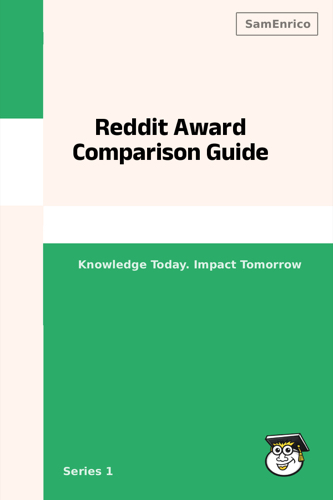
Non-FictionSelf-HelpAwardsRecognition
Reddit Award Comparison Guide eBook
Stop comparing your post awards and recognition to
Stop comparing your post awards and recognition to highly awarded content.
Formats
Free sample
Chapter 1: The Refresh Loop--You have just posted something you care about.Maybe it was a carefully researched answer in a history subreddit, three hours of cross-referencing Wikipedia and JSTOR. Maybe it was a vulnerable confession in a mental health community, a paragraph you typed and deleted seventeen times before hitting submit. Maybe it was a joke you thought was original, the first genuinely funny thing you have written in weeks. Whatever it was, you cared about it. It cost you something—time, emotional energy, creative risk.And now you wait.One minute passes.
Nothing. Two minutes. A single upvote appears. Your chest unclenches slightly. Three minutes.
Nothing else. Four minutes. You refresh the page. Five minutes. You refresh again.
Your thumb moves before your brain approves the motion. The page reloads. The upvote count is unchanged. Your jaw tightens.You tell yourself you are just checking. You are not checking.
You are performing a ritual that social media platforms have spent billions of dollars to optimize. You are a rat in a cage, pressing a lever, waiting for a pellet. The pellet is a number. The number means nothing outside this cage. And yet you cannot stop pressing.This book is about that lever.
It is about the cage. And it is about why the pellet is poison disguised as gold.But before we deconstruct the platform, before we cite the studies, before we build the detox, we have to name the thing that brought you here. You are reading this book for one reason. It is not curiosity. It is not intellectual interest.
It is pain. You have compared your post—the one you labored over, the one that cost you something—to a post that received thousands of upvotes, a cascade of awards, a mountain of gilded badges. And you have concluded, perhaps silently, perhaps with brutal clarity, that your work is worth less.That conclusion is wrong. Not inaccurate. Not misguided.
Wrong. And the proof of its wrongness is the reason this book exists.The Invention of the Refresh Let us go back to 2005. Reddit launches as a simple link aggregator. Users submit links. Other users upvote or downvote them.
The front page displays the most popular links of the last twenty-four hours. There are no comments, no user profiles, no Karma scores, no awards, no trophies, no coins, no premium subscriptions. The entire platform fits on a single server. The founders, Steve Huffman and Alexis Ohanian, have no idea that they have just invented one of the most powerful behavioral reinforcement systems in human history.The upvote button was not designed to be addictive. It was designed to be democratic.
The idea was simple: let the community decide what rises to the top. No editors, no gatekeepers, no centralized authority. Just millions of small choices aggregating into collective wisdom.That was the theory.The reality, as it almost always is with social media, was different. Within two years, researchers noticed something strange. Users were not just upvoting content they liked.
They were upvoting content that had already been upvoted. The rich got richer. The first few votes on a post determined its entire trajectory. A post that received three upvotes in the first five minutes had a 70 percent higher chance of reaching the front page than an identical post that received its first three upvotes fifteen minutes later.This is called the momentum effect, and it is the original sin of every ranking algorithm. The platform does not measure quality.
It measures velocity. And velocity has nothing to do with truth.Let me be specific. Reddit's algorithm, in its simplest form, works like this:Hotness score = log(upvotes) + (time since posting)/45000That is not the exact formula—Reddit has tweaked it dozens of times—but the logic is constant. A post's position on the front page is determined by two variables: the raw number of upvotes (logarithmically scaled, meaning the first ten upvotes matter more than the next hundred) and the age of the post (older posts decay). The result is a system that ruthlessly prioritizes early engagement.
If your post does not get upvotes in the first fifteen minutes, it will never be seen by the vast majority of users. It does not matter if your post is the most brilliant, insightful, valuable thing ever written on the platform. If the first fifty people who see it scroll past, it dies.Now add Karma to this system.Karma was introduced as a gamification layer. The founders noticed that users who received upvotes tended to post more. So they gave users a score: one point of Karma for each upvote received, minus one point for each downvote.
The score appeared next to every username. Users could see, at a glance, how much the community had validated them.This was the lever.From a behavioral psychology perspective, the Karma system is a near-perfect variable reward schedule. B.F. Skinner, the father of operant conditioning, discovered that animals press levers most frantically when the reward is unpredictable. If a rat receives a pellet every time it presses a lever, it will press the lever until it is full and then stop.
But if the rat receives a pellet randomly—sometimes after one press, sometimes after ten, sometimes after fifty—it will press the lever obsessively. It will press the lever until it collapses from exhaustion.Reddit's Karma system is a variable reward schedule. You do not know which post will succeed. You do not know how many upvotes you will receive. You do not know when the notification will come.
So you refresh. And refresh. And refresh.The Invention of the Award In 2010, Reddit introduced Gold.The origin story is almost quaint. A user named Christopher Slowe (u/Keyser Sosa) suggested that Reddit add a way for users to give money directly to other users as a "thank you" for particularly good posts. The idea was simple: for four dollars, you could give someone a month of Reddit Premium (then called Reddit Gold) and a small gold badge would appear next to their post.
The recipient received no money—only the badge and a month of ad-free browsing.For the first few years, Gold was rare. It was meaningful. Receiving Gold felt like winning a minor award from a respected institution. Users would post heartfelt thank-yous. Subreddits would celebrate their gilded members.
It was, by all accounts, a genuinely positive addition to the platform.Then Reddit realized what they had built.Gold was not just a thank-you. It was a revenue stream. Every time someone bought Gold, Reddit made money. And users who received Gold were more likely to buy Gold for others. The system fed itself.
So Reddit did what any for-profit company would do: they expanded the system.In 2018, Reddit replaced Gold with a new system called Coins. Users could now buy packs of Coins (500 for $1.99, 1,800 for $6.99, 7,200 for $24.99, 20,000 for $64.99) and spend them on a growing menu of awards. The original Gold award cost 500 Coins. A new Platinum award cost 1,800 Coins and gave the recipient a month of Premium. A Silver award cost 100 Coins and gave nothing—it was purely decorative.
Over time, Reddit added dozens of awards: Wholesome, Rocket Like, Take My Energy, Starstruck, Facepalm, among others. Each award had…
This is the end of the free sample. Get the eBook to keep going. Buy now
About this book
Details
- Author
- Martz Santana
- Publisher
- SamEnrico
- Language
- English
- Genre
- Non-Fiction, Self-Help, Awards, Recognition
- Released
- 2026-06-09
- Pages (approx.)
- 130
- Available as
- eBook, Audiobook

Read better in the ZLOADR app
Your eBooks on your phone or tablet. Sign in with your SamEnrico account and start reading.
More by Martz Santana
 Renting in Retirement Pros and ConsMartz Santana$11.99
 FTC Influencer Disclosure GuidelinesMartz Santana$11.99
 Teaching Children AssertivenessMartz Santana$11.99
 Weight Loss Goal Setting GuideMartz Santana$11.99
 The Silk Road Scam: How a Teen Hacker Extorted Millions from the Dark WebMartz Santana$11.99
 India B2B Procurement OutlookMartz Santana$12.99
 J.K. Rowling Detour MapMartz Santana$12.99
 Deputy DirectorMartz Santana$11.99
 Understanding Intestinal LymphangiectasiaMartz Santana$17.99
 A Beginners Guide to Board track racing (Volume 1)Martz Santana$11.99
You may also like
 Hong Kong Handover 1997Dunn Johnnie$11.99
 Zumba For Postnatal Recovery CourseNeal Christian$11.99
 Zumba for BeginnersLadner Nikia$11.99
 YouTube Comment Mining GuideHumes Pandora$12.99
 Worry Box MeditationCarlin Rudy$11.99
 Workplace Stress MeditationNguyen Lynn$11.99
 Workplace Stress and Sleep RepairHawley Ivory$11.99
 Workplace Perfectionism CureDelaney Jeffry$11.99
 Workplace Injustice Anger GuideWallen Isabelle$11.99
 Work Addiction and Burnout LinkGreenwood Ester$11.99
 Women in Yoga and WellnessBeattie Galina$11.99
 Women in Stand Up ComedyChun Evangeline$11.99