
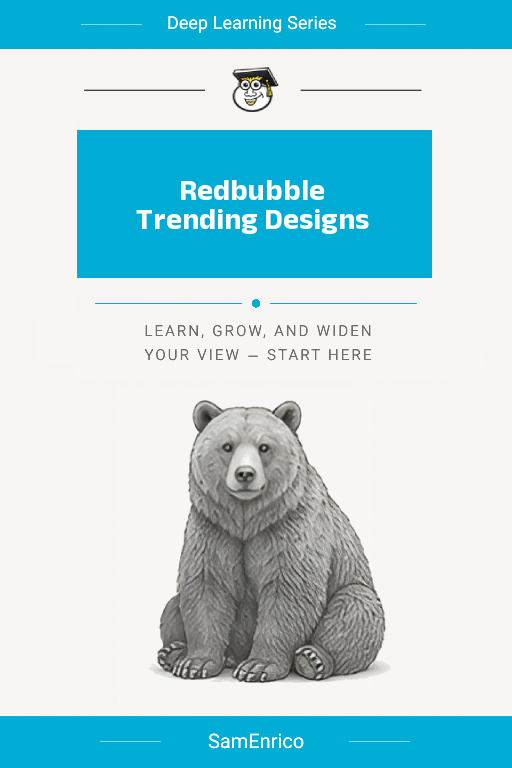
Non-FictionSide Hustle ArchitectTrendsResearch
Redbubble Trending Designs eBook
Identify trending designs on Redbubble and create
by Block Livia
Identify trending designs on Redbubble and create AI generated variations for passive income.
Formats
Free sample
Chapter 1: The Algorithm Awakens--The year is 2019. A graphic designer named Sarah spends twelve hours illustrating a detailed watercolor fox for her Redbubble shop. She uploads it with perfect tags, a loving description, and a prayer. Three months later, it has sold exactly zero times.The year is 2025. A former cashier named Marcus has never taken an art class.
He spends twenty minutes generating a sarcastic cactus design using artificial intelligence, uploads it with researched keywords, and sells two hundred stickers in his first ninety days.What changed? Not effort. Not talent. Not luck.The algorithm changed.Welcome to Print-on-Demand 2.0, where artistic skill has been commoditized and the new currency is the ability to read data, predict demand, and let technology handle the rendering. This book is not about becoming a better artist.
It is about becoming a better researcher. It is about understanding that on Redbubble, the person who spots the trend first wins – not the person who draws the best fox.If you picked up this book hoping for a magic "upload and get rich" button, close it now. That does not exist. But if you are willing to learn how algorithms think, how search behavior reveals hidden demand, and how to train artificial intelligence to produce exactly what that demand wants, then you have found the only roadmap you will ever need.This chapter will dismantle everything you think you know about selling on Redbubble. You will learn why the old rules of "make good art and wait" are bankrupt.
You will see exactly how Redbubble's algorithm decides what to show and what to bury. And perhaps most importantly, you will receive a realistic, data-backed income projection that will save you from quitting when the first month yields only three dollars and seventy-two cents.Let us begin.The Death of the Starving Artist Myth For decades, the creative economy operated on a simple but brutal premise: talent rises to the top. The best painters got gallery shows. The best illustrators got book deals. The best designers got hired by agencies.
Everyone else starved – or kept their day jobs.Print-on-Demand platforms initially promised to democratize this system. For the first time, anyone could upload a design and sell it on a t-shirt or sticker without holding inventory. The barrier to entry dropped from thousands of dollars (screen printing equipment, minimum orders, warehouse space) to zero dollars.But democracy created a new problem: saturation.As of 2026, Redbubble hosts over eight million active artists and more than eighty million designs. The competition for attention is not a battlefield; it is a gladiator pit. In the time it takes you to read this sentence, approximately forty new designs will be uploaded to Redbubble globally.Under the old model, the artist with the most skill won.
Under the current model, the artist with the most signal wins – the one who understands what the algorithm wants before the algorithm even knows it wants it.Here is the truth that successful sellers have learned and failing sellers refuse to accept: Redbubble does not care how beautiful your design is if nobody searches for it. The platform is not an art gallery. It is a search engine with a shopping cart.When a customer types "funny nurse coffee mug" into Redbubble's search bar, the platform has approximately two hundred milliseconds to retrieve and rank relevant results. It does not have time to appreciate your brushwork or your color harmony. It looks for keywords, historical sales velocity, and engagement signals.
That is it.Artificial intelligence has accelerated this shift dramatically. Tools like Adobe Firefly, Midjourney, and DALL-E have lowered the technical barrier to entry so low that a twelve-year-old with a credit card can generate professional-looking vector art. This means that "being able to draw" is no longer a competitive advantage. It is table stakes.The new competitive advantage is knowing what to draw. And that comes from one place only: data.Redbubble Versus The Alternatives Before we dive deeper into the algorithm, we need to establish why Redbubble is the correct platform for the strategies in this book.
You could take these same principles to Etsy, Amazon Merch, Society6, or Tee Public. But each platform has structural differences that make Redbubble the ideal sandbox for beginners.Etsy is a marketplace with a massive audience – nearly one hundred million active buyers. However, Etsy requires you to drive your own traffic or pay for its internal advertising system. New shops with zero sales and zero reviews get buried unless they pay. The book's later chapters will show you how to migrate your best Redbubble designs to Etsy once you have proven demand.
But for a beginner, starting on Etsy is like opening a restaurant in a city where you have to pay every passerby just to look at the menu.Amazon Merch on Demand has the largest audience of any platform, but it is invitation-only and notoriously difficult to tier up. You cannot simply create an account and start uploading. You must apply, wait months, and prove your sales history elsewhere – which is why this book treats Amazon Merch as a destination, not a starting point.Society6 is curator-driven. Its staff selects designs for homepage placement and promotional emails. This works well if you already have a following or a distinctive style.
But it works terribly for systematic, data-driven sellers who want to test dozens of niches quickly. You do not control your destiny on Society6; the curators do.Redbubble sits in a unique sweet spot. It has a large built-in audience – approximately fifteen million monthly visitors – who come specifically to shop for niche, quirky, and personalized items. Unlike Etsy, Redbubble does not force you to pay for visibility. Unlike Amazon Merch, anyone can join instantly.
Unlike Society6, the algorithm rewards volume and relevance, not curator whims.But here is the crucial nuance that most guides get wrong, and the one that caused confusion in earlier drafts of this book: Redbubble's built-in audience is sufficient to get you to approximately two hundred to five hundred dollars per month. That is your baseline. That is the floor, not the ceiling.To go beyond that – to reach two thousand or five thousand or ten thousand dollars per month – you will need to supplement Redbubble's organic traffic with external channels, primarily Pinterest. Chapter seven is devoted entirely to this "flywheel" effect. For now, understand that Redbubble gives you a running start, but you must eventually push your own sled.How Redbubble's Algorithm Actually Works Most sellers treat Redbubble's algorithm as a black box – mysterious, capricious, impossible to understand.
This is a mistake. The algorithm is not magic. It is code. And code follows rules.Redbubble's search and ranking system evaluates every design across approximately two dozen signals. The three most important signals, based on extensive testing by top sellers and data analysis of thousands of shops, are as follows.Search Query Relevance is the first gatekeeper.
When a customer types "sarcastic succulent sticker," Redbubble scans your title and tags for those exact words and related synonyms. If your design does not contain "sarcastic," "succulent," and "sticker" in its metadata, it will never appear – no matter how beautiful it is. This…
This is the end of the free sample. Get the eBook to keep going. Buy now
About this book
Details
- Author
- Block Livia
- Publisher
- SamEnrico
- Language
- English
- Genre
- Non-Fiction, Side Hustle Architect, Trends, Research
- Released
- 2026-05-29
- Pages (approx.)
- 141
- Available as
- eBook, Audiobook

Read better in the ZLOADR app
Your eBooks on your phone or tablet. Sign in with your SamEnrico account and start reading.
More by Block Livia
 Self Hypnosis For Pain Management WorkbookBlock Livia$11.99
 Chunking for Data AnalysisBlock Livia$11.99
 The Anger Postmortem MethodBlock Livia$11.99
 Exercise Focus Protection GuideBlock Livia$11.99
 Recurring Dream Interpretation GuideBlock Livia$11.99
 Hops & Hustle: The Untold Story of the Beer Barons Who Built AmericaBlock Livia$11.99
 Codex of the Forgotten: The AI ArchaeologistBlock Livia$11.99
 Shape Up Kanban for BasecampBlock Livia$12.99
 Understanding Endomyocardial FibroelastosisBlock Livia$17.99
 How to Start a Prefabricated Buildings or Elements Thereof Made of Wood Business (Beginners Guide)Block Livia$11.99
 Fulfillment Department ManagerBlock Livia$11.99
You may also like
 Hong Kong Handover 1997Dunn Johnnie$11.99
 Zumba For Postnatal Recovery CourseNeal Christian$11.99
 Zumba for BeginnersLadner Nikia$11.99
 YouTube Comment Mining GuideHumes Pandora$12.99
 Worry Box MeditationCarlin Rudy$11.99
 Workplace Stress MeditationNguyen Lynn$11.99
 Workplace Stress and Sleep RepairHawley Ivory$11.99
 Workplace Perfectionism CureDelaney Jeffry$11.99
 Workplace Injustice Anger GuideWallen Isabelle$11.99
 Work Addiction and Burnout LinkGreenwood Ester$11.99
 Women in Yoga and WellnessBeattie Galina$11.99
 Women in Stand Up ComedyChun Evangeline$11.99