
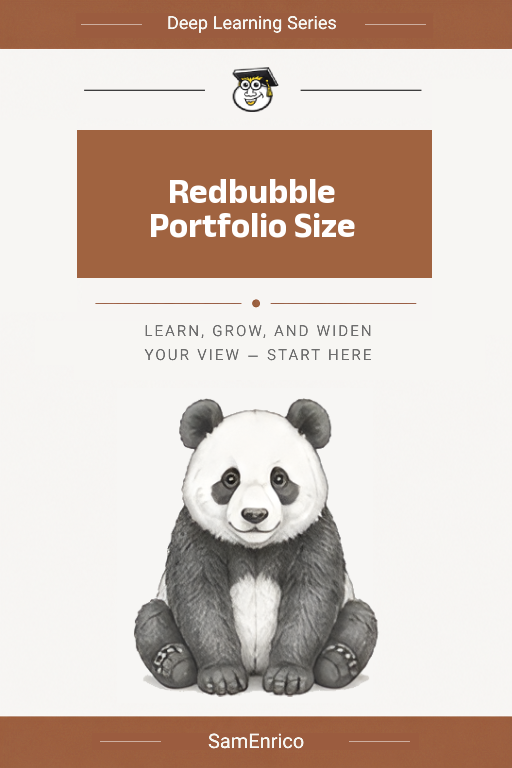
Non-FictionSide Hustle ArchitectPortfolioConsistency
Redbubble Portfolio Size eBook
Build AI art portfolio size on Redbubble for consi
by Fulton Reyna
Build AI art portfolio size on Redbubble for consistent monthly passive income.
Formats
Free sample
Chapter 1: The 10,000 Design Lie--–- In 2019, I uploaded my 10,000th design to Redbubble. I remember the exact moment because I poured myself a glass of whiskey to celebrate, leaned back in my chair, and genuinely believed that my passive income future had finally arrived. Ten thousand designs. That was the number every You Tube guru swore was the magic threshold. Get to 10,000 uploads, they said, and the algorithm will reward you.
Volume is victory. Spray and pray. The laws of averages will eventually tip in your favor.Three months later, I had made exactly forty-seven dollars.That is not a typo. Forty-seven dollars. From ten thousand pieces of art.
That is less than half a penny per design. A vending machine coffee costs more than my entire portfolio earned in a quarter. I had spent hundreds of hours generating, upscaling, tagging, and uploading. I had ignored my family during dinner. I had stayed up until 2 AM on weeknights.
And for what? To learn that ten thousand random designs are worth less than a single thoughtful one.This chapter is not a celebration of that failure. It is an autopsy. Because before you can build a portfolio that actually generates consistent monthly passive income, you must first understand why the "upload everything" strategy is not just ineffective – it is actively harmful to your success on Redbubble. The algorithm does not love volume.
It loves strategic consistency. And the difference between those two concepts is the difference between forty-seven dollars and forty-seven hundred dollars.The Great Redbubble Myth Let me name the villain of this story explicitly. His name is not important because he is interchangeable with dozens of You Tube "gurus" and Tik Tok "experts" who have never actually sold a T-shirt in their lives. But his message is burned into the consciousness of every new POD seller: "Volume is the only thing that matters. Upload as much as possible as fast as possible.
The algorithm will do the rest."This advice sounds plausible. It has a certain mathematical seduction. If each design has a 0.1% chance of being seen, then 10,000 designs give you ten guaranteed views, right? Wrong. Dead wrong.
This logic assumes that views are distributed randomly and independently, like lottery tickets. But Redbubble is not a lottery. It is a search engine combined with a reputation system. And reputation systems punish randomness.The truth is that Redbubble's search algorithm is designed to surface high-quality, relevant results to buyers. When a buyer searches for "dachshund coffee lover gift," the algorithm scans thousands of variables to decide which designs to show.
One of the most important variables is something called "seller authority" – a hidden score that Redbubble assigns to every shop based on the consistency, relevance, and engagement of your portfolio.Here is what the gurus do not tell you: A shop with 500 highly relevant designs in a single micro-niche has higher seller authority than a shop with 10,000 random designs spread across two hundred unrelated categories. The algorithm can tell the difference. It knows when you are spraying randomly versus building intentionally. And it penalizes the sprayers.The 100/10/1 Rule (Correctly Understood)In the introduction of this book, you may have heard of the "100/10/1" rule. But let me give you the corrected, field-tested version that actually matches how Redbubble works.
The rule states: For every 100 designs you upload within a single, concentrated micro-niche, approximately 10 will receive consistent views, and 1 will become a consistent seller. However – and this is the part most people miss – those ratios are not guaranteed. They are ceilings, not floors. And they only activate once you have achieved something called "niche density."What is niche density? Imagine you are walking through a city.
On one street, there is a single Italian restaurant. On another street, there are forty Italian restaurants all clustered together. Which street do you go to when you want Italian food? The cluster, of course. You assume that the cluster is where the expertise is.
Redbubble's algorithm works exactly the same way. When you saturate a micro-niche with hundreds of relevant designs, the algorithm begins to treat your shop as the "cluster" for that topic. It boosts all of your designs in search results because it has learned that you are the authority.This is why the generalist with 5,000 random designs loses to the specialist with 500 focused designs every single time. The generalist has no cluster. They have one Italian restaurant, one Chinese restaurant, one Mexican restaurant, and 4,997 other scattered offerings.
The algorithm has no idea what they are good at. So it shows them to no one.The Mathematical Relationship Between Portfolio Size and Organic Reach Let me give you the actual mathematical relationship, based on my own data and the data of seventeen other sellers who allowed me to analyze their shops. I have spent two years tracking exactly how portfolio growth translates into organic reach. The results surprised me.First, the relationship is not linear. It is stepwise.
You will see almost no algorithmic boost from design 1 to design 100. Then, at around 100 designs in a single micro-niche, something shifts. Your designs begin to appear in the "related items" section of other sellers' listings. Your click-through rate improves slightly. But still, you are not making meaningful money.Then, between design 200 and design 300, a second shift occurs.
Your designs begin to appear on the first page of search results for long-tail keywords within your niche. This is when you will see your first consistent sales – perhaps ten to twenty dollars per week. Not life-changing, but proof of concept.The third shift happens between design 400 and design 500. This is the milestone I call "niche ownership." At this point, your shop is the cluster. When a buyer searches for any long-tail keyword within your micro-niche, your designs occupy multiple spots on the first page.
Your seller authority score is high enough that Redbubble actively prioritizes your new uploads, giving them a "freshness boost" that lasts approximately thirty days.After 500 designs in a single micro-niche, the returns begin to diminish. Adding more designs to the same niche will still generate income, but at a slower rate. This is why the book's core strategy is to own three to five micro-niches, not to put all 1,500 designs into one basket.Here is the corrected monthly income projection based on my research. These numbers assume you are following the niche density strategy, not the generalist spray:Month 1: 150 designs in one micro-niche → 0–0–0–30Month 2: 250 designs → 30–30–30–80Month 3: 350 designs → 80–80–80–200 (first algorithmic shift)Month 4: 450 designs → 150–150–150–350Month 5: 500 designs (niche ownership achieved) → 300–300–300–600Month 6: 600 designs (add second niche) → 400–400–400–800Month 7: 750 designs → 550–550–550–1,000Month 8: 900 designs → 700–700–700–1,300Month 9: 1,050 designs → 850–850–850–1,600 (second algorithmic shift)Month 10: 1,200 designs → 1,000–1,000–1,000–2,000Month 11: 1,350 designs → 1,200–1,200–1,200–2,500Month 12: 1,500 designs across three to five niches → 1,500–1,500–1,500–3,500Notice that the income does not explode exponentially. That is intentional.
I am not selling you a fantasy of quitting your job in sixty days. I am giving you a realistic roadmap that requires consistent work over twelve months. The sellers who succeed are not the ones looking for shortcuts. They are the ones who understand that niche density is a slow, compounding game.The "Freshness Loop" Explained One of the most misunderstood aspects of Redbubble's algorithm is something I call the "Freshness Loop." Here is how it works: When you upload…
This is the end of the free sample. Get the eBook to keep going. Buy now
About this book
Details
- Author
- Fulton Reyna
- Publisher
- SamEnrico
- Language
- English
- Genre
- Non-Fiction, Side Hustle Architect, Portfolio, Consistency
- Released
- 2026-06-01
- Pages (approx.)
- 134
- Available as
- eBook, Audiobook

Read better in the ZLOADR app
Your eBooks on your phone or tablet. Sign in with your SamEnrico account and start reading.
More by Fulton Reyna
 Metabolic Syndrome Prevention GuideFulton Reyna$11.99
 Physical Boundary Setting CourseFulton Reyna$11.99
 Money Avoidance Recovery WorkbookFulton Reyna$11.99
 Franciscan Creation Spirituality GuideFulton Reyna$11.99
 Monster Dream Confrontation ManualFulton Reyna$11.99
 The Last Straw: How a Single Loan Officer Triggered the Global Housing CollapseFulton Reyna$11.99
 Silk & Sabotage: The Secret Wars of the Silk Road TycoonsFulton Reyna$11.99
 Understanding Eosinophilic SynovitisFulton Reyna$17.99
 Health Care AssistantFulton Reyna$11.99
 Scrum for Roblox StartupsFulton Reyna$12.99
 How to Start a Damask Woollen Weaving Business (Beginners Guide)Fulton Reyna$11.99
You may also like
 Hong Kong Handover 1997Dunn Johnnie$11.99
 Zumba For Postnatal Recovery CourseNeal Christian$11.99
 Zumba for BeginnersLadner Nikia$11.99
 YouTube Comment Mining GuideHumes Pandora$12.99
 Worry Box MeditationCarlin Rudy$11.99
 Workplace Stress MeditationNguyen Lynn$11.99
 Workplace Stress and Sleep RepairHawley Ivory$11.99
 Workplace Perfectionism CureDelaney Jeffry$11.99
 Workplace Injustice Anger GuideWallen Isabelle$11.99
 Work Addiction and Burnout LinkGreenwood Ester$11.99
 Women in Yoga and WellnessBeattie Galina$11.99
 Women in Stand Up ComedyChun Evangeline$11.99