
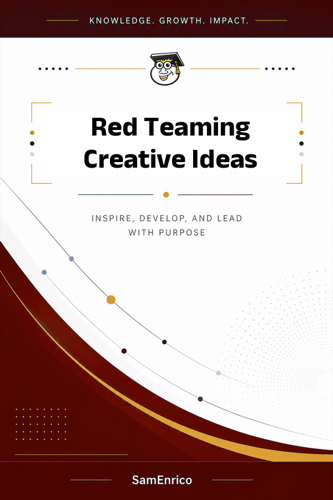
Non-FictionSelf-HelpCritical Thinking
Red Teaming Creative Ideas eBook
Assigns devil's advocates to stress-test concepts
by Whitley Reta
Assigns devil's advocates to stress-test concepts before they leave the team.
Formats
Free sample
Chapter 1: The Quiet Catastrophe–- The conference room was perfect. Floor-to-ceiling windows overlooking the city, a polished walnut table that cost more than most people's cars, twelve ergonomic chairs arranged with geometric precision, and a fresh pot of single-origin coffee that no one would drink because everyone was too busy nodding. The creative director had just finished presenting the new brand campaign—six weeks of work, two dozen mood boards, twenty-seven revised taglines, a four-million-dollar production budget, and a concept that had made the client's chief marketing officer cry during the rehearsal pitch. Around the table sat the head of strategy, the account lead, the brand manager, three senior designers, two copywriters, a production director, a media buyer, and a junior associate who had been invited to "learn how great ideas come to life."–- The question came from the account lead, a woman who had been at the agency for fourteen years and had learned to read rooms the way meteorologists read radar. "Before we sign off," she said, "does anyone see any risks here?
Any blind spots? Anything we might be missing?"–- Silence. The kind of silence that is not empty but full—full of thoughts, full of doubts, full of the quiet calculations that people make when they are deciding whether to speak or to stay safe. The head of strategy leaned back in his chair. "I think it's solid," he said.
"The insights are all there. We've validated the consumer research twice." The brand manager nodded. "The client is going to love this. They specifically asked for something bold." The creative director smiled, the smile of a craftsman who has just completed his finest work. One by one, every person in the room voiced agreement.
Some enthusiastic. Some reluctant. Some simply echoing what they had just heard, adding their voices to the chorus because the chorus already seemed so loud.–- The junior associate, whose name was Maya, had been at the agency for eleven weeks. She had graduated with honors from a portfolio school that taught her to see what others missed. And she had noticed something.
Something strange. The campaign's central visual metaphor—a stylized image of a key unlocking a door—worked beautifully in English. But Maya spoke three languages. She knew that in certain South American markets, that specific key shape had been used for decades by a political movement with a violent history. In one country, that image was effectively banned from commercial advertising.
In two others, its use would trigger an automatic regulatory review that could take six months. She had found this information in twenty minutes of research the night before. She had printed out the relevant statutes and case law. She had highlighted the key passages in yellow.–- Maya opened her mouth. She closed it.
She opened it again. She looked around the table. Eleven experienced professionals—people with titles like "Senior Vice President" and "Executive Creative Director"—were nodding in agreement. The creative director was beaming. The account lead was already talking about production timelines.
Maya was new. She was the youngest person in the room by at least a decade. She did not want to be difficult. She did not want to be the person who killed the mood. She put the printouts back in her folder and said nothing.–- The campaign launched seven weeks later.
Within forty-eight hours, the visual metaphor had been identified and condemned by political activists in three countries. Within seventy-two hours, a major international news outlet had published an exposé headlined "American Agency Accidentally Uses Violent Political Symbol in Global Campaign." Within a week, the client had canceled the contract, demanded a full refund, and filed a legal claim for reputational damages. The agency lost the account, laid off fifteen people, and spent the next two years rebuilding its reputation. The creative director resigned. The account lead was reassigned to a dead-end department.
And Maya, sitting in her cubicle, read the news and thought: I knew. I had the information. I had it printed out. And I said nothing.–- This book is for everyone who has ever been Maya. And it is for every leader who wants to build a team where no one ever has to be.The Anatomy of a Preventable Disaster–- The scene above is not an outlier.
It is not a cautionary tale from a dysfunctional agency. It is, with minor variations, the single most common pattern of failure in creative organizations. A team of smart, well-intentioned, experienced professionals gathers to review a concept. Someone has a doubt—a quiet whisper in the back of their mind, a piece of contradictory information, a pattern that does not quite fit. But no one speaks.
The silence is interpreted as agreement. Agreement hardens into consensus. Consensus becomes a plan. The plan becomes a disaster. And after the disaster, everyone says the same thing: "I had a feeling.
I just didn't want to be the one to say it."–- This chapter is called "The Quiet Catastrophe" because the catastrophe is not the failure itself. The failure is merely the final scene. The real catastrophe is the silence that precedes it—the quiet, the hesitation, the self-censorship, the well-intentioned politeness that transforms a room full of smart people into an echo chamber of agreement. That silence is not neutral. It is active.
It is destructive. It is the single most reliable predictor of creative failure that we know of, and yet almost no organization measures it, trains for it, or builds systems to prevent it. We spend millions on market research, user testing, creative development, and production. We spend almost nothing on the one thing that could save all of that investment: the ability to hear the quiet voice of dissent before it is too late.–- Let us name the enemy. It has a formal name in the psychological literature, though you may know it by its symptoms.
It is called groupthink.Groupthink: The Quiet Killer of Good Ideas–- In 1971, the social psychologist Irving Janis published a paper that would change how we understand collective decision-making. He had been studying a series of catastrophic foreign policy failures: the Bay of Pigs invasion, where a trained American force was routed by Cuban defenders; the escalation of the Vietnam War, despite mounting evidence that it could not be won; the failure to anticipate the attack on Pearl Harbor, despite multiple intelligence warnings. In each case, Janis found something surprising. The people making these disastrous decisions were not fools. They were not ideologues.
They were not corrupt. They were highly intelligent, deeply experienced, well-informed leaders who had access to excellent information. And yet they had made objectively terrible choices that, in hindsight, seemed obviously wrong.–- Janis's explanation was groupthink: a psychological phenomenon that occurs when a cohesive group's desire for harmony and consensus overrides its members' ability to realistically appraise alternative courses of action. In plain English: we would rather get along than be right. The social rewards of agreement—belonging, safety, approval—are immediate and tangible.
The rewards of being right are delayed and abstract. When these two forces conflict, the immediate almost always wins.–- And…
This is the end of the free sample. Get the eBook to keep going. Buy now
About this book
Details
- Author
- Whitley Reta
- Publisher
- SamEnrico
- Language
- English
- Genre
- Non-Fiction, Self-Help, Critical Thinking
- Released
- 2026-06-05
- Pages (approx.)
- 152
- Available as
- eBook, Audiobook

Read better in the ZLOADR app
Your eBooks on your phone or tablet. Sign in with your SamEnrico account and start reading.
More by Whitley Reta
 One Minute RescueWhitley Reta$11.99
 Vegan Iodine GuideWhitley Reta$11.99
 SAD And Serotonin GuideWhitley Reta$11.99
 Workplace Multitasking MythWhitley Reta$11.99
 The Online Car PurchaseWhitley Reta$11.99
 Anger De escalation with NarcissistsWhitley Reta$11.99
 Networking for AccountantsWhitley Reta$11.99
 The Golden Shadow: The First Olympic Doping Scandal and the Fall of a ChampionWhitley Reta$11.99
 The Earthweavers of Timbuktu: How Medieval Mali Built with the LandWhitley Reta$11.99
 Service Providers Guide to Garage SalesWhitley Reta$11.99
 How to Produce Voltage Transformers and RegulatorsWhitley Reta$11.99
 Ocean Breathing VisualizationWhitley Reta$12.99
You may also like
 Hong Kong Handover 1997Dunn Johnnie$11.99
 Zumba For Postnatal Recovery CourseNeal Christian$11.99
 Zumba for BeginnersLadner Nikia$11.99
 YouTube Comment Mining GuideHumes Pandora$12.99
 Worry Box MeditationCarlin Rudy$11.99
 Workplace Stress MeditationNguyen Lynn$11.99
 Workplace Stress and Sleep RepairHawley Ivory$11.99
 Workplace Perfectionism CureDelaney Jeffry$11.99
 Workplace Injustice Anger GuideWallen Isabelle$11.99
 Work Addiction and Burnout LinkGreenwood Ester$11.99
 Women in Yoga and WellnessBeattie Galina$11.99
 Women in Stand Up ComedyChun Evangeline$11.99