
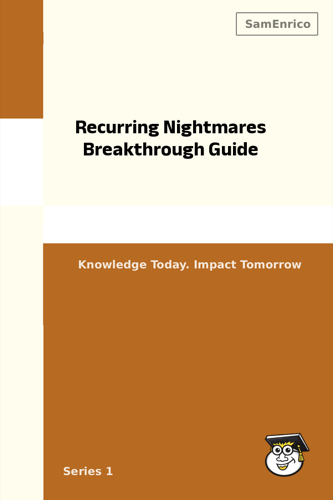
Non-FictionSelf-HelpNightmare Treatment
Recurring Nightmares Breakthrough Guide eBook
Use imagery rehearsal therapy to change and stop f
Use imagery rehearsal therapy to change and stop frightening dream patterns.
Formats
Free sample
Chapter 1: The 3 AM Terror...--–- The bedroom is dark. The clock reads 3:14 AM. Your heart is slamming against your ribs like a fist on a door. Your sheets are soaked with sweat. You are gasping for air, caught somewhere between the dream and reality, unsure for a terrible five seconds whether the thing that was chasing you is still in the room.
Your throat is raw. You might have screamed. Your partner might be awake, staring at you with that familiar mixture of concern and exhaustion. The dream is already starting to fade—the details slipping away like water through fingers—but the fear isn't fading. The fear is sitting on your chest.
The fear is telling you that if you close your eyes again, it will come back. So you don't close your eyes. You lie there in the dark, heart slowly decelerating from a sprint to a jog, and you wait. You wait for dawn. You wait for safety.
You wait for permission to sleep again.This is the 3 AM terror. And if you are reading this book, you know it intimately. Not as a metaphor. Not as a concept you've read about in psychology journals. You know it as a physical experience—the taste of adrenaline in the back of your throat, the trembling in your hands, the specific quality of darkness at three in the morning when the rest of the world is asleep and you are alone with whatever your brain just manufactured to terrify you.
Maybe it is the same nightmare you have had for years. Maybe it is a rotating cast of horrors. Maybe it is a replay of something that actually happened to you, something your waking mind has tried to bury but your sleeping mind insists on exhuming night after night. Whatever shape it takes, the result is the same: you are exhausted, you are afraid, and you have started to dread the very thing that is supposed to restore you.This book is not a collection of soothing affirmations. It is not a spiritual guide to interpreting the "hidden messages" in your nightmares.
It is not a medication protocol that will suppress your REM sleep and leave you groggy. This book is a protocol. It is a set of specific, repeatable, evidence-based steps that have been shown in dozens of clinical trials to reduce the frequency and intensity of recurring nightmares by seventy to ninety percent within four weeks. The protocol is called Imagery Rehearsal Therapy, or IRT. The American Academy of Sleep Medicine recommends it as the first-line treatment for nightmare disorder.
The Department of Veterans Affairs has trained thousands of clinicians in its use. And until now, it has largely been locked away in academic journals and therapist training manuals.We are going to unlock it together.The Three Types of Nightmares (And Why Only One of Them Is Your Problem)Before we can fix what is happening in your sleep, we need to be precise about what is actually happening. Many people use the word "nightmare" to describe any unpleasant dream, but from a clinical perspective, not all bad dreams are created equal. Understanding the difference matters because different sleep phenomena require different interventions. Using the wrong approach—treating a night terror with IRT, for example, or treating a bad dream with medication—is like using a hammer to fix a leaky pipe.
The tool is fine. The application is wrong.Let us distinguish three distinct sleep experiences.Ordinary Bad Dreams These are the dreams that leave you feeling vaguely unsettled when you wake up. Maybe you dreamed that you showed up to work without pants. Maybe you dreamed that your teeth crumbled in your mouth. Maybe you dreamed that you were back in high school and had forgotten about a final exam.
These dreams are unpleasant, but they do not typically wake you up. You sleep through them and only remember them in the morning, often with a sense of relief that they weren't real. They do not cause you to dread going to sleep. They do not leave you gasping and sweating at 3 AM. They are, in the grand scheme of sleep disturbances, relatively benign.
Everyone has them. They are not the target of this book.Night Terrors These are often confused with nightmares, but they are fundamentally different. A night terror typically occurs during non-REM sleep, usually in the first third of the night. The person experiencing a night terror will suddenly sit bolt upright, eyes wide open but not seeing, and may scream, thrash, or even sleepwalk. Their heart rate spikes dramatically.
They appear to be in a state of extreme terror. However—and this is the crucial distinction—when they wake up fully, they have no recall of any dream content. There is no narrative. There is no monster, no falling, no chase. There is only the physical experience of terror without a story attached.
Night terrors are more common in children than adults, and they require a different treatment approach (typically scheduled awakenings and stress reduction) than the protocol in this book. If you are experiencing night terrors, this book may still help with associated sleep anxiety, but the IRT protocol is not designed for non-REM parasomnias.Clinical Nightmare Disorder This is your problem. Clinical nightmares have three defining features. First, they are repeated—the same nightmare or a nightmare with the same thematic content occurs multiple times per week or month. Second, they are highly memorable upon waking.
You wake up with a clear (or clearing) narrative in your mind. You can describe what happened, where it happened, who was there. Third, they cause clinically significant distress or impairment. That distress might take the form of fear of falling asleep. It might take the form of daytime fatigue that affects your work or relationships.
It might take the form of sleep avoidance—staying up later and later because you dread what will happen when you close your eyes. If you are reading this book, you almost certainly meet these criteria. And the good news is that clinical nightmare disorder has one of the highest treatment success rates of any sleep disorder. The bad news is that most people never receive the treatment that works.The Myth of the "Message" Nightmare Let me say something that may contradict everything you have been told about dreams. Nightmares are not messages from your subconscious.
They are not secret warnings. They are not prophecies. They are not your psyche trying to tell you something important about your childhood, your relationship, your career, or your spiritual state. This is not to say that dreams have no meaning—they are made of the raw material of your memories and emotions, so of course they reflect something about your inner life. But the idea that nightmares are symbolic communications that must be "interpreted" to be resolved is not only wrong; it is actively harmful.Here is why.
When you believe that your nightmare is a message, you are implicitly believing that the nightmare is trying to tell you something you need to know. This creates a paradox: you cannot get rid of the nightmare without losing…
This is the end of the free sample. Get the eBook to keep going. Buy now
About this book
Details
- Author
- Odom Pearlene
- Publisher
- SamEnrico
- Language
- English
- Genre
- Non-Fiction, Self-Help, Nightmare Treatment
- Released
- 2026-06-09
- Pages (approx.)
- 135
- Available as
- eBook, Audiobook

Read better in the ZLOADR app
Your eBooks on your phone or tablet. Sign in with your SamEnrico account and start reading.
More by Odom Pearlene
 Wholesaling Craigslist GuideOdom Pearlene$11.99
 Loneliness After Abuse GuideOdom Pearlene$11.99
 Wholesaling Cold Calling GuideOdom Pearlene$11.99
 Quantum Computing Investment GuideOdom Pearlene$11.99
 Breath for Addiction CravingOdom Pearlene$11.99
 Parking Lot Anger GuideOdom Pearlene$11.99
 Zumba Family Party WorkoutOdom Pearlene$11.99
 The Grand Canyon ConspiracyOdom Pearlene$11.99
 Nefertiti’s Shadow: The Forbidden Love of a Pharaoh’s WifeOdom Pearlene$11.99
 The Oscar That Shocked the World: The Day France Stole the Show (1963)Odom Pearlene$11.99
 Love, Lies, and Lattes: The Starbucks Heiress Divorce ScandalOdom Pearlene$11.99
 The Mineral Guide to SpessartiteOdom Pearlene$11.99
You may also like
 Hong Kong Handover 1997Dunn Johnnie$11.99
 Zumba For Postnatal Recovery CourseNeal Christian$11.99
 Zumba for BeginnersLadner Nikia$11.99
 YouTube Comment Mining GuideHumes Pandora$12.99
 Worry Box MeditationCarlin Rudy$11.99
 Workplace Stress MeditationNguyen Lynn$11.99
 Workplace Stress and Sleep RepairHawley Ivory$11.99
 Workplace Perfectionism CureDelaney Jeffry$11.99
 Workplace Injustice Anger GuideWallen Isabelle$11.99
 Work Addiction and Burnout LinkGreenwood Ester$11.99
 Women in Yoga and WellnessBeattie Galina$11.99
 Women in Stand Up ComedyChun Evangeline$11.99