
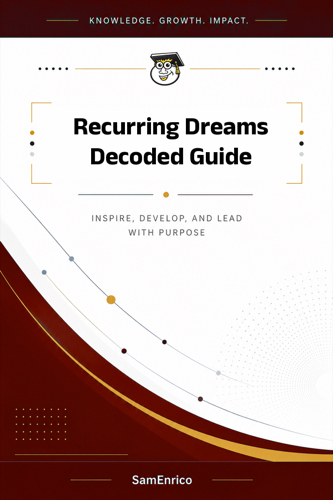
Non-FictionSelf-HelpDream Analysis
Recurring Dreams Decoded Guide eBook
Learn why your mind repeats certain dream scenario
Learn why your mind repeats certain dream scenarios and what they reveal about unresolved conflicts.
Formats
Free sample
Chapter 1: The Broken Record Myth...--–- You wake up gasping, your heart hammering against your ribs. For a moment, you cannot distinguish between the dream and reality. The sheets are tangled around your legs. The room is dark. And yet, your mind is still running—still falling, still failing that test, still standing naked in a crowded room.
You have been here before. Not just in this exact dream, but in this exact feeling of déjà vu upon waking. The dream is not new. It has returned, as it always does, like an unwelcome guest who refuses to take the hint.If this sounds familiar, you are not broken. You are not cursed.
And you are certainly not alone. Nearly two-thirds of adults report experiencing at least one recurring dream pattern during their lifetime. That is not a niche psychological anomaly; it is a near-universal human experience. Yet most people react to recurring dreams with a mixture of frustration and fear. They assume something is wrong with their brain—a glitch, a loop, a neurological error.
Some worry that the dream is prophetic, a warning of inevitable disaster. Others simply resign themselves to a lifetime of restless nights, believing there is nothing to be done.This book exists because that belief is false. And this first chapter exists to dismantle the most damaging myth of all: that recurring dreams are meaningless repetitions.The truth is far more useful, and far more hopeful. A recurring dream is not a broken record. It is the brain's most efficient signaling system—a carefully crafted metaphorical alarm designed to alert you to an unresolved conflict that your waking mind has been avoiding, ignoring, or failing to process.
Your dream repeats because the message has not been received. Once you receive it, the dream will stop. That is not wishful thinking. It is the conclusion of decades of clinical research, dream psychology, and neuroscience.This chapter will give you the foundational framework you need to understand why your mind repeats certain scenarios. You will learn the crucial distinction between three different types of repetitive dreams.
You will discover why the brain chooses metaphor over literal memory. And you will complete a practical exercise that will help you categorize your own dream for the first time. By the end of this chapter, you will never look at your recurring dream the same way again.The Broken Record Fallacy The most common misconception about recurring dreams is that they represent a kind of neurological stutter. The analogy of the "broken record" is pervasive in popular culture: something is stuck, skipping, unable to move forward. This framing is seductive because it captures the experience of repetition.
But it is fundamentally wrong about the cause.A broken record repeats because of physical damage—a scratch that forces the needle back to an earlier groove. The repetition is a malfunction. There is no intention, no information, no signal. It is simply a mechanical failure.Your brain is not a record player. And your recurring dream is not a scratch.When a dream repeats, it does so because the underlying emotional or psychological conflict has not been resolved.
Think of it less like a broken record and more like a persistent notification on your phone. You have an unread message. The notification appears. You glance at it and swipe it away without opening it. The notification returns.
You ignore it again. It returns again. The notification is not broken. It is functioning exactly as designed. It will continue to appear until you actually open the message and respond to it.Your recurring dream is that notification.
The dream is the message. And the longer you ignore it, the more insistent—and sometimes more intense—the dream becomes.This reframing is not merely semantic. It has practical consequences. If you believe your dream is a meaningless glitch, you will try to suppress it, medicate it, or simply endure it. If you believe your dream is a meaningful signal, you will try to decode it.
The first approach leads to frustration and chronic sleep disruption. The second approach leads to resolution. The choice is yours, but the evidence is clear: people who treat their recurring dreams as signals to be decoded are significantly more likely to see those dreams transform or disappear entirely.The Normalization Statistic: You Are Not Alone Before we go any further, let us address the shame and isolation that often accompany recurring dreams. Many people believe they are the only ones tormented by the same nightmare night after night. They feel embarrassed to admit that, as a grown adult, they still dream of showing up to high school without having studied for the final exam.
They worry that something is developmentally wrong with them.The data says otherwise.In a landmark study published in the journal Dreaming, researchers found that 66.6 percent of adults reported at least one recurring dream pattern. That is two out of every three people. Subsequent meta-analyses have confirmed this figure across multiple cultures and age groups. Recurring dreams are not a sign of psychopathology. They are not a marker of latent mental illness.
They are a normal, common, and predictable feature of human sleep architecture.What differentiates people who are distressed by recurring dreams from those who are not is not the presence of the dreams themselves. It is the presence of an effective decoding strategy. People who have a framework for understanding their dreams report lower distress, fewer sleep disturbances, and faster resolution of the recurring pattern. That is precisely what this book will provide.So take a breath. Whatever dream haunts you—whether it is the chase, the fall, the nudity, the test, the disaster, or the failing machine—you are in excellent company.
The goal of this book is not to pathologize your experience. It is to give you the tools to decode it.The Continuum of Repetition: Three Distinct Categories Not all repetitive dreams are the same. One of the most important distinctions you will learn in this book is the difference between three fundamentally different types of dream repetition. These categories are not arbitrary academic classifications. They have direct implications for how you should interpret and respond to your dream.Category One: Traumatic Nightmare A traumatic nightmare is a literal replay of a past traumatic event.
The dream reproduces the event more or less exactly as it occurred in waking life. A car accident survivor dreams of the crash. A assault survivor dreams of the attack. A combat veteran dreams of the specific firefight.These dreams are not metaphorical. They are not symbolic.
They are the brain's failed attempt to process and integrate a overwhelming experience. Traumatic nightmares are a core symptom of post-traumatic stress disorder (PTSD) and related conditions. They require a different approach than the other categories in this book.If you are experiencing literal replays of a traumatic event, the self-guided techniques in this book—including the decoding strategies in Part 2 and the IRT method in Chapter 11—should be used only with the guidance of a qualified trauma-informed therapist. Trauma memories are encoded differently than ordinary memories. Attempting to "rewrite" them without professional support can sometimes…
This is the end of the free sample. Get the eBook to keep going. Buy now
About this book
Details
- Author
- Rasmussen Christiana
- Publisher
- SamEnrico
- Language
- English
- Genre
- Non-Fiction, Self-Help, Dream Analysis
- Released
- 2026-06-11
- Pages (approx.)
- 155
- Available as
- eBook, Audiobook

Read better in the ZLOADR app
Your eBooks on your phone or tablet. Sign in with your SamEnrico account and start reading.
More by Rasmussen Christiana
 Wholesaling Short Sales GuideRasmussen Christiana$11.99
 Zumba Core Burn ExpressRasmussen Christiana$11.99
 The Office Politics ShieldRasmussen Christiana$11.99
 The EV Capital Allocation HandbookRasmussen Christiana$11.99
 Mentorship for Human ResourcesRasmussen Christiana$11.99
 GPS Alternate Route CalmRasmussen Christiana$11.99
 Anxiety Breath Anchor GuideRasmussen Christiana$11.99
 Alan Mulally FordRasmussen Christiana$11.99
 The Last Waltz: How a Single Dance Saved a NationRasmussen Christiana$11.99
 The Vanishing of Flight 1956: The Last BroadcastRasmussen Christiana$11.99
 The Last Dance of the KappaRasmussen Christiana$11.99
 Wind Turbine Inspection Using DronesRasmussen Christiana$11.99
You may also like
 Hong Kong Handover 1997Dunn Johnnie$11.99
 Zumba For Postnatal Recovery CourseNeal Christian$11.99
 Zumba for BeginnersLadner Nikia$11.99
 YouTube Comment Mining GuideHumes Pandora$12.99
 Worry Box MeditationCarlin Rudy$11.99
 Workplace Stress MeditationNguyen Lynn$11.99
 Workplace Stress and Sleep RepairHawley Ivory$11.99
 Workplace Perfectionism CureDelaney Jeffry$11.99
 Workplace Injustice Anger GuideWallen Isabelle$11.99
 Work Addiction and Burnout LinkGreenwood Ester$11.99
 Women in Yoga and WellnessBeattie Galina$11.99
 Women in Stand Up ComedyChun Evangeline$11.99