
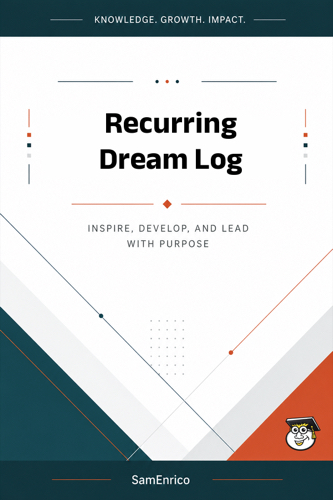
Non-FictionSelf-HelpPattern Recognition
Recurring Dream Log eBook
Track repeated dream themes to uncover unresolved
by Bragg Eugena
Track repeated dream themes to uncover unresolved life issues.
Formats
Free sample
Chapter 1: The 3 AM Noun Rule...--–- You wake up at 3:17 AM. The room is dark. Your heart is pounding. You were running—something was chasing you—but now you can’t remember what. It was a dog.
No, a man. No, it wasn’t a person at all. The details are dissolving like aspirin in water. By the time you reach for your phone to check the time, the dream is already gone. Only the feeling remains: a low, throbbing dread that sits in your chest like a second heartbeat.You roll over and tell yourself it was nothing.
Just a dream. Just your brain flushing out the day’s cognitive garbage. You close your eyes and wait for sleep to return.But here is the question this entire book exists to answer: If it was nothing, why does it keep happening?Not once. Not twice. The same dream.
The same chase. The same falling. The same teeth crumbling. The same hallway that never ends. The same monster that never gets closer but never goes away.
Week after week. Month after month. Sometimes for years.This is not nothing. This is a signal.The Stuck Record Theory of the Unconscious Let us begin with a truth that will either terrify you or liberate you, depending on how long you have been ignoring your dreams: Your subconscious mind does not give up easily. In fact, it is perhaps the most persistent communicator you will ever encounter.
It has no ego to bruise, no schedule to keep, and no concern for whether you find its messages convenient. It has one job: to keep you alive, to keep you whole, and to alert you when something in your waking life is dangerously out of alignment.Think of your subconscious as a fire alarm. When smoke fills the kitchen, the alarm screams. You do not yell at the alarm. You do not smash it with a broom and go back to bed.
You find the fire. You put it out. Only then does the alarm fall silent.A recurring dream is exactly that: a fire alarm you have refused to investigate. The dream repeats not because your subconscious is broken, but because the fire is still burning.This is what I call the Stuck Record Theory of the Unconscious. In the early days of vinyl records, a scratch on the surface would cause the needle to skip backward, playing the same groove over and over.
The listener did not assume the music had suddenly become repetitive by design. They understood that something was stuck. The needle could not move forward because the surface was damaged.Your recurring dreams are that scratched record. The damage is not in your dreams. The damage is in your waking life.
And until you repair the scratch, the needle will keep jumping back to the same broken groove.The Neuroscience of Repetition: Why Your Brain Won't Let Go Before we go any further, let me address the skeptical voice in your head—the one that says dreams are random, meaningless, the neurological equivalent of static. This perspective has a name: the activation-synthesis hypothesis, proposed by Harvard psychiatrists J. Allan Hobson and Robert Mc Carley in 1977. It suggests that dreams are merely the brain’s attempt to make sense of random neural firing during REM sleep. In this view, a dream about being chased is no more meaningful than a screen saver.There is only one problem with this theory: it has been largely abandoned by the same researchers who proposed it.Decades of subsequent research, including functional neuroimaging studies of REM sleep, have revealed that dreaming is anything but random.
The brain during REM is highly organized, with specific regions lighting up in predictable sequences. The amygdala—your brain’s fear and emotion center—is more active during REM than during wakefulness. The visual cortex blazes with activity. The prefrontal cortex, responsible for logic and self-awareness, is suppressed. This is not static.
This is a specific, evolved state of consciousness with a specific, evolved purpose.That purpose, according to a growing consensus in sleep neuroscience, is emotional memory consolidation.Here is how it works. Every day, you experience hundreds of emotional events—small and large. Your boss criticizes your work. You argue with your partner. You feel a flash of joy when a friend texts.
You feel a wave of shame when you remember something you said five years ago. Your brain cannot possibly store every detail of every emotional event. So during REM sleep, it sorts through the day’s emotional debris, deciding what to keep, what to file, and what to discard.Most of this processing happens beneath the surface of conscious awareness. You wake up, and the emotional weight of yesterday feels slightly lighter. That is your brain doing its job.But sometimes, an emotional event is too painful, too complex, or too threatening to process in a single night.
The brain tries to file it away, but the file won’t close. The emotion is too hot to handle. So the brain does the only thing it can do: it replays the event—or a symbolic version of the event—the next night. And the next. And the next.This is not a bug.
This is a feature. Your brain is not failing at processing. It is persisting at processing. It is saying, in the only language it has, I cannot let this go because you have not let this go. You are still carrying this weight.
Put it down so I can rest.The Phantom Versus the Message Now we arrive at the most important distinction in this entire book. If you remember nothing else from Chapter 1, remember this: Your recurring dream contains two elements—the Phantom and the Message. They are not the same thing.The Phantom is the surface content of the dream. The monster. The falling teeth.
The nakedness. The lost building. The chase. The paralysis. The phantom is what you see, what you feel, what you wake up gasping from.
It is the story your brain tells itself about the unresolved issue.The Message is the underlying waking-life conflict that the phantom represents. The message is not a dream symbol. It is a real, concrete, often uncomfortable truth about how you are living your life.Let me give you an example. A woman comes to me with a recurring dream she has had for seven years. In the dream, she is walking through her childhood home, but the rooms keep shifting.
Doors lead to rooms she has never seen. Hallways double back on themselves. She cannot find the front door. She wakes up disoriented and anxious.The phantom is the shifting house. The message, after eight weeks of logging and analysis, turns out to be this: she has been avoiding a decision about leaving her marriage for nearly a decade.
The shifting rooms represent her inability to find a stable sense of self. The missing front door represents her feeling that there is no way out.When she finally filed for divorce—not because of the dream, but because the dream had made her confront the truth—the shifting house dream stopped.…
This is the end of the free sample. Get the eBook to keep going. Buy now
About this book
Details
- Author
- Bragg Eugena
- Publisher
- SamEnrico
- Language
- English
- Genre
- Non-Fiction, Self-Help, Pattern Recognition
- Released
- 2026-06-07
- Pages (approx.)
- 133
- Available as
- eBook, Audiobook

Read better in the ZLOADR app
Your eBooks on your phone or tablet. Sign in with your SamEnrico account and start reading.
More by Bragg Eugena
 Values And Mission Alignment Investor RelationsBragg Eugena$11.99
 Morning Meditation Made EasyBragg Eugena$11.99
 Debt Free From Compulsive Spending GuideBragg Eugena$11.99
 Food Addiction and Body ImageBragg Eugena$11.99
 Rhythm Rebels: How One Dancer Defied Gravity and Redefined Hip-HopBragg Eugena$11.99
 Echoes from the Southern Sky: Australia’s Pioneers of Cosmic DiscoveryBragg Eugena$11.99
 How to Start a Shopping Carts (hand-propelled) Business (Beginners Guide)Bragg Eugena$11.99
 Gap Year Before UniversityBragg Eugena$12.99
 Post Investment CommunicationBragg Eugena$12.99
 Head of Information SecurityBragg Eugena$11.99
 Understanding Complex 5 Mitochondrial Respiratory Chain DeficiencyBragg Eugena$17.99
You may also like
 Hong Kong Handover 1997Dunn Johnnie$11.99
 Zumba For Postnatal Recovery CourseNeal Christian$11.99
 Zumba for BeginnersLadner Nikia$11.99
 YouTube Comment Mining GuideHumes Pandora$12.99
 Worry Box MeditationCarlin Rudy$11.99
 Workplace Stress MeditationNguyen Lynn$11.99
 Workplace Stress and Sleep RepairHawley Ivory$11.99
 Workplace Perfectionism CureDelaney Jeffry$11.99
 Workplace Injustice Anger GuideWallen Isabelle$11.99
 Work Addiction and Burnout LinkGreenwood Ester$11.99
 Women in Yoga and WellnessBeattie Galina$11.99
 Women in Stand Up ComedyChun Evangeline$11.99