
Non-FictionInformativeEducational
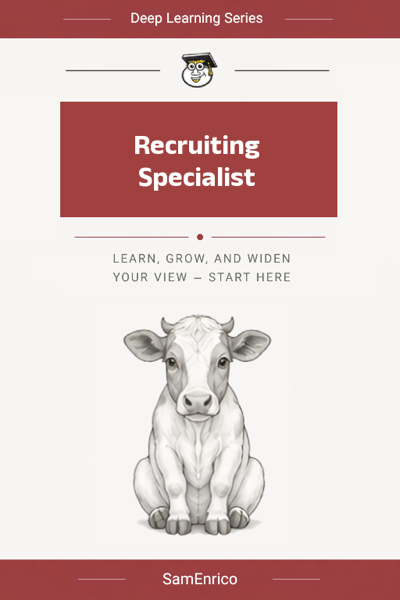
Recruiting Specialist eBook
A Coursebook on Recruiting Specialist
A Coursebook on Recruiting Specialist
Formats
Free sample
Chapter 1: The $4,000 Lie...--–- The first time I hired a sociopath, I didn‘t know it. The second time, I had no excuse.His resume was immaculate. Ivy League education. Progressive responsibility at three recognizable tech companies. Flawless references that, in hindsight, were too flawless—every former manager used the exact same three adjectives.
He wore a navy suit to the interview, laughed at my jokes, and asked thoughtful questions about the company’s long-term strategy. I walked out of that room and told my boss, “We found him.”Eleven days after he started, our head of finance pulled me into a conference room and closed the door. “The new hire in sales operations,” she said, sliding a folder across the table. “He‘s submitted six expense reports in ten days. Each one is for a client dinner that never happened.
Each one is for exactly $47.50—under the approval threshold. He’s been doing this at every job for seven years. We just called his last three employers. None of them would give a reference. The ones who did?
They used the same three adjectives. It‘s a script.”We fired him that afternoon. He filed a wrongful termination claim within a week. It cost us $47,000 in legal fees to settle—almost exactly the amount he had stolen in unreimbursed expenses across his career. My boss called me into her office.
She didn’t yell. She didn‘t have to. She just said, “You’ve been doing this for four years. How did you miss it?”I didn‘t have an answer. But I spent the next decade finding one.This book is that answer.The Hidden Cost of Bad Hiring Before we talk about how to recruit well, we need to talk about what happens when you recruit poorly.
Most recruiters never see the full cost of their mistakes because the damage unfolds slowly, in quiet meetings and silent resignations and project delays that never get attributed to a single cause. The sociopath was obvious. Most bad hires are not. They are pleasant, competent enough, and entirely average—except that average, in most roles, is a silent profit killer.Let me give you a number: $4,000.That is the approximate cost of a bad hiring decision at the median professional role, according to a synthesis of twenty-three studies conducted between 2010 and 2022. But that number is misleading because it averages across all roles.
For a salesperson, the cost of a bad hire is the revenue they don‘t generate minus the salary you pay them—easily 50,000to50,000 to 50,000to150,000 per year. For a software engineer, the cost includes the bugs they introduce, the features they delay, and the senior engineers who quit because they have to clean up the mess. For a manager, the cost multiplies across their entire team.The most honest answer is that no one knows exactly how much bad hiring costs because most companies don’t track it. They track time to fill. They track cost per hire.
They track source of hire. They do not track, in any systematic way, the single most important metric: quality of hire.This is the $4,000 lie. We pretend recruiting is a logistical problem—get the req filled, get the butt in the seat—because measuring quality is hard. But hard is not impossible. And the companies that have figured out how to measure quality consistently outperform the ones that haven‘t.What This Book Actually Is Let me be direct with you about what you are holding.This is not an academic textbook.
I am not a professor, and I have no interest in summarizing every peer-reviewed study published in the last twenty years. (Although I have read most of them, and you will find their conclusions embedded throughout these chapters.)This is not a motivational manifesto. I will not tell you to “follow your passion” or “trust your gut.” Your gut, as we will discuss in Chapter 9, is a liar. It is a pattern-matching machine optimized for survival on the savanna, not for predicting whether a candidate will show up on time and treat their colleagues with respect.This is a coursebook. It is designed to be used, not just read.
Every chapter ends with a 5-Minute Fix—a specific, actionable exercise that takes less than five minutes and immediately improves some aspect of your recruiting practice. The appendix contains templates you will use every week. The glossary contains fifty terms you actually need to know, not one hundred.And this book has a single, organizing framework: The R.E.C.R.U.I.T. System™.The R.E.C.R.U.I.T. System™ – An Overview Over the next eleven chapters, we will build this system together.
For now, here is the map.R – Reality-check workforce planning. You cannot recruit what you have not planned for. Chapter 2 teaches you how to forecast demand, build proactive pipelines, and stop reacting to fires.E – Eliminate bias from every touchpoint. Bias is not a moral failing; it is a design flaw. Chapter 3 (legal) and Chapter 6 (DEI) give you the tools to design bias out of your process.C – Competency scorecards (not job descriptions).
Job descriptions are liability magnets. Scorecards define success. You will build your first one in Chapter 2 and use it throughout the rest of the book.R – Resume-free screening. Resumes are useful for finding people (Chapter 4) and worthless for evaluating people (Chapter 7). This distinction is the single most important conceptual shift in the book.U – Universal structured interviews.
Same questions, same order, same scoring for every candidate. Chapter 8 gives you the seven questions that work for almost any role.I – Intentional closing. The best recruiter is the one who wins the yes. Chapter 10 gives you scripts for negotiation, objection handling, and keeping the silver medalist warm.T – Track what matters. Three metrics, not twelve.
Chapter 12 gives you the dashboard.This system is not original in any single part. Structured interviewing comes from Google’s Project Oxygen. Work samples come from industrial-organizational psychology. The competency scorecard comes from Geoff Smart and Randy Street. What is original is the integration—a single, end-to-end system that moves from workforce planning through onboarding without contradictions or gaps.And speaking of contradictions: let me address the two frameworks you may have heard of that I am not using as the primary structure of this book.A Note on What This Book Is Not Using You may have encountered Geoff Smart and Randy Street‘s Who or Lou Adler’s Performance-Based Hiring.
These are excellent books, and I have learned from both. But they are not the framework of this book for two reasons.First, they are incomplete. Smart and Street‘s “A Method for Hiring” (scorecard, source, select, close) ends at the offer letter. It does not address onboarding, retention, or the metrics that tie recruiting to business outcomes. Adler’s model is stronger on job design but weaker on structured interviewing and legal compliance.
The R.E.C.R.U.I.T. system covers the entire lifecycle.Second, they are unnecessarily complex. The A Method requires a four-step process that can be distilled into two pages. Performance-Based Hiring requires a philosophical shift that many recruiters find intimidating. I have…
This is the end of the free sample. Get the eBook to keep going. Buy now
About this book
Details
- Author
- Hullinger Elanor
- Publisher
- SamEnrico
- Language
- English
- Genre
- Non-Fiction, Informative, Educational
- Released
- 2026-05-11
- Pages (approx.)
- 133
- Available as
- eBook, Audiobook

Read better in the ZLOADR app
Your eBooks on your phone or tablet. Sign in with your SamEnrico account and start reading.
More by Hullinger Elanor
 Remote Company Retreats Safety GuideHullinger Elanor$11.99
 Telling Children About DivorceHullinger Elanor$11.99
 The Regression in Dreams GuideHullinger Elanor$11.99
 Naturopathy for Women's HealthHullinger Elanor$11.99
 Kwakwakawakw Hamatsa Cannibal DancerHullinger Elanor$11.99
 The Poisoned Scrolls: The Ancient Spy Who Wrote the First Crime NovelHullinger Elanor$11.99
 Ultimate Handbook Guide to Bareilly : (India) Travel GuideHullinger Elanor$11.99
 KAIST Master's in AI GuideHullinger Elanor$12.99KAIST Master's in AI GuideHullinger Elanor$12.99
 Franchise Insurance Global GuideHullinger Elanor$12.99
 Understanding Secernentea InfectionsHullinger Elanor$17.99
You may also like
 Hong Kong Handover 1997Dunn Johnnie$11.99
 Zumba For Postnatal Recovery CourseNeal Christian$11.99
 Zumba for BeginnersLadner Nikia$11.99
 YouTube Comment Mining GuideHumes Pandora$12.99
 Worry Box MeditationCarlin Rudy$11.99
 Workplace Stress MeditationNguyen Lynn$11.99
 Workplace Stress and Sleep RepairHawley Ivory$11.99
 Workplace Perfectionism CureDelaney Jeffry$11.99
 Workplace Injustice Anger GuideWallen Isabelle$11.99
 Work Addiction and Burnout LinkGreenwood Ester$11.99
 Women in Yoga and WellnessBeattie Galina$11.99
 Women in Stand Up ComedyChun Evangeline$11.99