
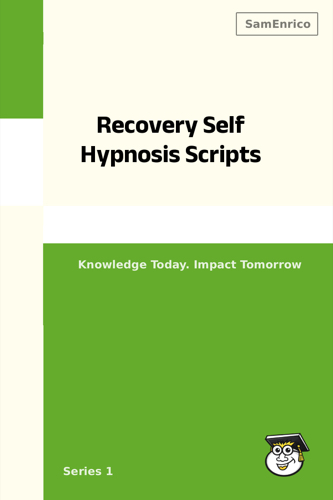
Recovery Self Hypnosis Scripts eBook
Accelerates physical repair and muscle relaxation
by Culp Nida
Accelerates physical repair and muscle relaxation through trance.
Formats
Free sample
Chapter 1: The Repair Paradox...–- You are about to discover something that most doctors will never tell you, something that the $67 billion physical therapy industry dances around but rarely addresses directly. Your body already knows how to heal itself. It has always known. When you were five years old and scraped your knee on the pavement, that wound closed without you giving it a single instruction. When you sprained your ankle in high school, the swelling eventually subsided, the torn fibers knitted back together, and you walked again without consciously directing a single platelet or fibroblast.
Your body is a self-healing machine of extraordinary intelligence. And yet, here you are, reading this book, because something has gone wrong. Perhaps you are nursing a hamstring tear that refuses to heal despite months of rest. Perhaps you are three weeks post-surgery, watching the calendar crawl toward a recovery date that keeps moving further away. Perhaps you are a weekend warrior whose rotator cuff has become a constant, whispering companion of dull pain.
Or perhaps you are simply tired of being tired, of waking up stiff, of moving through your days with the quiet desperation of someone whose body no longer feels like an ally.Here is the paradox that sits at the heart of this book, and I want you to hold it in your mind for the next two hundred pages. The very act of trying to heal often prevents healing. The more you focus on your injury with clenched determination, the more you monitor every twinge and analyze every sensation, the more you activate a neurological pathway that actually blocks physical repair. This is not philosophy. This is physiology.
And understanding it is the difference between remaining injured for months and recovering in weeks.Let me tell you about a patient I will call Marco. Marco was a thirty-four-year-old soccer player, a recreational athlete who played twice a week in a competitive men's league. He tore his left hamstring during a sprint—that unmistakable feeling of something ripping deep in the posterior thigh, followed by the sickening realization that he would not be walking normally for a long time. His orthopedist gave him the standard prognosis: six to ten weeks of recovery, starting with rest and ice, moving to physical therapy, and eventually returning to sport if everything went perfectly. Marco did everything right.
He rested. He iced. He stretched according to the protocol. He attended every physical therapy session. And at the eight-week mark, he was still limping.
The MRI showed that the tear had healed structurally, but the pain persisted. The physical therapist used words like "guarding" and "compensation patterns." Marco used words like "frustrated" and "hopeless."What Marco did not know—and what his physical therapist could not tell him because it fell outside the scope of traditional practice—was that his attention had become part of the problem. Every time Marco walked, he was watching his hamstring. Every time he bent down to tie his shoe, he was waiting for the pain. His conscious mind had become a hypervigilant security guard, scanning for threats, ready to sound the alarm at the slightest provocation.
And that hypervigilance was keeping his sympathetic nervous system activated, which meant his body was in a state of low-grade fight-or-flight, which meant blood flow was being diverted away from the injured area, which meant the final stages of healing could not complete.Marco came to me not as a patient—I am not a medical doctor—but as a participant in a self-hypnosis workshop I was running for injured athletes. He was skeptical. He had heard of hypnosis for smoking cessation and weight loss, but for a torn hamstring? That sounded like wishful thinking. I asked him to try one thing.
For the next seven days, I told him, I do not want you to try to heal. I want you to stop trying. I want you to stop monitoring your hamstring. I want you to stop analyzing every step. And instead, I want you to spend twenty minutes each morning and evening listening to a recording of a very simple script.Marco agreed.
He had nothing to lose.Seven days later, he walked into the workshop without a limp. He described the change as something he could not quite explain. "I stopped fighting it," he said. "I stopped trying to make it heal. And then it just...
did."This is not magic. This is the neurology of focused attention, and it is the subject of this chapter.The $67 Billion Question: Why Don't We Know This?Before we go any further, let us acknowledge the elephant in the room. If self-hypnosis for physical repair is so effective, why haven't you heard about it from your doctor? Why isn't it taught in physical therapy school? Why do the top ten books on injury recovery barely mention trance states at all?The answer is not conspiracy but fragmentation.
Modern medicine excels at acute intervention—surgery, medication, immobilization—but it has historically neglected the role of the mind in physical healing. This is changing. The National Institutes of Health now funds research on hypnosis for pain management. The American Psychological Association recognizes clinical hypnosis as an evidence-based intervention for a range of conditions. But the gap between peer-reviewed research and clinical practice remains vast.
Your orthopedist was trained to cut and cast. Your physical therapist was trained to stretch and strengthen. Neither was trained to teach you how to access the parasympathetic nervous system through trance. Not because they are incompetent, but because their education simply did not include it.This book exists to bridge that gap. I am not a doctor, and nothing in this book should replace medical advice.
But I am a certified clinical hypnotherapist with fifteen years of experience, and I have worked with hundreds of clients recovering from injuries, surgeries, and chronic pain conditions. The science is clear. The techniques work. And the barrier to entry is not cost or complexity—it is simply lack of knowledge.By the end of this chapter, you will understand the physiological mechanism that makes hypnosis effective for physical repair. You will be able to distinguish between the two nervous system states that determine whether you heal quickly or slowly.
And you will have a clear answer to the question that brought you here: Can self-hypnosis really help my body repair itself?The answer is yes. But understanding why is the first step.The Two Nervous Systems: A Tale of Survival and Repair To understand how hypnosis accelerates physical repair, you need to understand something your body does automatically, thousands of times per day, without your conscious awareness. Your nervous system has two main branches, and they operate like a seesaw. When one is up, the other is down. They cannot both be fully activated at the same time.The first branch is the sympathetic nervous system.
You know it as fight-or-flight. It evolved to save your life when a predator was chasing you. When it activates, your heart rate increases, blood pressure rises, digestion slows or stops, and blood is shunted away from your extremities and internal organs toward your large muscle groups—because…
This is the end of the free sample. Get the eBook to keep going. Buy now
About this book
Details
- Author
- Culp Nida
- Publisher
- SamEnrico
- Language
- English
- Genre
- Non-Fiction, Self-Help, Recovery
- Released
- 2026-06-06
- Pages (approx.)
- 150
- Available as
- eBook, Audiobook

Read better in the ZLOADR app
Your eBooks on your phone or tablet. Sign in with your SamEnrico account and start reading.
More by Culp Nida
 Mice Phobia Pest ControlCulp Nida$11.99
 Research Proposal for STEM FieldsCulp Nida$11.99
 Sector Research ReviewCulp Nida$11.99
 The Consumer Choice FrameworkCulp Nida$11.99
 Cannabis and Motivation GuideCulp Nida$11.99
 The Positive Aging Affirmation GuideCulp Nida$11.99
 Addison Rae DanceCulp Nida$11.99
 The Hollow King’s Last Stand: A Warrior’s Oath in the OtherworldCulp Nida$11.99
 Kali’s Shadow: The Goddess Who Dances on CorpsesCulp Nida$11.99
 The Mineral Guide to BorniteCulp Nida$11.99
 Crowd Monitoring and Public Safety DronesCulp Nida$11.99
 UK Company Credit Score FactorsCulp Nida$12.99
You may also like
 Hong Kong Handover 1997Dunn Johnnie$11.99
 Zumba For Postnatal Recovery CourseNeal Christian$11.99
 Zumba for BeginnersLadner Nikia$11.99
 YouTube Comment Mining GuideHumes Pandora$12.99
 Worry Box MeditationCarlin Rudy$11.99
 Workplace Stress MeditationNguyen Lynn$11.99
 Workplace Stress and Sleep RepairHawley Ivory$11.99
 Workplace Perfectionism CureDelaney Jeffry$11.99
 Workplace Injustice Anger GuideWallen Isabelle$11.99
 Work Addiction and Burnout LinkGreenwood Ester$11.99
 Women in Yoga and WellnessBeattie Galina$11.99
 Women in Stand Up ComedyChun Evangeline$11.99