
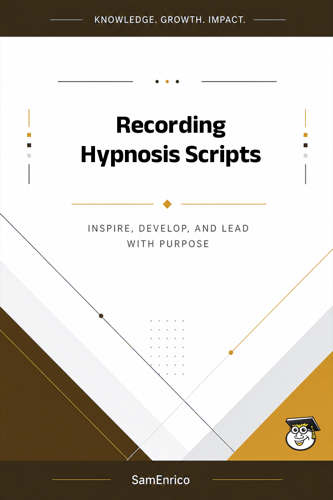
Recording Hypnosis Scripts eBook
Provides templates and recording workflows for tur
by Saunders Van
Provides templates and recording workflows for turning written scripts into effective audio.
Formats
Free sample
Chapter 1: Your Invisible Instrument--–- Every hypnosis recording you have ever heard, every script you have ever admired, and every trance you have ever induced has been filtered through a single, unavoidable, and almost always overlooked instrument. It is not the quality of the microphone, the sophistication of the studio, or the elegance of the words on the page. It is your voice. And the truth that most practitioners refuse to accept is this: a mediocre script delivered by a trusted, authentic voice will consistently outperform a brilliant script delivered by a generic, unfamiliar, or overly polished voice. This chapter exists to overturn the foundational assumption that has dominated hypnotherapy literature for decades.
We have been taught to worship the script. We collect scripts like rare coins. We trade them, modify them, and judge our competence by how many we own. But the script is merely sheet music. The recording is the performance.
And the performance lives or dies in the voice.The voice you bring to the microphone is not simply a carrier of words. It is a relational bridge, a neurological trigger, and a subconscious doorway. When you understand why your voice matters more than the script, you stop chasing the perfect set of words and start cultivating the one instrument that every client will hear before they hear a single suggestion. This chapter draws directly from the work of William Hewitt, who demonstrated that recordings utilizing the user's own voice or the voice of a trusted therapist produce measurably deeper trance states than generic audio. We will explore the neuroscience of familiar voices, the concept of the internal narrator, and the voice-first methodology that underpins this entire book.
By the end of this chapter, you will never look at a script—or listen to your own voice—the same way again.The Great Misunderstanding: Why Scripts Have Been Overvalued The hypnotherapy publishing industry has built a multi-million dollar empire on the sale of scripts. Walk into any professional bookstore or scroll through any online marketplace, and you will find volumes promising hundreds of scripts for every condition imaginable. Anxiety, phobias, weight loss, smoking cessation, confidence, sleep, pain management, sports performance, past life regression, and even niche concerns like public speaking for accountants or test anxiety for law students. The implicit promise is always the same: acquire the right words, and the results will follow. This promise is seductive because it reduces a complex therapeutic art to a simple transaction.
You buy the script. You read the script. The client improves. No messy interpersonal dynamics, no nuanced vocal delivery, no need to examine your own presence as a practitioner.But here is the problem that the script-selling industry does not want you to consider. A script is a static artifact.
It cannot adjust to the listener's breathing. It cannot notice when a suggestion has landed and when it has bounced off. It cannot soften in response to tension or firm up in response to resistance. The script is dead on the page. It only comes to life when a voice animates it.
And that animation—the pacing, the tonality, the pauses, the authenticity, the relational presence—determines whether the words enter the subconscious or bounce off the critical factor. I have watched practitioners deliver exquisitely written scripts from best-selling authors with flat, lifeless voices, producing minimal results. I have watched other practitioners deliver simple, almost clumsy scripts written on the back of napkins, delivered with such warmth and presence that clients achieved profound shifts. The difference was never the words. The difference was always the voice.This is not to say that scripts are worthless.
They are invaluable as blueprints, as safety nets, and as sources of inspiration. But they are raw materials, not finished products. The sooner you internalize this distinction, the sooner you will stop searching for the perfect script and start developing the perfect delivery. Hewitt understood this when he argued that the most effective self-hypnosis recordings are those recorded by the user themselves, in their own voice, for their own specific needs. He recognized something that neuroscience has since confirmed: the brain responds differently to familiar voices than it does to generic ones.The Neuroscience of Familiar Voices: What Research Reveals Let us move from opinion to evidence.
Over the past two decades, neuroscientists have become increasingly interested in how the brain processes vocal stimuli. The findings are directly relevant to anyone recording hypnosis scripts. When you hear a voice that you recognize and trust—whether it is your own voice played back from a recording, the voice of a long-term therapist, or even the voice of a close family member—your brain activates a distinct neural network that is not engaged when you hear a generic voice actor. The Reticular Activating System, or RAS, which filters incoming sensory information and determines what deserves conscious attention, shows heightened activity in response to familiar voices. The anterior cingulate cortex, involved in error detection and emotional regulation, also responds differently, showing reduced activation of the critical factor—that internal gatekeeper that evaluates and rejects suggestions that do not align with existing beliefs.What does this mean in practical terms?
When a client listens to a generic hypnosis track downloaded from a mass-market platform, their brain is doing something quite different from when they listen to a track recorded by you, their practitioner, or by themselves. The generic voice triggers a subtle but persistent evaluation process. The brain asks: Who is this? Do I trust them? Why should I follow their suggestions?
This evaluation happens in milliseconds, often below conscious awareness, but it erects barriers to trance. The familiar voice, by contrast, bypasses much of this evaluation. The brain recognizes the voice, associates it with safety or self, and lowers its defenses. Suggestions travel more directly to the subconscious. This is the neurological "familiarity advantage," and it is the single most underutilized tool in recorded hypnosis.Consider the research on self-instruction.
Studies have shown that individuals who record their own hypnosis scripts and listen to their own voices achieve better outcomes than those who listen to professionally recorded tracks, even when the professional track uses objectively better equipment, superior vocal training, and more elegant phrasing. The self-voice is not better because it sounds better. It is better because it is familiar. It bypasses the critical factor not through technique but through relationship. Your voice, to your client, can occupy a similar space.
It is not generic. It is not random. It is attached to a person they have sat with, breathed with, and trusted in a therapeutic context. That pre-existing relationship is gold. It cannot be bought in a script.
It can only be earned and then recorded.Listener Rapport: Why Trust Lives in Tone Rapport is one of the most discussed concepts in hypnotherapy training. We learn to mirror body language, match breathing rates, and use similar predicates. But we rarely discuss rapport in the context of recorded audio. The conventional wisdom suggests that rapport is impossible in a recording because the practitioner is not present. This is incorrect.
Rapport can be encoded in tone, pace, and presence. The listener can feel, even through a recording, whether the voice…
This is the end of the free sample. Get the eBook to keep going. Buy now
About this book
Details
- Author
- Saunders Van
- Publisher
- SamEnrico
- Language
- English
- Genre
- Non-Fiction, Self-Help, Scriptwriting
- Released
- 2026-06-09
- Pages (approx.)
- 123
- Available as
- eBook, Audiobook

Read better in the ZLOADR app
Your eBooks on your phone or tablet. Sign in with your SamEnrico account and start reading.
More by Saunders Van
 Grief and Anger After Child LossSaunders Van$11.99
 Open Office Distraction SolutionsSaunders Van$11.99
 Dividend Snowball Method GuideSaunders Van$11.99
 Liberation of Paris UprisingSaunders Van$11.99
 Mindfulness for NatureSaunders Van$11.99
 Burnout Recovery BreathingSaunders Van$11.99
 Goal Setting for ExtrovertsSaunders Van$11.99
 The Lion and the Eagle: A Tudor-Scottish Alliance That Changed HistorySaunders Van$11.99
 The Last Flight of the Kon-Tiki: A Voyage of Courage and ControversySaunders Van$11.99
 How to Start a Hobby in BartendingSaunders Van$11.99
 How to Produce Measuring Cups and SpoonsSaunders Van$11.99
 Growing AcokantheraSaunders Van$11.99