
Non-FictionSelf-HelpReciprocity
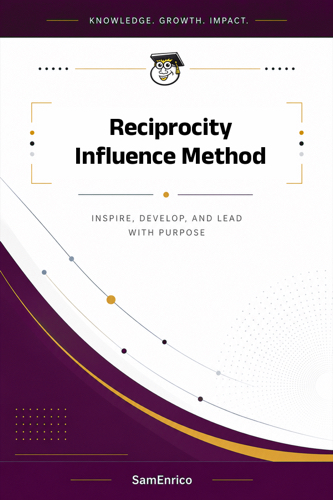
Reciprocity Influence Method eBook
Gives first to receive willingness to agree.
Gives first to receive willingness to agree.
Formats
Free sample
Chapter 1: The Giving Paradox--–- The first time I saw the Giving Paradox destroy a promising career, I was sitting in the fourth row of a hotel conference room in Chicago, watching a man named David slowly bleed out in front of forty colleagues. David was a regional sales director with fifteen years of experience, a wall of plaques in his home office, and a reputation for being the toughest negotiator in his company. He had just delivered a forty-five-minute presentation on how to "extract maximum value" from every client interaction. He used words like leverage, capture, and close. He taught the room how to withhold discounts until the very last moment, how to create artificial scarcity, and how to make sure you never give anything away without getting something slightly larger in return.He was good at it.
Really good. His numbers proved it.But then something happened that no spreadsheet could capture. A young woman in the back row raised her hand and asked a question that stopped the room cold. She said, "David, if your methods work so well, why did your three biggest clients leave last quarter?"The silence that followed lasted a full seven seconds. I know because I counted.David's face changed.
The polished confidence drained away, replaced by something raw and unguarded. He said, "They left because they didn't trust me anymore." Then he gathered his notes and walked off the stage.I found him an hour later in the hotel bar, staring at a glass of whiskey he hadn't touched. He wasn't angry. He wasn't defensive. He was confused.
He said to me, "I gave them everything. I gave them the best prices. I gave them the best service. I gave them solutions their own teams couldn't build. And at the end of every quarter, I held back just enough to make sure I had leverage for the next negotiation.
I thought that was smart. I thought that was how you win."I asked him, "What did they say when they left?"He looked down at his glass. "Every single one of them said the same thing. They said, 'You always made us feel like we owed you something.'"And that, right there, is the Giving Paradox.The More You Take, The Less You Have Every professional eventually learns this lesson, though most learn it too late. The people who chase influence most aggressively—the ones who demand, pressure, bargain, and withhold—end up with the least influence of all.
Their tactics produce short-term compliance but long-term resentment. Their colleagues cooperate only when watched. Their clients stay only until a better offer appears. Their teams follow orders but never volunteer ideas.David had mastered the Take First Model. This model dominates outdated sales training, negotiation seminars, and management culture.
It rests on a simple assumption: influence is a finite resource, like a pie. If you want a larger slice, you must take it from someone else. So you demand. You pressure. You bargain.
You withhold information, resources, and cooperation until the other person gives you what you want.The Take First Model sounds logical. It feels powerful in the moment. It produces immediate results. But it carries a hidden cost that compounds over time. Every time you take first, you signal to the other person that you are transactional.
You are not a partner. You are not someone who can be trusted without a contract, a deadline, or a threat. You are someone who must be managed, monitored, and guarded against.The research on this is brutal. A study of 2,500 workplace relationships published in the Journal of Applied Psychology found that managers who consistently used Take First tactics—demanding, withholding, threatening—had teams with 40 percent higher turnover, 60 percent lower discretionary effort, and dramatically worse problem-solving scores. The managers themselves reported higher stress levels, lower job satisfaction, and more frequent conflicts with their own superiors.
They were winning battles and losing wars.The More You Give, The More You Gain The Giving Paradox says the opposite: influence flows to those who give it away. When you provide value first—without conditions, without strings, without visible self-interest—you trigger a psychological mechanism so powerful that it bypasses the other person's defensive logic entirely.This is not wishful thinking. It is not a moral lecture dressed as business advice. It is a neuropsychological reality.Robert Cialdini, the godfather of influence science, spent three decades proving that the principle of reciprocity is the single most potent weapon of persuasion across every culture, every industry, and every relationship type. In his foundational studies, he showed that a simple, unexpected gift—a dollar, a flower, a few minutes of free advice—increased compliance with a subsequent request by up to 300 percent.
Not ten percent. Not thirty percent. Three hundred percent.But Cialdini's work only tells us that reciprocity works. It does not teach us how to use it systematically, strategically, and authentically. That is what this book exists to do.The Reciprocity Influence Method is the first complete operating system for the Giving Paradox.
It teaches you exactly what to give, to whom, when, in what currency, with what words, and with what timing, so that giving first becomes a daily habit rather than a desperate tactic.The Neuroscience of Why Giving Works To understand why the Giving Paradox works, we have to look inside the human brain. Functional magnetic resonance imaging studies conducted at the University of Zurich revealed that when someone receives an unexpected gift, three specific neural systems activate simultaneously.First, the anterior insula lights up. This region is associated with visceral emotions—disgust, pain, pleasure, and, crucially, unfairness. When you see someone cut in line or break a promise, your anterior insula registers the violation. The same region activates when you receive a gift you cannot immediately repay.
Your brain literally feels the debt as a form of discomfort, a small but persistent imbalance that demands correction.Second, the ventral striatum activates. This is your brain's reward center, the same region that responds to food, sex, and money. Receiving a genuine gift produces a small dopamine hit. You feel good. You feel seen.
You feel a warm glow toward the giver.Third—and this is the most important finding—the prefrontal cortex begins generating justifications for why you should say yes to the giver's future request. Your brain does not wait for the request to arrive. It begins preparing your compliance in advance, constructing rational arguments for why agreeing is the right, fair, and smart thing to do.This means that by the time you ask for what you want, the other person's brain has already started saying yes for them. Your only job is not to get in the way.The Two Models Side by Side Let me show you the difference between the Take First Model and the Give First Model in concrete terms.The Take First Model sounds like this:"If you approve my budget, I'll help you with your project.""I need you to do X before I can do Y.""What's in it for me?""I can't help you until you help me first."The Give First Model sounds like this:"I already helped you with your project. Can we…
This is the end of the free sample. Get the eBook to keep going. Buy now
About this book
Details
- Author
- Christianson Sydney
- Publisher
- SamEnrico
- Language
- English
- Genre
- Non-Fiction, Self-Help, Reciprocity
- Released
- 2026-06-06
- Pages (approx.)
- 141
- Available as
- eBook, Audiobook

Read better in the ZLOADR app
Your eBooks on your phone or tablet. Sign in with your SamEnrico account and start reading.
More by Christianson Sydney
 Inventory Turnover AIChristianson Sydney$11.99
 DCIS Ductal Carcinoma GuideChristianson Sydney$11.99
 Mindful Driving Audio CourseChristianson Sydney$11.99
 Divorce and Religion CommunityChristianson Sydney$11.99
 Training and DevelopmentChristianson Sydney$11.99
 Team Brainstorming GuideChristianson Sydney$11.99
 Anticipatory Grief Art TherapyChristianson Sydney$11.99
 The Architect of Independence: How a Visionary Urban Planner Reshaped a NationChristianson Sydney$11.99
 Tāwhaki’s Skyward Ascent: The Lightning Warrior’s DefianceChristianson Sydney$11.99
 A Collector's Handbook to the Triumph Dolomite 1500Christianson Sydney$11.99
 How to Produce Cookie Decorating KitsChristianson Sydney$11.99
 How to Start a Process Timers Business (Beginners Guide)Christianson Sydney$11.99
You may also like
 Hong Kong Handover 1997Dunn Johnnie$11.99
 Zumba For Postnatal Recovery CourseNeal Christian$11.99
 Zumba for BeginnersLadner Nikia$11.99
 YouTube Comment Mining GuideHumes Pandora$12.99
 Worry Box MeditationCarlin Rudy$11.99
 Workplace Stress MeditationNguyen Lynn$11.99
 Workplace Stress and Sleep RepairHawley Ivory$11.99
 Workplace Perfectionism CureDelaney Jeffry$11.99
 Workplace Injustice Anger GuideWallen Isabelle$11.99
 Work Addiction and Burnout LinkGreenwood Ester$11.99
 Women in Yoga and WellnessBeattie Galina$11.99
 Women in Stand Up ComedyChun Evangeline$11.99