
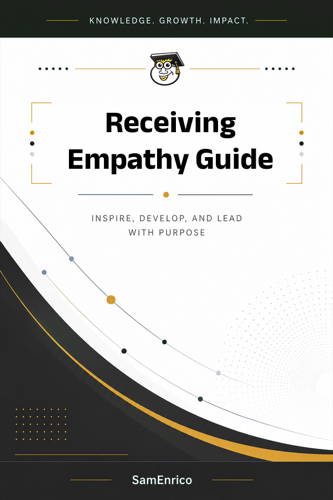
Receiving Empathy Guide Audiobook
Listen to others' pain without defensiveness, fixi
Listen to others' pain without defensiveness, fixing, or advice giving.
Formats
Free sample
Chapter 1: The Fixing Reflex--–- The conversation had been going on for twenty minutes. Maria's friend Jenna was crying, explaining in fragmented sentences how her partner had forgotten their anniversary, how she felt invisible, how she was starting to doubt whether he cared at all. Maria listened—or thought she listened—for the first few minutes. But then something familiar happened. Her brain started searching for solutions.
"Maybe he's just stressed at work." "Have you tried talking to him about it?" "You know, my partner used to do the same thing until I started leaving him notes." Each suggestion landed like a stone in water, creating ripples of silence. Jenna would nod, say "maybe," and then continue crying about the same thing. Maria felt increasingly frustrated. She was trying to help. Why wasn't Jenna accepting the help?This scene plays out millions of times every day.
In living rooms, on phone calls, in text threads, across dinner tables. Someone shares pain. Someone else offers fixes. The fixes don't land. The sharer feels unheard.
The fixer feels unappreciated. Both leave the interaction feeling worse than when it started.This chapter is about the fixing reflex—the automatic, well-intentioned, culturally reinforced urge to solve problems that are not ours to solve. We will explore why this reflex is so powerful, why it fails so consistently, and how to begin interrupting it. Because until you can recognize the fixing reflex in yourself, you cannot begin to offer the one thing that actually helps: presence.The Anatomy of the Fixing Reflex The fixing reflex has three common expressions. Each is well-intentioned.
Each fails. And each, ironically, is designed to make the listener feel useful while leaving the speaker feeling more alone.Expression 1: Advice-Giving. Someone shares a problem. You offer solutions. "You should talk to your boss." "Have you tried meditation?" "What if you just told them how you feel?" "Here's what worked for me when I was in a similar situation."The assumption behind advice-giving is that the person needs information or a plan.
They are confused, and you have the clarity they lack. But most of the time, people already know what to do. They are not confused. They are hurting. They do not need advice.
They need to be heard.When you offer advice before the person has been fully heard, they hear something you never intended: "Your problem is not worth my…
This is the end of the free sample. Get the Audiobook to keep going. Buy now
About this book
Details
- Author
- Ford Clifford
- Publisher
- SamEnrico
- Language
- English
- Genre
- Non-Fiction, Self-Help, Active Listening
- Released
- 2026-06-10
- Pages (approx.)
- 97
- Available as
- eBook, Audiobook

Listen in the VoxFlicks app
Audiobooks and audio dramas wherever you go. Sign in with your SamEnrico account and press play.
More by Ford Clifford
 Hackathon Planning Creativity GuideFord Clifford$11.99
 Migraine and Anxiety ConnectionFord Clifford$11.99
 Tribe Influencer StoryFord Clifford$11.99
 The Elderly Sibling TrapFord Clifford$11.99
 The Solar Panel ArrayFord Clifford$11.99
 The Fatigue Stress ConnectionFord Clifford$11.99
 Blue Zone Garden CultivationFord Clifford$11.99
 Pilot Nap Cockpit GuideFord Clifford$11.99
 The Star Chasers of the Nile: Ancient Egypt's Celestial NavigatorsFord Clifford$11.99
 The Last Broadcast of Radio Luxembourg: The Secret Cold War Signals That Never StoppedFord Clifford$11.99
 Crowns and Chaos: The Unlikely Reign of Queen LiliʻuokalaniFord Clifford$11.99
 The Mineral Guide to MiniumFord Clifford$11.99
You may also like
 NVC Empathetic Listening CourseHummel Lucila$11.99
 Empathic Listening NVC GuideIrizarry Laronda$11.99
 Empathetic Listening Skills GuideMiranda Athena$11.99
 Poor Listening Anger Triggers HandbookCarlisle Cathryn$11.99
 Active Listening for NamesPrice Anna$11.99
 Active Listening for ConflictsElmore Valarie$11.99
 The Listening Hostility FixSena Lashawnda$11.99
 Listen Reflect De escalateOakley Tanika$11.99
 Active Empathy WorkbookCallaway Brooks$11.99
 The Listening Led Opener GuideTalbott Katrice$11.99
 Active Listening for Anger ManagementWills Micah$11.99
 The Listening Led ApproachCulbertson Vaughn$11.99