
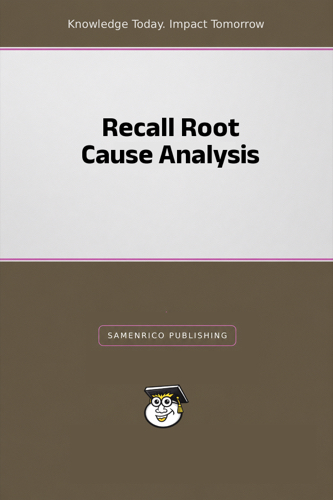
Recall Root Cause Analysis eBook
Investigate common recall triggers including undec
by Dexter Tory
Investigate common recall triggers including undeclared allergens pathogens and foreign materials.
Formats
Free sample
Chapter 1: The 3 AM Phone...--The call always comes when you least expect it. Not during a staff meeting. Not during an audit. Not when you are reviewing pristine quarterly reports. It comes at 3:14 AM on a Tuesday, because recalls do not respect business hours, and they certainly do not respect sleep.The voice on the other end belongs to the night shift plant manager.
He does not say hello. He does not ask if he woke you. He says exactly seven words that will split your life into two distinct eras: the time before the recall, and everything that comes after."We have a problem. A child is in the hospital."Your mouth goes dry. Your heart, which was peacefully resting moments ago, now hammers against your ribs like a trapped bird.
You are suddenly, violently awake."Tell me everything," you say, already reaching for the notepad you keep on your nightstand for exactly this nightmare.What follows in the next seventy-two hours will determine not just the fate of the product in question, but the future of your company, your career, and quite possibly your freedom. The decisions you make in the fog of panic, fatigue, and incomplete information will be dissected by regulators, lawyers, journalists, and juries. Every email you send will become evidence. Every phone call you take will be scrutinized for the gaps between what you knew and when you knew it.This is not hyperbole. This is the reality of food safety in the twenty-first century.And here is the terrifying truth that most quality assurance manuals will not tell you: you are probably not ready.Not because you are incompetent.
Not because your team lacks dedication. But because the overwhelming majority of recall training focuses on what to do after the recall is announced—the logistics of pulling product, notifying customers, and drafting press releases. Almost no one trains you for the first three hours, when you have no data, no clear cause, and a panicked executive demanding answers you cannot possibly provide.This chapter changes that.We are going to walk through the anatomy of a recall in forensic detail. You will learn what actually happens inside a food facility during the critical seventy-two-hour window. You will understand why undeclared allergens have quietly become the single greatest threat to food brands in 2026—eclipsing even the most terrifying pathogen outbreaks.
And perhaps most importantly, you will learn to distinguish between the two fundamental types of failures: misbranding (the label is wrong) and adulteration (the product is dangerous). Confusing these two will cost you millions.But first, we need to understand the scale of what we are facing.The Quiet Epidemic: Why Allergens Are Winning Let us begin with a fact that should terrify every food manufacturer, retailer, and restaurant chain in North America.Undeclared allergens are now the leading cause of FDA food and dietary supplement recalls.Not pathogens. Not foreign materials. Not undeclared colors or preservatives. Allergens.According to a comprehensive analysis of FDA Enforcement Reports spanning twenty-six years (2000–2026), undeclared allergens now account for nearly forty percent of all food recalls—a staggering increase from just fifteen percent in the early 2000s.
Pathogen recalls (Listeria, Salmonella, E. coli) have remained relatively flat over the same period, hovering around twenty-five percent. Foreign material recalls have declined slightly due to improved detection technology.But allergens? They are accelerating.Why?The answer is not simple, but it is clear. Three forces have converged to create the perfect allergen storm:First, the explosion of "free-from" products.
The global market for allergen-free and vegan foods has grown more than four hundred percent since 2015. Every major food company now produces products labeled "gluten-free," "dairy-free," "nut-free," or "vegan." These labels are not marketing gimmicks—they are medical claims. Consumers with celiac disease, severe peanut allergies, and dairy intolerances rely on them for survival. When a "dairy-free" product contains milk, it is not a labeling error. It is a poison.Second, the complexity of modern supply chains.
Thirty years ago, a food manufacturer bought flour from a local mill, sugar from a regional processor, and chocolate from a domestic supplier. Today, that same manufacturer buys tapioca starch from Vietnam, coconut oil from the Philippines, and vanilla extract from Madagascar—each ingredient passing through multiple brokers, repackagers, and logistics providers before arriving at the loading dock. Every handoff is an opportunity for cross-contact. Every supplier change is a risk.Third, the inadequacy of traditional cleaning validation. The food industry has spent decades perfecting visual inspection and ATP swabbing for pathogen control.
But allergen proteins are not bacteria. They do not die when heated. They do not wash away with standard detergents. They adhere to surfaces through protein-protein bonds that require specific chemical conditions to break. A line that passes a visual inspection and an ATP swab can still harbor enough peanut protein to send a sensitive consumer into anaphylaxis.The result is a recall landscape that looks nothing like what most quality professionals were trained to expect.Consider this: in 2025 alone, the FDA recorded over seven hundred food recalls related to undeclared allergens.
That is nearly two per day. The hardest-hit categories were not niche specialty foods, but everyday staples: snack bars, frozen meals, baked goods, and plant-based meat alternatives. Major national brands—household names that you would recognize immediately—found themselves in the embarrassing and expensive position of explaining to consumers why their "allergen-friendly" product had sent someone to the emergency room.And here is the detail that keeps food safety lawyers awake at night: the FDA is getting faster. Much faster.The 72-Hour Window: Why Speed Is Your Only Ally In 2011, the FDA received an average of eleven days of advance notice before a recall—usually from the manufacturer itself, often after internal investigations were already complete. By 2026, that number had shrunk to less than seventy-two hours.
Sometimes less than twenty-four.What changed?Three things.First, whole genome sequencing. The FDA's Genome Trakr network now allows the agency to match clinical isolates from sick patients to environmental samples from food facilities in a matter of hours, not weeks. When a child in California tests positive for a specific strain of E. coli, the FDA can query its database and see if that same strain has ever been found in a processing facility—anywhere in the country. If the answer is yes, the agency already knows where to look before the manufacturer has even opened its complaint log.Second, consumer digital surveillance.
Social media has become the world's most sensitive food safety sensor. Before the first formal complaint reaches the FDA's consumer complaint coordinator, there are almost always Instagram posts, Reddit threads, and Facebook comments describing the reaction, the rash, the hospitalization. These posts are scraped, analyzed, and flagged by FDA algorithms. By the time the agency calls you, they already know what happened. They are calling to see if you will tell the truth.Third, state and local health department coordination.
The days of siloed investigations—where California did not talk to Texas who did not talk to New York—are over. The CDC's Pulse Net and the FDA's coordinated outbreak response networks have turned fifty disparate health departments into a single…
This is the end of the free sample. Get the eBook to keep going. Buy now
About this book
Details
- Author
- Dexter Tory
- Publisher
- SamEnrico
- Language
- English
- Genre
- Non-Fiction, Compliance & Risk Archive, Food Safety
- Released
- 2026-06-09
- Pages (approx.)
- 150
- Available as
- eBook, Audiobook

Read better in the ZLOADR app
Your eBooks on your phone or tablet. Sign in with your SamEnrico account and start reading.
More by Dexter Tory
 The Nun Who Wrote PoetryDexter Tory$11.99
 The Beginner's Walking MeditationDexter Tory$11.99
 Guilt Anticipatory GriefDexter Tory$11.99
 AI Pitch Deck GeneratorDexter Tory$11.99
 Step Prayer CollectionDexter Tory$11.99
 Reformation Clergy Marriage Revolution CourseDexter Tory$11.99
 No School Supplies EverDexter Tory$11.99
 Recurring Child DreamsDexter Tory$11.99
 The Wolf of Wall Street's Shadow: The Untold Scandal of Jordan Belfort's GhostwriterDexter Tory$11.99
 The Quantum Gardeners of the Congo: Unlocking the Secrets of LifeDexter Tory$11.99
 The Emperor's Cartographer: Conrad Celtis and the Birth of German HumanismDexter Tory$11.99
 Understanding Acrofacial Dysostosis Preis TypeDexter Tory$17.99