
Non-FictionCompliance & Risk ArchiveClass Actions
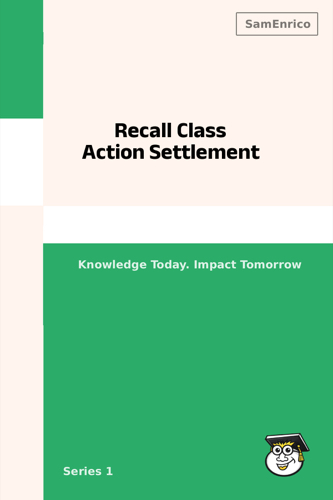
Recall Class Action Settlement eBook
Review consumer class action settlements following
by Meeks Otha
Review consumer class action settlements following major food recall events.
Formats
Free sample
Chapter 1: The Empty Shelf--–- The first sign that your life is about to intersect with the class action system arrives not as a summons, not as a legal document, but as an absence. You walk down the familiar aisle of your grocery store—the one you've navigated a hundred times without thinking—and you notice it immediately. The shelf is bare. Where there should be rows of your usual brand of peanut butter, or frozen spinach, or pet food, there is nothing but empty space and a small sign taped to the metal rack. The sign reads: "Product temporarily unavailable." Sometimes, if the store is being transparent, it reads: "Recalled."That sign on an empty shelf is the beginning of a journey that most people never realize they've begun.
It is the catalyst for a legal process that will unfold over months or years, involving federal judges, specialized attorneys, claims administrators, and ultimately, a settlement fund that might put a few dollars back in your pocket—or might leave you wondering what happened.This chapter is about that moment. It is about understanding why a recall notice transforms from a public health announcement into a potential class action lawsuit. It is about recognizing that when you throw away that recalled product, you are not just protecting your health. You are also, potentially, establishing a legal claim. And whether that claim is worth pursuing depends on a single, crucial legal doctrine that most consumers have never heard of: the Economic Loss Rule.The Trigger Event: When a Recall Becomes a Lawsuit The journey from recall to class action begins with a discovery.
Somewhere in a manufacturing plant, in a testing laboratory, or at a consumer's kitchen table, someone finds something wrong. Maybe a routine sample tests positive for Listeria monocytogenes, the bacteria that caused the deadly Boar's Head outbreak of 2024. Maybe pets start dying inexplicably, leading veterinarians to trace the common denominator back to a single brand of canned food, as happened in the 2007 Menu Foods recall. Maybe consumers report symptoms of salmonella poisoning after eating eggs, triggering an investigation that eventually recalls hundreds of millions of eggs, as in the 2010 Wright County Egg outbreak.Whatever the specific trigger, the result is the same: a recall notice. The manufacturer voluntarily—or under pressure from the Food and Drug Administration or the United States Department of Agriculture—announces that certain products should not be consumed, should be returned, or should be thrown away.At this moment, most consumers think only of their immediate options.
They can return the product for a refund. They can throw it away and accept the loss. Or, if they have become ill, they can seek medical attention and consider contacting a lawyer.But for the legal system, the recall notice is something else entirely. It is an admission. It is the manufacturer acknowledging that something went wrong.
And that admission is often the first piece of evidence in a potential class action lawsuit.The legal machinery begins to turn within days of a major recall. Plaintiff's law firms—many of whom monitor recall announcements as part of their business development—begin investigating. They ask several critical questions: How many people were affected? How widespread was the distribution? Were there injuries?
And crucially, how much money did consumers lose?These questions matter because class actions are not designed to compensate every wrong. They are designed to address situations where individual claims are too small to justify individual lawsuits, but the aggregate harm is large enough to demand a legal remedy. If you spent $12 on a recalled box of frozen waffles, you are not going to hire a lawyer to sue the manufacturer. The legal fees would exceed your recovery by a factor of a hundred. But if 500,000 people each lost $12, the total harm is $6 million—enough to attract legal representation, enough to justify the enormous effort of a class action.This is the economic reality that drives recall class actions.
And it is why the sign on the empty shelf matters. It represents not just a missing product, but a potential claim.The Four Requirements of Every Class Action Before a recall can become a class action, the lawsuit must be "certified" by a federal judge under Rule 23 of the Federal Rules of Civil Procedure. This is not a technicality. Certification is the single most important hurdle in any class action, and the vast majority of proposed class actions die at this stage.Rule 23 establishes four prerequisites that every class action must satisfy -1-3.First, the class must be so numerous that joining all members individually is impracticable. This is called numerosity.
In practice, courts generally find that any class with more than 40 members satisfies this requirement. A major food recall will affect tens of thousands, hundreds of thousands, or even millions of consumers. Numerosity is almost never the obstacle.Second, there must be questions of law or fact common to the class. This is called commonality. In a recall case, common questions might include: Was the product contaminated?
Did the manufacturer know about the contamination before the recall? Did the manufacturer take reasonable steps to prevent the contamination? These questions apply equally to every class member, regardless of where they bought the product or when they consumed it.Third, the claims of the representative plaintiffs—the named individuals who agree to serve as the face of the lawsuit—must be typical of the claims of the class as a whole. This is called typicality. If the representative plaintiff bought the recalled product at a grocery store in Ohio, and the class includes consumers who bought it online or at a warehouse club in Texas, the court must be satisfied that the Ohio plaintiff's experience is representative.
This requirement prevents plaintiffs with unusual or idiosyncratic claims from hijacking the litigation.Fourth, the representative plaintiffs must fairly and adequately protect the interests of the class. This is called adequacy. The court will scrutinize the named plaintiffs to ensure they have no conflicts of interest with the class, and it will scrutinize the proposed class counsel to ensure they have sufficient experience and resources to handle the litigation.These four requirements—numerosity, commonality, typicality, adequacy—are the gateway to any class action. But they are only the beginning. For a recall case to proceed, the court must also find that the class action is the "superior" method of resolving the dispute, and that common questions "predominate" over individual ones.In recall cases, this predominance requirement often turns on whether class members suffered physical injuries or purely economic losses.
And that distinction brings us to the most important legal doctrine that recall class action participants need to understand.The Economic Loss Rule: The Hidden Barrier to Recovery Imagine two consumers. The first buys a recalled frozen dinner, throws it away after seeing the recall notice, and is frustrated about wasting $8. The second buys the same frozen dinner, eats it, spends three days in the hospital with severe food poisoning, and incurs $50,000 in medical bills.Under the law, these two consumers are treated very differently. The second consumer—the one who suffered physical injury—has a strong claim. They can sue for…
This is the end of the free sample. Get the eBook to keep going. Buy now
About this book
Details
- Author
- Meeks Otha
- Publisher
- SamEnrico
- Language
- English
- Genre
- Non-Fiction, Compliance & Risk Archive, Class Actions
- Released
- 2026-06-10
- Pages (approx.)
- 158
- Available as
- eBook, Audiobook

Read better in the ZLOADR app
Your eBooks on your phone or tablet. Sign in with your SamEnrico account and start reading.
More by Meeks Otha
 The Beginner's Waiting Room PracticeMeeks Otha$11.99
 NYC Pop Up Build Out CostsMeeks Otha$11.99
 Dreams About Being LostMeeks Otha$11.99
 The Calcutta Madrasa MutinyMeeks Otha$11.99
 Czechoslovakian Velvet EscapeMeeks Otha$11.99
 Body Image Workbook for TeensMeeks Otha$11.99
 Work Addiction And Self WorthMeeks Otha$11.99
 GLP 1 Agonists GuideMeeks Otha$11.99
 The Tower That Broke the Sky: How the Burj Khalifa Defied Gravity and EconomicsMeeks Otha$11.99
 Pandamonium: The Great Zoo Heist of 1975Meeks Otha$11.99
 The Billion-Dollar Betrayal: How a Tech Titan Toppled His Own EmpireMeeks Otha$11.99
 Tsinghua University Scholarship GuideMeeks Otha$12.99
You may also like
 Hong Kong Handover 1997Dunn Johnnie$11.99
 Zumba For Postnatal Recovery CourseNeal Christian$11.99
 Zumba for BeginnersLadner Nikia$11.99
 YouTube Comment Mining GuideHumes Pandora$12.99
 Worry Box MeditationCarlin Rudy$11.99
 Workplace Stress MeditationNguyen Lynn$11.99
 Workplace Stress and Sleep RepairHawley Ivory$11.99
 Workplace Perfectionism CureDelaney Jeffry$11.99
 Workplace Injustice Anger GuideWallen Isabelle$11.99
 Work Addiction and Burnout LinkGreenwood Ester$11.99
 Women in Yoga and WellnessBeattie Galina$11.99
 Women in Stand Up ComedyChun Evangeline$11.99