
Non-FictionCompliance & Risk ArchiveRecord Keeping
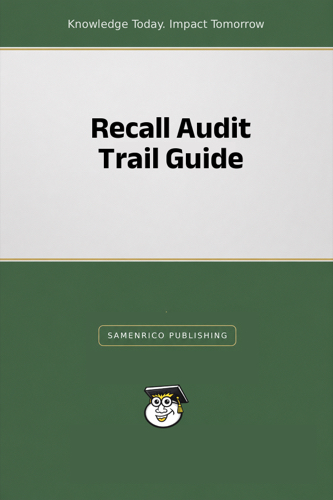
Recall Audit Trail Guide eBook
Document the recall process from detection to clos
Document the recall process from detection to closure for regulatory inspection defense.
Formats
Free sample
Chapter 1: The 2 AM Reckoning--The phone rang at 11:47 PM on a Sunday. Sarah Chen, Vice President of Quality at Med Tech Dynamics, was reviewing quarterly reports when the caller ID showed a hospital area code she didn't recognize. She almost let it go to voicemail."Ms. Chen, this is Dr. James Okonkwo at Memorial University Medical Center.
I have a patient in the ICU. She received one of your insulin pumps three days ago. Her blood glucose has been unreadable for the last eighteen hours. We've removed the pump. The device log shows erratic delivery patterns.
I have eleven more patients with the same lot number still wearing these pumps. What are you going to do about it?"Sarah's hand trembled as she wrote down the lot number. She had been in quality for seventeen years. She had run mock recalls. She had trained her team on documentation requirements.
But nothing prepares you for the moment when a doctor tells you that your product may be killing people.What happened over the next seventy-two hours would determine whether Med Tech Dynamics survived as a company, whether Sarah kept her job, and whether twelve more patients would be harmed. The difference between success and failure came down to one thing: documentation.Not the documentation Sarah would create from that moment forward. The documentation she had already created—or failed to create—in the months and years before the phone rang.This book exists because most companies learn about recall documentation the way Sarah learned about it: the hard way. But you don't have to.The Three-Thousand-Dollar Difference Before we go any further, let me tell you about two food manufacturers. Same product category.
Same distribution channels. Same regulatory environment. Both discovered metal fragments in their products within six months of each other.Company A had a recall that cost them $2.3 million. They notified 147 consignees. They recovered 94 percent of affected product.
Their recall closed in ninety-one days. The FDA investigator who audited their recall file wrote in her close-out memo: "Company A demonstrated thorough documentation and effective recall execution."Company B had a recall that cost them $5.8 million. They notified 143 consignees—four fewer than Company A, because they couldn't locate four customers in their distribution records. They recovered only 67 percent of affected product. Their recall remained open for eleven months.
The FDA issued a warning letter citing "inadequate investigation documentation" and "failure to maintain complete distribution records."The difference between $2.3 million and $5.8 million was not the severity of the defect. Both companies had identical problems. The difference was documentation.Company A had documented every customer complaint with timestamps, lot numbers, and verbatim descriptions. When the metal fragments appeared, they could trace the first complaint to a specific production date. Company B had logged complaints as "customer reported issue" with no lot numbers and no dates.Company A had documented their investigation in real-time: who did what, when, what they found, what they ruled out.
Company B had a three-page final report and nothing else.Company A had documented their consignee identification process, including a methodology for estimating customers when records were incomplete. Company B had no documentation of how they identified consignees—only a list of names that the FDA later proved was incomplete.Here is the truth that will transform how you think about recall documentation: regulators and juries do not judge you by what you did. They judge you by what you can prove you did.And the only way to prove what you did is to have documented it before you needed to prove it.Why This Book Exists I have been in regulatory affairs for twenty-two years. I have managed recalls for medical device companies, pharmaceutical manufacturers, and consumer product firms. I have sat across the table from FDA investigators, CPSC compliance officers, and plaintiffs' attorneys.
I have seen recalls that went flawlessly and recalls that destroyed careers.The difference has never been the quality of the people involved. The difference has always been the quality of the documentation that existed before the recall began.Most recall guides focus on what to do during a recall. This book is different. This book focuses on what to document before, during, and after a recall—and why that documentation will save your company, your career, and potentially lives.This book is organized around the recall lifecycle: detection (how you know you have a problem), investigation (what caused it), risk assessment (how bad it is), decision (whether to recall), strategy (how to execute), communication (who needs to know), status reporting (how you track progress), and closure (when you're done). Each chapter provides specific documentation requirements, templates, and real-world examples.But before we dive into the how, we need to understand the why.
And the why starts with three letters: CFR.The 24-Hour Clock Let me tell you something that every recall professional knows but few executives understand: the moment you decide to recall a product, you have twenty-four hours to notify the FDA.Twenty-four hours.That is not a typo. Under 21 CFR 7.46, manufacturers must notify the FDA of a recall within twenty-four hours of recall initiation. For CPSC-regulated products, Section 15(b) of the Consumer Product Safety Act requires notification within twenty-four hours of a defect determination.Twenty-four hours is not enough time to build a documentation system. Twenty-four hours is not enough time to find missing records. Twenty-four hours is not enough time to reconstruct a complaint file that you failed to maintain.Twenty-four hours is only enough time if your documentation already exists.This is the central paradox of recall documentation: you must prepare for a recall before you know you need to prepare.
You must document complaints before they become patterns. You must maintain distribution records before you need to find consignees. You must train your team on investigation protocols before an investigator knocks on your door.The companies that survive recalls are not the ones with the best lawyers or the deepest pockets. They are the ones that already had their documentation in order when the phone rang at 11:47 PM on a Sunday.The Three Shields Recall documentation serves three purposes. I call them the Three Shields, because each one protects you from a different threat.Shield One: Regulatory Compliance The first shield protects you from regulatory enforcement.
When the FDA investigates a recall, they are not looking for perfection. They are looking for evidence that you followed your own procedures, that you acted reasonably given the information available, and that you documented your actions in a way that allows them to verify your claims.The regulatory requirements for recall documentation are spread across multiple parts of the Code of Federal Regulations. The most important sections are:21 CFR Part 7 (Recall policy and procedures): This is your master framework. It covers recall classification, strategy, communications, status reporting, and termination.21 CFR Part 803 (Medical device reporting): If you make medical devices, you must report certain adverse events and product problems within specific timeframes.21 CFR Part 806 (Corrections and removals): This requires reporting of certain device corrections and removals to the FDA.21 CFR Part 820 (Quality system regulation): This requires complaint files, corrective and preventive action (CAPA) records, and design change documentation.21…
This is the end of the free sample. Get the eBook to keep going. Buy now
About this book
Details
- Author
- Pinkerton Digna
- Publisher
- SamEnrico
- Language
- English
- Genre
- Non-Fiction, Compliance & Risk Archive, Record Keeping
- Released
- 2026-06-07
- Pages (approx.)
- 153
- Available as
- eBook, Audiobook

Read better in the ZLOADR app
Your eBooks on your phone or tablet. Sign in with your SamEnrico account and start reading.
More by Pinkerton Digna
 Fractionation Self Trance Induction GuidePinkerton Digna$11.99
 Mindfulness for Night Shift WorkersPinkerton Digna$11.99
 Low HDL Cholesterol GuidePinkerton Digna$11.99
 AI Presentation Speed GuidePinkerton Digna$11.99
 Disfigurement Esteem GuidePinkerton Digna$11.99
 New Sibling Dream ThemesPinkerton Digna$11.99
 Bulgarian IT Outsourcing ShiftPinkerton Digna$11.99
 The Business Creativity WorkbookPinkerton Digna$11.99
 The Imperial Crowns of the Rhine: Power, Art, and Majesty in the Holy Roman EmpirePinkerton Digna$11.99
 Frozen Genesis: The Arctic Voyagers Who Shaped Darwin's RevolutionPinkerton Digna$11.99
 The Last Dance of the Shah: How Iran’s Crown CrumbledPinkerton Digna$11.99
 The Complete Guide to the Cook Yourself Thin CookbookPinkerton Digna$11.99
You may also like
 Hong Kong Handover 1997Dunn Johnnie$11.99
 Zumba For Postnatal Recovery CourseNeal Christian$11.99
 Zumba for BeginnersLadner Nikia$11.99
 YouTube Comment Mining GuideHumes Pandora$12.99
 Worry Box MeditationCarlin Rudy$11.99
 Workplace Stress MeditationNguyen Lynn$11.99
 Workplace Stress and Sleep RepairHawley Ivory$11.99
 Workplace Perfectionism CureDelaney Jeffry$11.99
 Workplace Injustice Anger GuideWallen Isabelle$11.99
 Work Addiction and Burnout LinkGreenwood Ester$11.99
 Women in Yoga and WellnessBeattie Galina$11.99
 Women in Stand Up ComedyChun Evangeline$11.99