
Non-FictionInformativeEducational
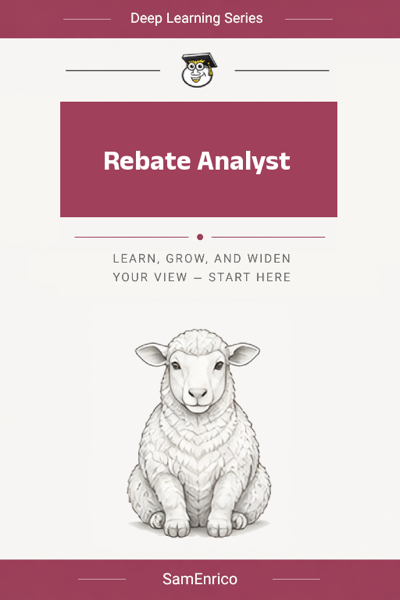
Rebate Analyst eBook
A Coursebook on Rebate Analyst
A Coursebook on Rebate Analyst
Formats
Free sample
Chapter 1: The Margin Eaters--– Every morning, Sarah Chen walked past a $2 million mistake.It sat quietly in a spreadsheet column labeled “Accrued Rebate Liability – Q4 Estimate.” No one had questioned it for six quarters. The CFO signed off on it. The auditors ticked the box. The sales team celebrated their quarterly bonuses based on the gross margin number that liability helped produce. And every single quarter, the estimate was wrong by an average of 18 percent.Sarah was a senior rebate analyst at a $1.2 billion consumer packaged goods company.
She had been there for eleven years. She knew the ERP system better than the IT director who installed it. She could spot a duplicate claim from three rows away. But when she walked into the quarterly close meeting on the first Monday of December, she was not there to save the day. She was there to deliver news that would get someone fired.“We have a problem,” she said, placing a single page on the conference table.The page showed a simple calculation.
A major retailer – let’s call them Big Box – had earned a 4 percent volume rebate based on their purchases through November. The contract, signed eighteen months earlier by a sales director who had since been promoted, contained a single ambiguous phrase: “Rebate applies to Net Sales.”Big Box interpreted “Net Sales” as gross sales minus returns, freight, co-op advertising deductions, and a 2 percent “administrative fee” that the supplier had never agreed to. The supplier’s finance team had been accruing based on gross sales minus returns only. The difference over twelve months was $2.1 million.“They’ve already deducted it from their last invoice,” Sarah said. “We have forty-eight hours to dispute or we waive our rights.”The CFO, a woman named Diane who had been in the role for only four months, looked around the table.
“Who signed this contract?”Silence.“Who approved the accrual methodology?”More silence.“Who is responsible for rebates in this company?”Sarah raised her hand. “I calculate them,” she said. “But I don’t set the terms. I don’t negotiate the contracts. And no one told me about the co-op deduction clause until I saw the customer’s claim.”The meeting ended with a directive: dispute the deduction, but don’t lose the customer.
Sarah spent the next seventy-two hours building an audit trail, reconciling 14,000 line items, and drafting a dispute letter that was polite enough to preserve the relationship but firm enough to preserve 2.1million.Shewonback2.1 million. She won back 2.1million.Shewonback1.6 million. The remaining $500,000 was deemed “cost of doing business.”The sales director who signed the contract received his annual bonus three weeks later. The analyst who fixed the problem received a $50 gift card to a coffee shop.This book is for every Sarah Chen who has ever been handed a mess and told to clean it up with no authority, no budget, and no thanks. It is for the finance professional who knows that rebates are not just a cost of doing business but a source of business intelligence that, when managed correctly, can add millions to the bottom line.
And it is for the aspiring analyst who wants to move from data processing to strategic profitability – from the back office to the boardroom.The Great Invisibility of Rebates Let us begin with a simple question: Why do rebates exist?On the surface, the answer is obvious. A manufacturer offers a rebate to incentivize a distributor to buy more. A retailer offers a rebate to encourage a customer to choose their product over a competitor’s. Rebates are discounts, just delayed and conditional.But that answer misses something critical. A discount is a price cut.
A rebate is a behavioral contract.When you offer a 2 percent discount on every unit, you are simply reducing your price. The customer does not change their behavior – they just pay less. When you offer a 4 percent rebate on every unit purchased above 100,000, you are creating a threshold. You are saying, “If you buy more than you would have bought anyway, I will reward you.” The rebate is not a gift. It is a gamble.
You are betting that the customer’s behavior will change enough to make the rebate profitable for you.This is why rebates are invisible in most organizations. They are not treated as strategic tools. They are treated as accounting afterthoughts – something to be calculated at quarter end and forgotten until the next dispute. The average Fortune 500 company has between 50millionand50 million and 50millionand500 million in rebate liabilities on its balance sheet at any given time. Ask the CFO how much of that is accurate, and you will get a shrug.
Ask the sales director how many rebate deals actually changed customer behavior, and you will get a guess. Ask the rebate analyst, and you will get a spreadsheet with seventeen tabs and a haunted look in their eyes.This book exists because the gap between those numbers and that guess is where millions of dollars disappear every single year.Who Is This Book For?Before we go any further, let me be clear about who this book serves – and who it does not.This book is for the Level 1 Foundation Analyst who is new to rebates and needs to understand the basics: What is a volume rebate? How do I accrue for it? Why does the CFO keep asking about breakage? Chapters 1 through 5 will give you the tactical skills to survive your first year without making a catastrophic error.This book is for the Level 2 Practitioner Analyst who has mastered the basics but wants to move from calculation to negotiation.
You know how to build a tiered rebate model. Now you need to know how to audit a customer’s claim, redline a contract, and win a dispute without losing a relationship. Chapters 6 through 8 are your operating manual.This book is for the Level 3 Strategic Analyst who is ready to design systems, not just execute them. You have automated the easy stuff. Now you need to understand the psychology of B2B incentives, the cross-functional politics of Sales versus Finance, and the control points that prevent errors before they happen.
Chapters 9 through 11 will elevate you from analyst to architect.And this book is for the Level 4 Futurist Analyst who sees where the profession is heading. AI, blockchain, sustainability-linked rebates – these are not buzzwords. They are the tools that will define the next decade. Chapter 12 will prepare you for a career that does not fully exist yet.If you are a CFO who wants to understand why your rebate liability is always wrong, this book will give you the questions to ask. If you are a sales director who keeps signing deals that Finance hates, this book will show you how to structure incentives that actually work.
If you are an auditor who has seen one too many “immaterial” rebate adjustments, this book will validate your skepticism.But primarily, this book is for the rebate analyst. The person who sits between Sales and Finance, between the customer and the system, between a $2 million mistake and the coffee shop gift card.The Profitability Guardian Framework Throughout this book, I will refer to…
This is the end of the free sample. Get the eBook to keep going. Buy now
About this book
Details
- Author
- Tames Shaquana
- Publisher
- SamEnrico
- Language
- English
- Genre
- Non-Fiction, Informative, Educational
- Released
- 2026-05-18
- Pages (approx.)
- 151
- Available as
- eBook, Audiobook

Read better in the ZLOADR app
Your eBooks on your phone or tablet. Sign in with your SamEnrico account and start reading.
More by Tames Shaquana
 Remote Company Retreats Team BondingTames Shaquana$11.99
 Divorce Credit Score RepairTames Shaquana$11.99
 Tarascan Petamuti Fire PriestTames Shaquana$11.99
 Naturopathy for DiabetesTames Shaquana$11.99
 The Condensation Dream SymbolTames Shaquana$11.99
 The Lens of Enlightenment: African Filmmakers and the Birth of Visual Storytelling (1700s)Tames Shaquana$11.99
 Understanding Seafood PoisoningTames Shaquana$17.99
 Franchise Renewal Global GuideTames Shaquana$12.99
 ETH Zurich Master's AI GuideTames Shaquana$12.99
 Ultimate Handbook Guide to Banjul : (Gambia) Travel GuideTames Shaquana$11.99
You may also like
 Hong Kong Handover 1997Dunn Johnnie$11.99
 Zumba For Postnatal Recovery CourseNeal Christian$11.99
 Zumba for BeginnersLadner Nikia$11.99
 YouTube Comment Mining GuideHumes Pandora$12.99
 Worry Box MeditationCarlin Rudy$11.99
 Workplace Stress MeditationNguyen Lynn$11.99
 Workplace Stress and Sleep RepairHawley Ivory$11.99
 Workplace Perfectionism CureDelaney Jeffry$11.99
 Workplace Injustice Anger GuideWallen Isabelle$11.99
 Work Addiction and Burnout LinkGreenwood Ester$11.99
 Women in Yoga and WellnessBeattie Galina$11.99
 Women in Stand Up ComedyChun Evangeline$11.99